Micronesian Names by Island or Island Groups: Meringel (Palau), Donne, Donne sali or Doni (Mariana Islands), T’ebil tebil, T’eebil or Mwech mwig (Yap), Mukh (U1ithi), Mwech mwig (Ifaluk), Amuek or Ammwiik (Satawal), Amwiik, Mwiik, Moek or Muik (Chuuk), Mwik (Namoluk), Sele (Pohnpei), Sele (Pingelap), Jeli or Chille (Mwoakilloa), Pwepuh (Kosrae), Paybah or Pepa (Marshall Islands), Te beneka (Kiribati, Banaba), Epeba (Nauru).
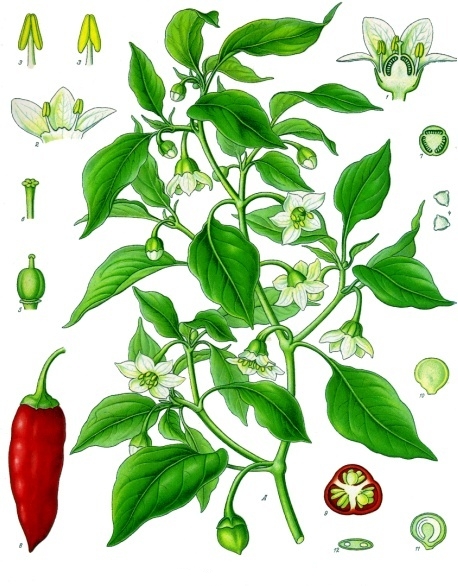
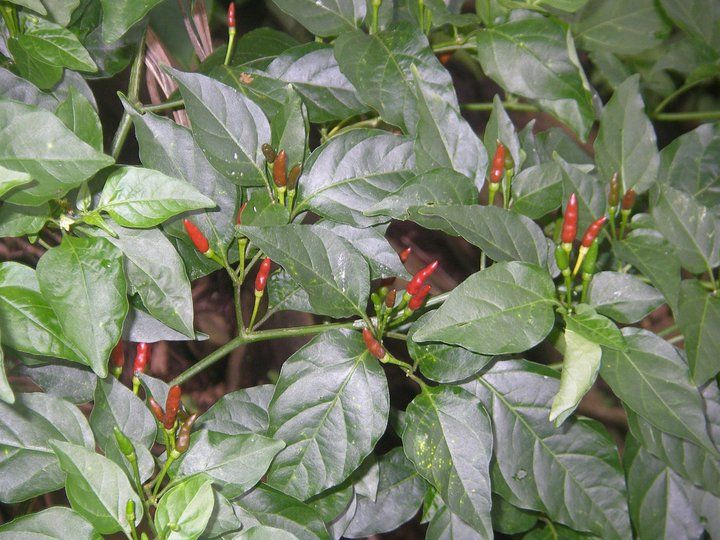
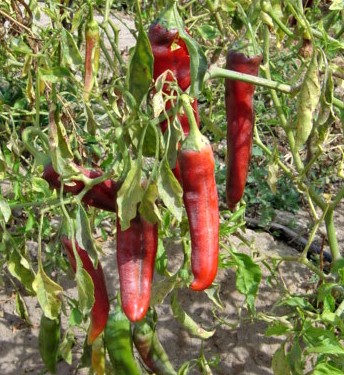
Description: The chili pepper plants, Capsicum spp., belong to Solanaceae, the nightshade family, which includes tobaccos, tomatoes, potatoes, eggplants and many other interesting and often medicinally or economically significant species and hybrids. Capsicum plants are shrubby, relatively short lasting perennials (where frost does not occur). They generally grow to heights of 1 m (3 ft) or more with the woody, glabrous stems at the bottom and branched near the top. The leaves are ovate to lanceolate with entire margins and petioles. The greenish-white flowers grow in the leaf axils alone, or in pairs, or in threes. The ripe fruit, or pepper, is a many-seeded pod with a leathery exterior in various shades of red or yellow, as well as variable degrees of pungent taste. There are a great many diverse cultivars of the chili pepper species, i.e., C. annuum and C. frutescens, which are provisionally accepted here as either two separate species, or one, as yet not fully resolved taxonomic species.
Distribution: The widely cultivated chili peppers of Capsicum are important as spice and vegetable crops over a huge range of distribution, and are among the most diverse series of artificially selected plants as reflected in the great variety of their cultivars (e.g., see Eshbaugh 2012). The genus Capsicum appears to have originated somewhere within Central and South America. Indeed, one (or more) species within this genus was probably among the first New World cultivated plants with its domestication possibly occurring before the iniation of farming in the New World (e.g., see Pickersgill 1969; Long-Solis 1986; Perry et al. 2007). Eshbaugh (2012:14) described some the key aspects of chili pepper taxonomy and history of human use:
“When Europeans discovered the New World they began what became known as the Colombian exchange, future explorers (exploiters) of the Americas would focus on the material riches of these new lands. However, the real significance of the discovery was an initiation of transfer of previously unknown plants from the west to the east (and vice versa) in the form of new species, many of which later became economically important in the Old World. One was a plant whose unique fruit possessed a “bite” that added zest to the Caribbean diet. Eshbaugh (1993) concluded that few could have imagined the impact of the discovery of a spice so pungent that it rivaled the Old World black pepper. Five centuries later chilli peppers (Capsicum) dominate the world hot spice trade and are grown everywhere in the tropics and in warm temperate regions. Not only have hot peppers come to command the world’s spice trade but a genetic recessive no-pungent form has become an important “green” vegetable crop especially in temperate regions.”
Recent genetic evidence, based on 139 wild peppers collected and analyzed by a scientific team at the University of California at Davis suggests that the “hot big bang” of Capsicum, the chili pepper (which they identify as C. annuum),took place in northeastern Mexico, perhaps many thousands of years ago. (e.g., see Kraft et al. 2014). In any case, the present range of C. annuum and C. frutescens is now very widespread in many parts of the world, including numerous Pacific Islands:
“The species is intolerant of shade: it will grow with broken overhead shade and moderate competition from grass and forbs, but fruits best in full sun. Red peppers can be cultivated in areas that receive from 30 to 430 cm [~12- 170 inches] of annual precipitation at elevations from near sea level to more than 2,000 m…. Wild red pepper grows as individuals or groups in gardens, fields, vacant lots, river flood plains, abandoned fields, roadsides, and early secondary forest” (Francis 2004:147).
General Uses of Capsicum peppers: Red chili peppers are used and much appreciated in many parts of the world, mostly as a spice, added to fresh, dried or refined food and as the “principal or incidental ingredient in sauces” (Francis 2004:148). The chief chemical source of the common “biting sensation” of these peppers are the capsaicinoids (alkaloid compounds), mainly capsaicin. Serving as a condiment, chili peppers add flavor and diversity to everyday dishes. In addition, these Capsicum fruits are a first-rate source of vitamins A and C (e.g., see Bosland and Votava 2000; Lim 2012). Furthermore, Chili peppers can serve as an important vegetable added to variety of contemporary diets in a number of regions, including island areas within Micronesia where daily food consumption is currently based on only a few staple crops (e.g., see Valenzuela 2011; Yamamoto 2014). Chili peppers generally have also had numerous medicinal uses. Some of the most widely applied and consistently efficacious uses have been as as a “salve to relieve muscle, joint, and toothache pain, to treat cough, asthma, and sore throat, as a stimulant, and to treat stomach ache, seasickness, and flatulence” (Francis 2004:148). Regarding chili pepper use as a medicinal, capsaicin in the fruit, besides being responsible for the spiciness in peppers, is “used to relieve pain from arthritis and migraines and for cough or stuffy nose relief [and] has also been shown to have anti-clotting properties” (Valenzuela 2011; also see Lim 2012 for a comprehensive review of the chemical contents and phytochemical effects of chili pepper fruits).
Uses by Island or Island Group: Whistler (1992a:131) indicated that prior to the arrival of Europeans in the Pacific region, “Polynesians cultivated several species or varieties of Solanum as condiments, but these have now been largely neglected and lost, and the chili pepper [which he identified as C. frutescens] has assumed many of their medicinal uses.” This cultural use shift over time of related plant genera from Solanum to Capsicum species (both in the Nightshade Famiy, Solanaceae) may also apply to some societies of the Micronesian Islands. Capsicum pepper plants were introduced to the islands of Micronesia after contact with Europeans and other foreign peoples, and in many places have become important sources of food, spice, vegetable and medicine. Indeed, throughout much of the tropical Pacific chili peppers are widely used as a popular condiment and are found cultivated in most home gardens; however, there is still not much data on the degree of human consumption of these food and medicinal crops in the region:
“Even though Capsicum did not originate in FSM, it has been cultivated and consumed there for an estimated 300-400 years and thus it is reasonable to consider it a traditional local food. The importance of this plant as a nutritious and local food in this region has been largely overlooked despite the fact that the fruits and leaves are rich in carotenoids and vitamins…. In addition, information on Capsicum usage itself is very limited” (Yamamoto 2013:88).
Uses in Palau: Meringel is the Palauan word of chili pepper, and is said have a variety of meanings in English in addition to its association with a red-hot chili pepper, these other meanings include “painful,” “hard,” “difficult,” “sore,” “potent,” “hard liquor.” Note: Meringelhas been identified as a name used in Palau to refer to both C. annuum and C. frutescens (see Falanruw et al. 1990:17). Chili peppers are grown near people’s houses on the high and low islands of Palau, and are used as condiment for food. The fruits of these cultivated plants in Palau can occur in shades of red, orange and green colors, and these fruits are used especially for soups and for dipping sauces, mixed with soy sauce.
Uses in the Mariana Islands: Chili peppers are found growing in many home gardens in the Mariana Islands. Fosberg (1946) listed doni as a name referring to both C. annuum and C. frutescens. Potent tasting chili peppers are reportedly very popular today in various Mariana Islands where they integrated into a spicy sauce used by many people. Widespread popularity of chili peppers in the Mariana Islands is reflected in the festivals featuring these fruits. For example, on Guam there has been an annual “Mangilao Donne [chili pepper] Festival” and in the Commonwealth of the Northern Mariana Islands [CNMI] there is the annual Tinian Hot Pepper Festival which highlights the “famously potent ‘Donne Sali’ pepper” of Tinian Island; Sakaziro (2017) provided the following comments on the preparation of spicy chili pepper sauce in the Marianas Variety in a daily newspaper published in Saipan [CNMI]:
“When the donne’ pepper is prepared (the Chamorro word fa’, or ‘to make’), it becomes fina’denne’. Donne’ that is prepared. Usually, fina’denne’ is donne’’ dropped in soy sauce, vinegar or lemon juice, often with onion slices added. You can dip food into this sauce or spoon it over the dish. Other islands prepare donne’ by smashing the hot pepper (ma gulek) into a paste, usually with salt and maybe some vinegar added for flavor and preservation, and the result is known as fina’denne’ dinanche. Dinanche means ‘correct.’ On Guam, they call it donne’ dinanche.”
Uses on Namoluk Atoll: Marshall (1975) described some aspects of the distribution and use of chili peppers on this Atoll, indicating that their Capsicum plants are cultivated in close proximity to people’s homes as a “condiment food,” while a number of “different colors of fruits may be found on varieties growing on Namoluk,” and the “hot peppers are eaten (especially with raw fish) and sometimes are included in leis [garlands].”
Uses in Chuuk: Tn the atoll lagoon of Chuuk, Yamamoto (2013a) studied the local nomenclature and usage of Capsicum on the islands of Weno, Romanum, and Piis, where he investigated the relationship between people and Capsicum plants; his focus was “on dispersal routes, ethnobotany, and food security.” Yamamoto recognized C. annuum and C. frutescens as separate introduced species cultivated in Chuuk, and noted that the common Chuukese name for the chili peppers is “mwik (mwiik).” He identified key varieties of the cultivated Capsicum peppers in Chuuk, “especially the green type, [which] is a common seasoning in the daily diet of locals and has become an important and indispensable condiment.” Yamamoto (2013a:77) elaborated on the traditional varied use and importance of “Capsicum frutescens” as naturalized plant resource in Chuuk:
“People used C. frutescens in various ways: as a condiment (fresh fruits and fruits soaked in the water of mature coconuts), vegetable (leaves), and medicine (fruits and/or seed for treating toothaches, fruits for eliminating the stomach parasite known as “nikanipwun,” roots for an ointment to treat skin wounds, fruits for treating sick domestic fowl, and fruits for boosting energy of gamecocks after fighting). However, with modernization, residents of Chuuk Atoll have been eating fewer C. frutescens leaves in recent years. The [Federated States of Micronesia] has faced serious public health problems due to a new diet and other lifestyle changes especially from the 1980s, and the government, non-governmental organizations, and many researchers have attempted to promote a return to local foods because of their higher carotenoid and vitamin contents compared to modern foods. On small islands and atolls, imported foods and medicines may not arrive for more than a month if a typhoon or an oil crisis occurs. Therefore, for food security, it is imperative to re-discover plants already naturalized on each island. From this perspective, an important candidate plant is C. frutescens, which can serve not only as a spice but also as a vegetable rich in carotenoids and vitamins. Capsicum frutescens has long been naturalized in these regions; therefore, it does not need to be cultivated and its fruits and leaves can be harvested throughout the year. To improve public health on Pacific islands, there should be renewed focus on plants that are already naturalized on each island.”
Yamamoto (2012) had reported earlier that in the Federated States of Micronesia, it has been recognized that the “lifestyle” on the main or high islands such as that in Pohnpei or Chuuk is generally more modernized than that of the much smaller and more remote atolls, and that this phenomenon appear to have affected the use of C. frutescens leaves which Yamato (2014:31-32) pointed out are “known to be used in [those islands] as a vegetable.” In fact, Yamamoto (2009) had also previously reported “that the indigenous people of Taiwan seem to rarely use the leaves of C. frutescens because they can buy other vegetables at markets,” and that “these results suggest that the leaves of C. frutescens may be used less in modern society.” Therefore, Yamamoto (2014:31-32) again suggested that there should be a renewed focus on the naturalized chili pepper plants where they exist on Micronesian Islands in order “to improve the situation of food security and public health on Pacific islands.”
In sum, according to Yamamoto (2013a:87), on the islands Chuuk atoll in which he carried out his field work, he found that the use of C. frutescens is still an important spice, vegetable, therapeutic and cultural resource; however, Yamamoto noted that “its use as a medicine is more limited in Chuuk Atoll than on other small and remote Pacific islands, such as Pohnpei” (see below).
Uses in Pohnpei: Yamamoto (2011) recorded the local names and uses of Capsicum plants on Pohnpei Island, Pingelap Atoll and Mokil (Mwoakilloa) Atoll in order to identify the relationships between people and chili pepper plants on these islands. The local names recorded by Yamamoto for Capsicum were “sele” in both Pohnpei Island and Pingelap Atoll, and “jeli” on Mokil (Mwoakilloa) Atoll. Yamamoto noted that these local names appear to be related to “chile” in Spanish, suggesting that some Capsicum peppers were brought to the islands into Pohnpei and its associated atolls from the tropical New World by the Spanish during the Manila galleon trade, perhaps when the Spanish colonized Pohnpei Island. However, Ragone et al. (2001) suggested that C. frutescens was introduced to Pohnpei lsland during the early period of European or Western contact (1830-l886), and was also brought into this island during the American Trust Territory period (1945-1986); however, Yamato (2011:92) assumed, that additional “research on C. frutescens specimens collected early in the 20th ccntury in Oceania will reveal more about its dispersal.” During his recent research on Pohnpei Yamamoto (2011:90) identified two species of Capsicum which were being used in Pohnpei Island:
“C. annuum (two types: a pungent long fruit and a nonpungent bell pepper or sweet pepper) and C. frutescens (several pungent types exhibiting green or greenish-yellow immature fimit color and a variety of fruit sizes). People who cultivated the long fruit cultivar of C. annuum on Pohnpei Island said that it had been introduced there within the past five years. Cultivation of sweet peppers seemed unknown in three regions; although the peppers were sold in rnarkets, some were confirmed to be imported from the United States of Ameria. Unlike C. annuum, C. frutescens is often used for seasoning foods in the daily diet and has become an indispensable condiment on Pohnpei Island and Mokil and Pingelap Atolls”
Balick et al. (2009:501) in their long term, comprehensive study of ethnobotany on Pohnpei referred to some of the uses of “Capsicum frutescens” on that high island, such as the use of chili pepper fruit as a flavoring to “spice fish,” treating skin rashes or wounds to prevent infection and stop bleeding, and as a medicine for chickens with an “unspecified illness.”
Yamamoto (2011:87) also reported on the varied use of “Capsicum frutescens” today in Pohnpei:
“…as a condiment (on fresh or salted fruit and fruit soaked in unboiled water or the water of mature coconuts), as a vegetable (the leaves), and as a medicine (the fruit as an anthelmintic drug, the leaves for curing boils and wounds, and the flowers for promoting childbirth or blood expulsion in pregnant women). With modernization, however, residents of Pohnpei Island have been eating fewer C. frutescens leaves in recent years. Rediscovering and maintaining knowledge of plants already naturalized on each island are important to food security.”
Uses in Kosrae: Following his studies in Chuuk and Pohnpei (see above), Yamamoto (2013) reported on the names and use of Capsicum, especially C. frutescens on Kosrae, describing the relationships between people and Capsicum plants on that high island. Yamamoto identified three species of cultivated Capsicum in Kosrae, including C. annuum, C. frutescens, and C. chinense. Although C. frutescens probably arrived first in Kosrae, Yamamoto indicated that several cultivars of C. annuum and “one accession of C. chinense” are believed to have been brought into Kosrae in very recent times:
“In contrast to C. annuum and C. chinense, C. frutescens, especially the green type, is a common seasoning in the daily diet of locals and has become an important and indispensable condiment on Kosrae Island. People called it “Kosraen pepper,” “native,” or “local.” This terminology may imply that people on Kosrae Island are more attached to C. frutescens than they are to the other species of Capsicum. Capsicum peppers are called pwepuh on Kosrae Island, which seems to be related to pfeffer in German or pepper in English. Kosrae Island residents do not have any specific names for the various pungent types of Capsicum peppers. They view Capsicum peppers in various ways: as a condiment (fresh or salted fruits and hot sauces), vegetable (leaves of C. frutescens), and medicine (fruits and/or seeds for toothaches, fruits for diarrhea, and leaves for curing boils and wounds). However, the uses of Capsicum spp. as a medicine are very limited on Kosrae Island compared to other small and remote islands in the Pacific, and people there have been eating fewer C. frutescens leaves in recent years partly due to modernization of the culture” (Yamamoto 2013:87).
Uses in Kiribati: Luomala (1953:23) referred to “Capsicum frutescens” as an introduced, cultivated plant on Tabiteuea in Kiribati, locally known as Te beneka which she reported as brought in from “Ocean Island” (Banaba Island), where it also an introduced species. Luomala (1953:68) described this “the chili plant” as producing “small, thin, red peppers about an inch long,” and pointed out that Hiram Bingham identified beneka as the Kiribati “word for vinegar” in this Gilbertese-English dictionary published in Boston in 1908. Thaman (1987:12) referred to “te boro”as the name (borrowed from the Fijian boro) in Kiribati for the “bell pepper or sweet capsicum (Capsicum annuum var. grossum).” Thomas (2003:13-14) referred the governmental efforts in the mid-1980s in Kiribati to encourage cultivation of “exotic food plants capable of growing well under harsh atoll conditions.” This government incentive was designed to produce higher levels of “local food production as a strategy for reducing imports as well as search for specialist foods or products that might contribute as minor exports,” and as an example of this agricultural initiative, Thomas (2002) reported the results of a household study that sampled the “mixed gardens” planted by 20 farmers along with the “frequency occurrence” of the species cultivated by smallholder farmers in Bonriki Village on South Tarawa, and among the most frequently crops observed in this survey was Capsicum frutescens “chilli” (also see Peduzzi 1999). Thaman and Tye (2015:63), in their listing and discussion of vascular plants documented from Kiritimati (Christmas) Atoll in the Northern Line Islands of the Republic of Kiribati, referred to three related taxa of Capsicum as recently introduced from the tropics of the New World: [1] “Capsicum annuum L. vars.” as the “Annual chili pepper” with the “Kiribati Name: te beneka (‘vinegar’)” that was “commonly planted” in settlements on the island by 2006; [2] “Capsicum annuum L. var. grossum (L.) Sendtn. Synonym: Capsicum grossum L.” as the “Bell pepper, sweet pepper, sweet capsicum” with the “Kiribati Name: te boro, te beba” that was a seasonal food plant observed “in a number of food gardens in 2006,” and [3] “Capsicum frutescens L.” as “Tabasco, bird chili, perennial chili” with the “Kiribati Name: te beneka (‘vinegar’)” that was apparently not very common on Kiritimati Atoll by 2006.
Use on Banaba: Thaman and Samuelu (2016:84) referred to the chili pepper plants observed on Banaba as “Capsicum annuum L. vars. Synonym: Capsicum frutescens L.” These plants are known on this raised reef island by the Banaban name “te beneka (‘vinegar’)” and were reportedly introduced recently and occasionally found today as a spice plant in “household gardens.” Thaman and Samuelu indicated that chili pepper fruits are put into “bottles of fermented sour toddy [on Banaba] and used as a spicy condiment (te beneka) for food.”
Use on Nauru: On this raised reef island, hot chili pepper fruits (“Capsicum annuum L. var. annuum”) are reportedly used to spice food, and the bell or sweet pepper fruits (“Capsicum annuum L. var. grossum (L.) Sendtn.”) are consumed “raw in salads and cooked as a green vegetable,” while the fruits of the “tabasco” or the “perennial chilli” (“Capsicum frutescens L.”) are also reportedly used on Nauru to spice food; However, this species was apparently “much more common in the past” (Thaman et al. 1994:196-197).