
Acanthaceae
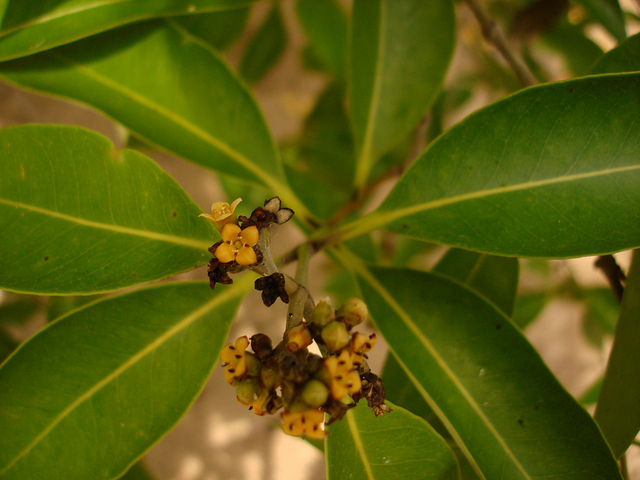
Agnes Reinhart

Small trees, shrubs, climbers or herbs, rarely spiny, with usually entire simple opposite leaves; stipules none; flowers axillary or terminal, solitary or in racemes or panicles, often bracteate; often bracteolate; calyx usually 4-5-lobed, sometimes a truncate rim, or rarely with 8-18-lobes; corolla tubular, usually bilabiate; stamens 4 or 2, with or without staminodes, rarely 5; anthers 2-celled or 1-celled; sometimes anthers basally spurred; ovary superior, sometimes on a hypogynous disk, 2-celled; cells 1-2-ovulate, or ovules 3-many; style single, bifid (rarely trifid or simple); capsule usually 2-valved, with 2 to many seeds, valves elastic; or rarely fruit drupaceous; seed usually with a jaculator (the hard funicle), often with hairs which become slimy if wetted; endosperm usually lacking.--A large family of 180 genera and more than 2000 species throughout the Tropics. None of these is native to Guam, but 13 or more species are found in cultivation (all as ornamentals) or escapes.