


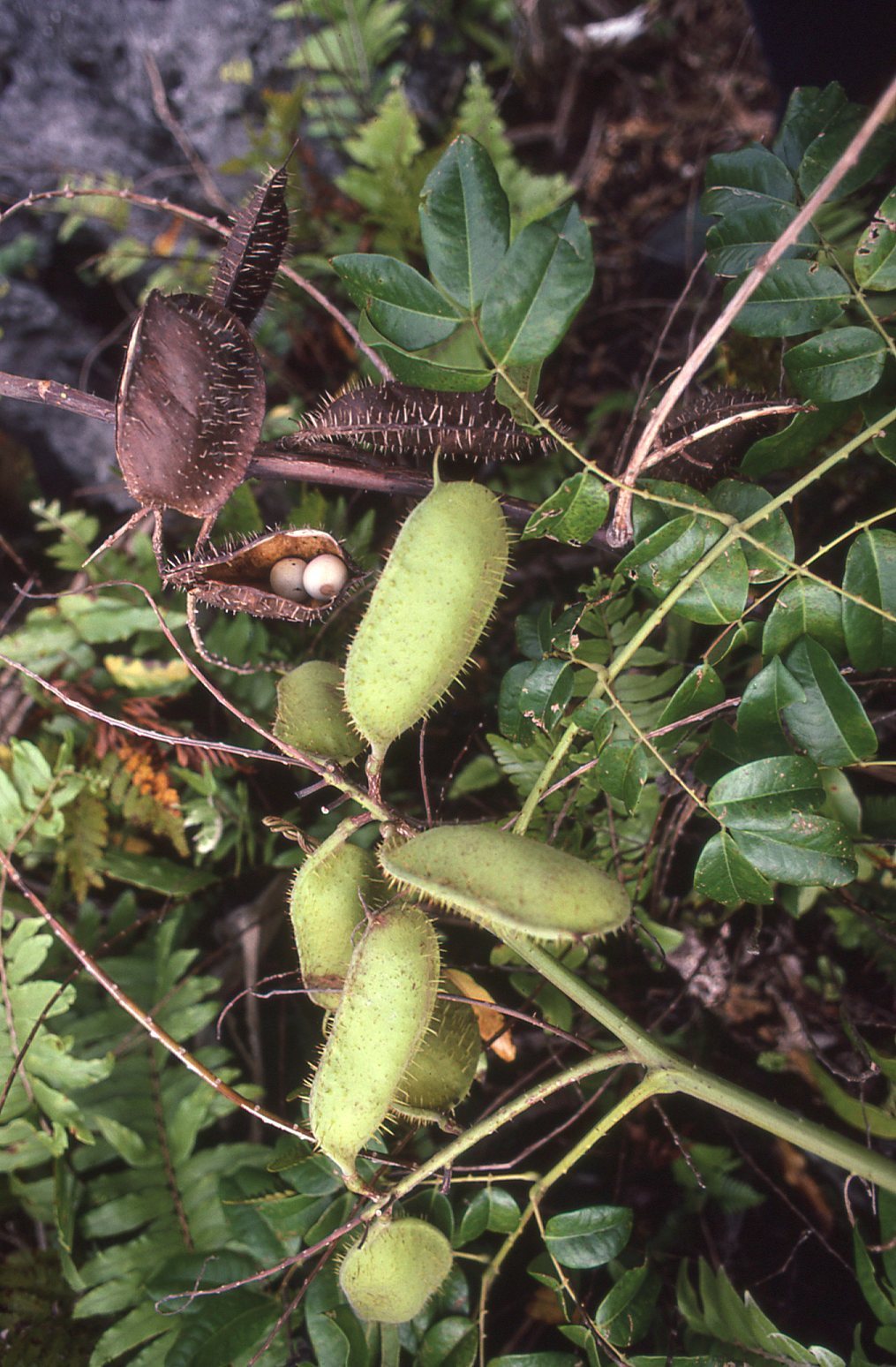
Description: Caesalpinia bonduc is a sprawling, perennial, prickly shrub or high-climbing vine that has compound leaves and clusters of abundant and noticeable, but not necessarily showy yellowish flowers arranged on an inflorescence. Its thorny, semi-flat seed pods contain 1-2 glossy seeds about the size of marbles. As the green seeds of this plant mature, they shrink, harden and turn gray.
Distribution: C. bonduc is a littoral shrub with floatable seeds that is found in many tropical areas around the world and is widespread in the Pacific. The recurved thorns on its foliage are sharp and can be troublesome, and may therefore be considered a weed (“any plant growing where it is not wanted”). This plant and another closely related species (C. major) are found in the coastal zone of some high islands and atolls in Micronesia.
“These species are generally regarded as being native throughout the tropics, including the Pacific Islands. The seeds float in sea water, and Caesalpinia bonduc holds the ‘record’ for long distance dispersal with a viable seed having been found on a beach in Spitsbergen in the Arctic Ocean. Seeds can be found along the strandline of beaches throughout the tropics and are long-lived. They can be very attractive (e.g., grey with faint brown stripes) and are sometimes used as ‘checkers’ in board games” (see http://www.pestnet.org).
Uses by Island or Island Group: Ecologically, where thorny C. bonduc occurs it adds to the biodiversity of the vegetation by helping protect the soil and providing refuge for wildlife; it is also cultivated in some places as a barrier fence for protection. The hard, marble-sized seeds have been used historically for ornamentation, prayers, charms and even for weight standards in parts of South Asia. In several areas of tropical Africa, Asia and in some of the tropical Pacific Ocean islands, C. bonduc is reportedly an important medicinal plant; however, in large doses it is supposedly toxic (e.g., see Burkill 1995, Oudhia 2007).
Uses in the Mariana Islands: Stone (1967b:72) referred to C. bonduc as an indigenous species in the Mariana Islands. McMakin (1978:45) referred to the “indigenous thorny shrub” he identified as “Caesalpinia major (Wait-a-bit) Pakao” which he indicated was a medicinally useful plant on Guam: “The seeds are cracked and boiled in a preparation taken for diarrhea.” Space (2010:25) listed both C. bonduc and C. major as “native species (or early introductions) that exhibit aggressive behavior” on Rota Island in the Commonwealth of the Northern Marianas.
Uses on Namoluk Atoll: According to Marshall, on Namoluk (1975): “All of the specimens of Simota [possibly C. bondoc, but more probably the attractive, ornamental Caesalpinia pulcherrima shrub or small tree] on the atoll have been planted next to people’s houses to facilitate gathering the blossoms for leis; both the variety with bright yellow and that with striking red-orange flowers occur on Namoluk. Occasionally, large branches are cut into coconut husking stakes. Although ‘simota’ grew on Namoluk pretyphoon [storm] Phyllis, they were all destroyed in the storm and were reintroduced from Truk [Chuuk] in 1958 or 1959.” Note: Fosberg (1969:7) reported C. pulcherrima as planted in the village on the single coral reef island of Satawal, the easternmost island in the Yap island group
Uses in Pohnpei:Kehsaphl (as C. bondoc is known in Pohnpeian) has been tentatively identified as a weed on Pohnpei Island, but is also said to be used on this island for treating “food or drink poisoning that may have been caused by sorcerers…” (see Balick 2009).
Uses in the Marshall Islands: Kālōklōk (or Kāliklik)is a name Marshallese people use to refer to this spiny plant (C. bondoc) since it means “thorns” or “brambles.” Indeed, some may consider this sprawling vine-like plant to be a pest, especially where it forms thickets, because the small hooked thorns easily rip clothing and skin.