Micronesian Names by Islands or Island Groups: Chebeludes or Ebeludes (Palau), Angel (Yap), Ngoi (Ulithi), Ngu (Woleai), Nger (Mariana Islands), Nguner (Namoluk), Ngö (Namonuito), Ngo (Chuuk), Tará (Nukuoro), Sekesek or Tehsilite (Pohnpei), Kitahk (Pingelap), Kitak (Mwoakilloa or Mokil), Lah (Kosrae), Kūtaak (Marshall Islands)
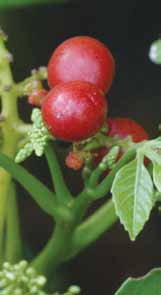
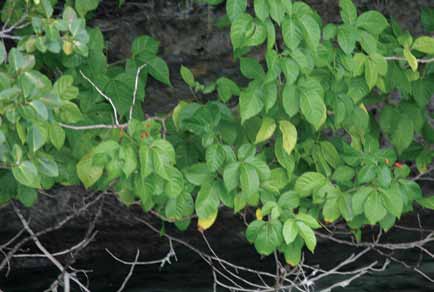
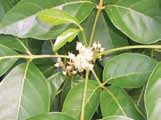
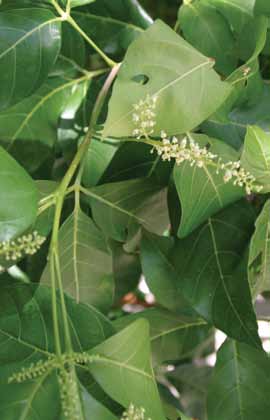
Description: Allophylus timorensis is a native scandent shrub or small tree that grows to heights of 4 m (~13 ft). It has trifoliate leaves (3 leaflets per leaf) and stalks (racemes) of tiny white flowers. The round or oval shaped fruits are also small (1-4 cm, up to about 1.5 in) in width, turning from green to red as they mature.
Distribution: This woody species is widespread, generally found in the inner coastal strand forests of some areas of tropical Asia and across the Pacific to Micronesia and Eastern Polynesia. Its distribution stretches at least from Timor, eastward including the Philippines to Tonga, Niue, Samoa, the Marquesas and the Society Islands as well as in Micronesia. Although many “endemic” species have been named for Allophylus trees in different areas of its geographical range, they all probably belong to the single species listed here as Allophylus timorensis. On the atolls of Micronesia, this shrub or small tree is one of several woody species still found in the broadleaf "wind-breaks" left on the windward sides of islets to protect crops inland.
Uses by Island or Island Group: Allophylus timorensis is widely used as medicine and other applications, although its wood is generally considered to be relatively poor in quality.
Uses in Palau: The fruits of A. timorensis (known as Ebeludes in Palau) are eaten by children and the leaves are used in traditional medicine for headaches, arthritis, etc. (e.g., see Defilipps et al. 1988). According to Tuyama (1941), parts of A. timorensis have been used “in making fishing traps and towing-ropes.”
Uses in Yap: Known as Angel in Yap, this small native tree has medicinal uses (Falanruw 2015:208). For example, on Yap the crushed leaves of A. timorensis can be cupped in the hands and inhaled to clear the sinuses; but caution should be used because, the “scent” is quite strong. The small tasty fruits are sometimes eaten when ripe.
Uses on Ifaluk: The wood of A. timorensis (known asis reportedly used on Ifaluk to make fish traps and small branches served as fans to keep flies away.
Uses in Namoluk: Known as Nguner on Namoluk Atoll, the wood of A. timorensis has been reportedly used on in the making of lean-to shelters as well as for fuel, and the leaves supposedly “reduce swelling when crushed and applied to painful swollen bruises” (Marshall 1975).
Uses in Pohnpei: Sekesek or Tehsilite, as A. timorensis is known in Pohnpei, is used to make sticks for traditional stick dancing; its wood has also been used to make baseball bats and as firewood as well as for fishing poles. Additionally, it is used as a charm to cast away evil spells and for medicine such as soumwahu en naniak (mangrove sickness), diarrhea, painful urination, back, muscle and joint pains, and to treat bruises or sprained ankles, wrists, or knees. Furthermore, it is planted as an ornament and used for decoration in Pohnpei (e.g., see Balick et al. 2009).
Uses in the Marshall Islands: Kutaak, as this small tree, A. timorensis, is known as in the Marshall Islands, is maintained on the windward side of islets to serve as a windbreak to protect crops planted inland. It also has medicinal properties with applications for men, women, and babies, and a potion involving the use of green and yellow leaves is used to induce romantic enchantment. The leaves also constitute an ingredient in a potion that serves as a psychic energizer for children. Kutaak also provides wood for fishing poles, fish traps and for house building materials in the Marshall Islands (e.g., see Merlin et al. 1997).
Note: Allophylus timorensis was reported from Butaritari Atoll in Kiribati by Fosberg and Sachet (1987:20); otherwise, no additional information regarding presence or human use of this widespread woody species adapted to the inner coastal strand has been found for Kiribati, and Thaman et al. (1994:20) reported that the “shrub” A. timorensis was “conspicuously absent on Nauru.”
Allophylus timoriensis (chebeludes) is a small coastal tree common in sand and coral rock strand vegetation. It is a native species found on limestone in the Rock Islands and in the strand vegetation of other islands. Allophylus is a genus of 175 species that occur throughout the tropics.
Description
Size and shape: Chebeludes is a small tree growing from 4 to 5 m in height, with densely foliated branches.
Leaves: The alternate leaves are trifoliate, with toothed margins. They are borne along a central axis 4 to 11 cm long, with three oval-shaped leaflets 4 to 19 cm long. The central leaflet is larger than the other two and the leaflets’ surfaces are dull. The leaflet stalks are 0.2 to 1.2 mm long.
Flowers: A white compound flower cluster has a central axis up to 13 cm long. The stalked flower clusters are on a single long main axis with the youngest flowers at the top. White tiny flowers have a calyx with four green sepals and a corolla with four petals that are hairy inside. Male and female flowers are mixed in the same flower cluster. Flowers were observed in February, May, June, August and October.
Fruits: Orange-red fleshy round fruits are 4 to 6 mm in diameter and contain a single seed. Fruits often have one main lobe and two aborted lobes. Fruits were observed in February, March, May, June, August and October.
Uses
Allophylus is used as medicine for healing after birth and as an energizer. The fruits are eaten by birds.