


Family: Amaranthaceae
Prickly Chafflower, more...
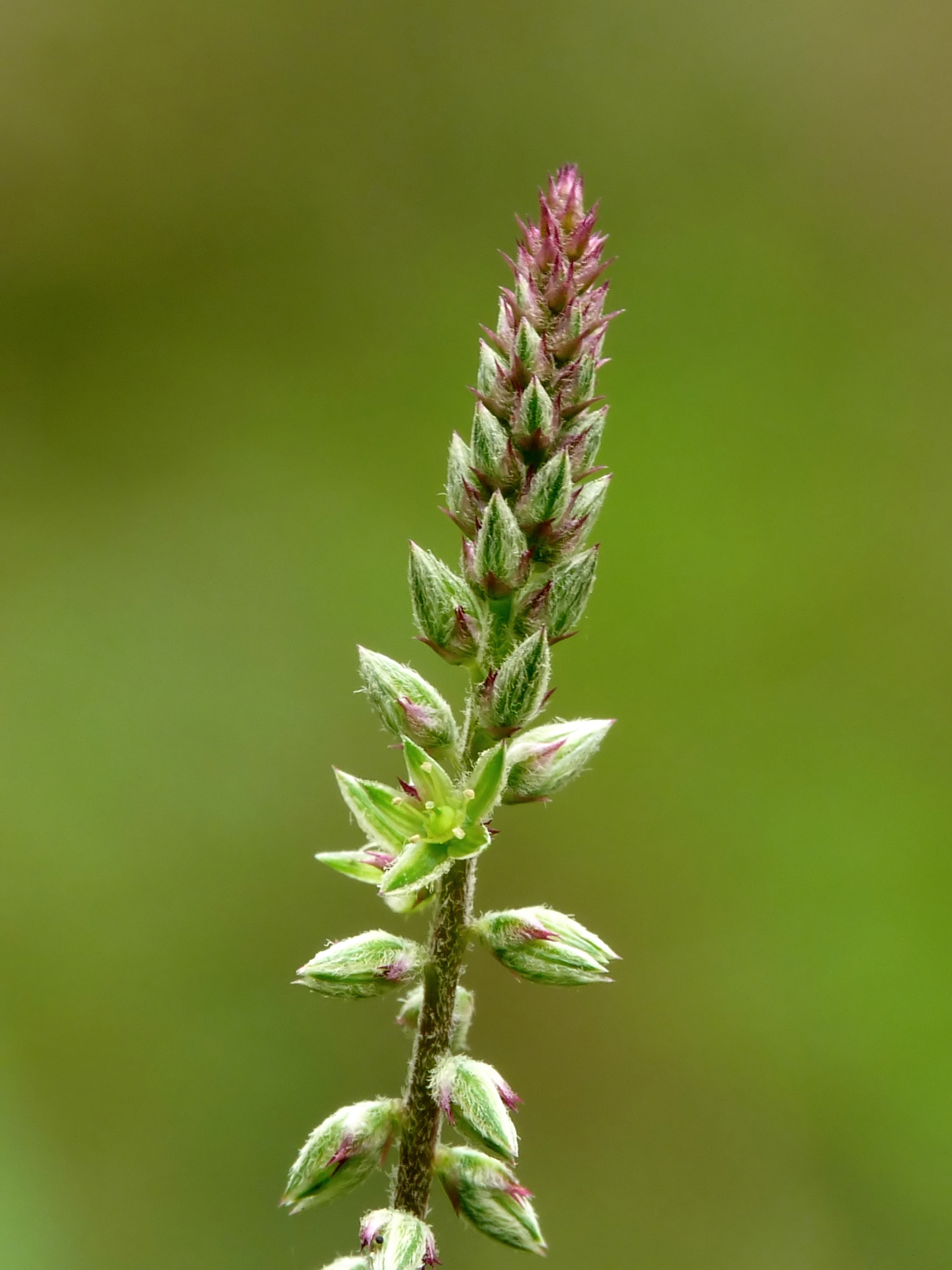
Jeevan Jose
Achyranthes aspera L. – Amaranthaceae
Common or English Name: Chaff-Flower, Prickly Chaff Flower, Devil's Horsewhip
Micronesian Names by Islands or Island Groups: Louchelbeluu or Louch beluu, (Palau), Koi (Ulithi), Gugu (Woleai), Eeg’gohur, Gogo (Yap), Gogo (Ifaluk), Eeg'gohur (Satawal), Chichitun (Guam), Niké, Chichiton, Chichitun, Lasocata or Lasogado (Chuuk), Likkakééké (Pulusuk), Liko or Uököl (Namoluk), Tikeng tutui or Kenga tutui (Kapingamarangi), Suga Dugokok (Mokil), Kaleklek or Kaloklok (Marshall Islands)
Description: Achyranthes aspera is an herb or small shrub up to 4 m (13 ft) tall, but is normally much shorter. In English this plant is known by some as "chaff-flower." The stems, especially young ones, have small hairs. The leaves are produced in opposing pairs, up to 12 cm (4.8 in) long. The greenish, prickly flowers are about 6 mm (0.25 in) long and clustered in erect terminal spikes up to 20 cm (8 in) long. “This coarse, prickly plant is said to stand up rigidly at first and later become epiphytic.” It catches on skin and clothing and its names in Chuuk refer to its “grabbing” habit (Mahony 1973).
Distribution: Achyranthes aspera is common in various areas of the tropics. It is either a native species, or was introduced to Yap during the prehistoric period. It is sometimes found in open coastal areas of atolls and high islands, frequently becoming weedy in lowland plantations along roadsides. Its spikelet-like fruits become rather easily attached to clothing or to fur or feathers, and this serves as the plant’s major dispersal mechanism.
Uses by Island or Island Group:
Uses in outer islands of Yap: On Ulithi and Ifaluk Atolls, Achyranthes aspera is reported to be used medicinally; and on Ulithi, flower tips mixed with other ingredients are used to make a kind of legabwol, i.e., a type of charm worn to ward off possible disease (Lessa 1977:154).
Uses in Guam: On Guam, A. aspera was reported to be a “troublesome weed” over a century ago; “the vernacular name, signifying ‘tick’, is given on account of the property the fruit has of sticking to the clothing” (Safford, 1905:174).
Uses in Pohnpei: The smoke produced by burning the root of A. aspera is reputedly used to treat the sting of a stonefish in Pohnpei: “as many roots as needed to fill half a coconut shell (Cocos nucifera) are pounded and placed in the shell, covered with a hot stone, and then covered with the other half of the shell, which has a small hole on the end, and the steam and smoke that come out are directed to the place where the sting is…” (Balick et al. 2009:320).
Common or English Name: Chaff-Flower, Prickly Chaff Flower, Devil's Horsewhip
Micronesian Names by Islands or Island Groups: Louchelbeluu or Louch beluu, (Palau), Koi (Ulithi), Gugu (Woleai), Eeg’gohur, Gogo (Yap), Gogo (Ifaluk), Eeg'gohur (Satawal), Chichitun (Guam), Niké, Chichiton, Chichitun, Lasocata or Lasogado (Chuuk), Likkakééké (Pulusuk), Liko or Uököl (Namoluk), Tikeng tutui or Kenga tutui (Kapingamarangi), Suga Dugokok (Mokil), Kaleklek or Kaloklok (Marshall Islands)
Description: Achyranthes aspera is an herb or small shrub up to 4 m (13 ft) tall, but is normally much shorter. In English this plant is known by some as "chaff-flower." The stems, especially young ones, have small hairs. The leaves are produced in opposing pairs, up to 12 cm (4.8 in) long. The greenish, prickly flowers are about 6 mm (0.25 in) long and clustered in erect terminal spikes up to 20 cm (8 in) long. “This coarse, prickly plant is said to stand up rigidly at first and later become epiphytic.” It catches on skin and clothing and its names in Chuuk refer to its “grabbing” habit (Mahony 1973).
Distribution: Achyranthes aspera is common in various areas of the tropics. It is either a native species, or was introduced to Yap during the prehistoric period. It is sometimes found in open coastal areas of atolls and high islands, frequently becoming weedy in lowland plantations along roadsides. Its spikelet-like fruits become rather easily attached to clothing or to fur or feathers, and this serves as the plant’s major dispersal mechanism.
Uses by Island or Island Group:
Uses in outer islands of Yap: On Ulithi and Ifaluk Atolls, Achyranthes aspera is reported to be used medicinally; and on Ulithi, flower tips mixed with other ingredients are used to make a kind of legabwol, i.e., a type of charm worn to ward off possible disease (Lessa 1977:154).
Uses in Guam: On Guam, A. aspera was reported to be a “troublesome weed” over a century ago; “the vernacular name, signifying ‘tick’, is given on account of the property the fruit has of sticking to the clothing” (Safford, 1905:174).
Uses in Pohnpei: The smoke produced by burning the root of A. aspera is reputedly used to treat the sting of a stonefish in Pohnpei: “as many roots as needed to fill half a coconut shell (Cocos nucifera) are pounded and placed in the shell, covered with a hot stone, and then covered with the other half of the shell, which has a small hole on the end, and the steam and smoke that come out are directed to the place where the sting is…” (Balick et al. 2009:320).
Uses in outer islands of Yap: On Ulithi and Ifaluk Atolls, Achyranthes aspera is reported to be used medicinally; and on Ulithi, flower tips mixed with other ingredients are used to make a kind of legabwol, i.e., a type of charm worn to ward off possible disease (Lessa 1977:154).
Uses in Guam: On Guam, A. aspera was reported to be a “troublesome weed” over a century ago; “the vernacular name, signifying ‘tick’, is given on account of the property the fruit has of sticking to the clothing” (Safford, 1905:174).
Uses in Pohnpei: The smoke produced by burning the root of A. aspera is reputedly used to treat the sting of a stonefish in Pohnpei: “as many roots as needed to fill half a coconut shell (Cocos nucifera) are pounded and placed in the shell, covered with a hot stone, and then covered with the other half of the shell, which has a small hole on the end, and the steam and smoke that come out are directed to the place where the sting is…” (Balick et al. 2009:320).
Uses in Guam: On Guam, A. aspera was reported to be a “troublesome weed” over a century ago; “the vernacular name, signifying ‘tick’, is given on account of the property the fruit has of sticking to the clothing” (Safford, 1905:174).
Uses in Pohnpei: The smoke produced by burning the root of A. aspera is reputedly used to treat the sting of a stonefish in Pohnpei: “as many roots as needed to fill half a coconut shell (Cocos nucifera) are pounded and placed in the shell, covered with a hot stone, and then covered with the other half of the shell, which has a small hole on the end, and the steam and smoke that come out are directed to the place where the sting is…” (Balick et al. 2009:320).
Indigenous, subshrub.
Somewhat shrubby, up to 1 m tall; leaves long ovate or elliptic, acuminate; spikes rigid; spinous bracteole often pinkish or purplish; perianth green; fruit adherent to fur or clothing, 5-seeded. A troublesome, frequent weed of waste ground, trails, etc. Probably native in the Oriental tropics. Merizo (4758); Asdonlucas-Yigo (5269).