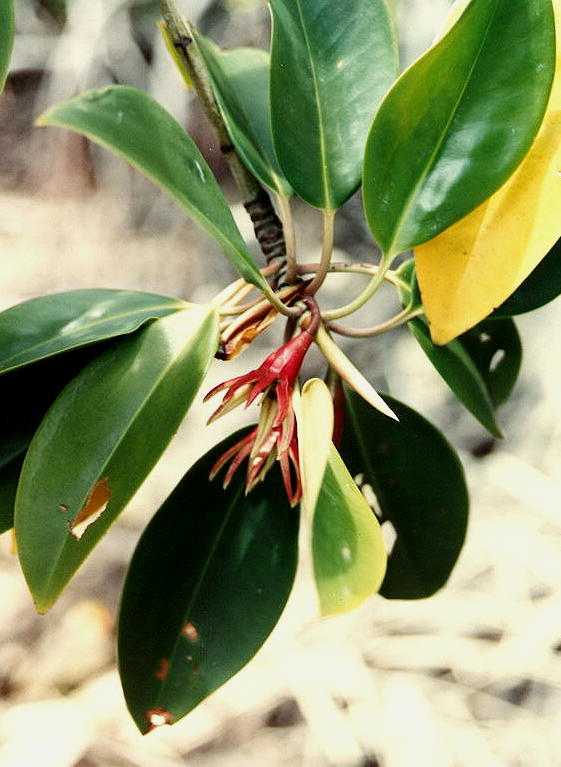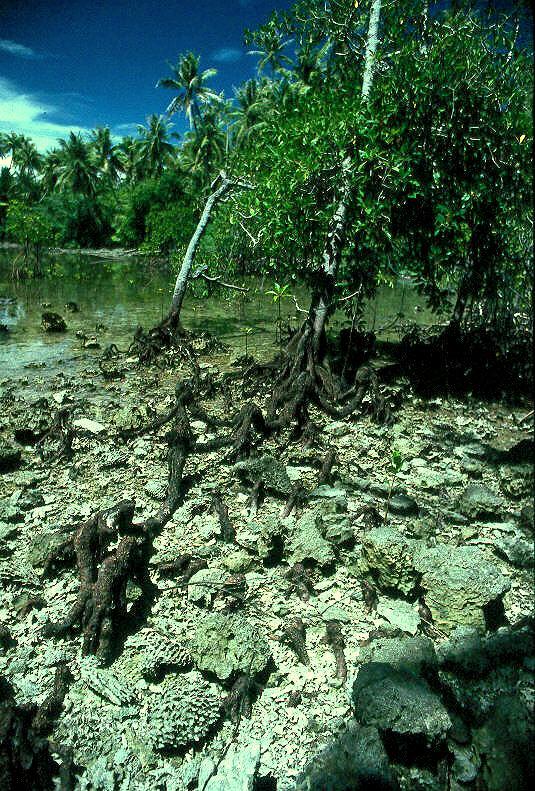
Description: Bruguiera gymnorrhiza is a mangrove tree can grow to heights of 25 m (80 ft) or more. It has a buttressed, fissured trunk, and knobby breathing roots (pheumatophores) that spread out over the muddy soil in which the tree grows. These knee-like breathing roots stick out above the mud during low tides and allow the plant to take in oxygen in the swampy soil environments. It produces attractive and long lasting, red to yellow flowers about 2.5-4 cm (1-1.5 in) in length. The fruits, which germinate while still attached to the “mother” plant (vivipary), can grow to be 15-35 cm (6-14 in) long before becoming detached from the trees and falling into the water, mud or sand below. In fact, mangroves have a special reproductive strategy. Similar to most mammals, mangroves are viviparous (bringing forth live young), not by producing dormant seeds like most flowering plant species. “Mangroves disperse propagules via water with varying degrees of vivipary or embryonic development while the propagule is attached to the parent tree” (www.nhmi.org/mangroves/rep.htm).
Distribution: The large mangrove tree, Bruguiera gymnorrhiza, is found in tropical, swampy coastal areas from East Africa to the Western Pacific, including many waterlogged soil environments of Micronesia. Although this tree is often planted by people who have extended its distribution into various (natural or artificially excavated swampy areas, e.g., possibly into the Marshall Islands), it is most likely a native plant in most areas of Micronesia (in other words, it reached most of these islands without the conscious or accidental help of humans). It is a very common tree in the middle to landward parts of mangrove swamps. Although B. gymnorrhiza is said to be: “Indigenous to East Africa, the Indian Ocean, and tropical Asia to Tonga and Samoa in western Pacific and to Nauru and the Marshall and Gilbert Islands in eastern Micronesia” (Clarke and Thaman 1993), it may have been introduced by humans to some of the islands (including some atolls) in the eastern regions of Micronesia. St. John (1951) observed this woody mangrove species in the Marshall Islands atolls of Aur, where it was about 20 feet (6 meter) tall and rare “at edge of swampy excavation in forest” on Tabal Islet, and on Majuro where it was growing at the border of a “swampy Cyrtosperma [large cultivated swamp Taro] patch.” Obake (1941d:9) cited S. Kusano as stating in his book “Forests of the South Sea Islands” that the mangrove tree species [B. gymnorrhiza]“is not indigenous but was introduced from some other islands with a view to dye fibers for mats etc.”
Uses by Island or Island Group: This mangrove tree has many uses in Micronesia as rot resistant timber, firewood and other uses, including even as a food source. A comparison of its use for food in the tropical Maldive Islands (atolls) in the Indian Ocean is instructive; in the Maldives, the propagules or green pods (hypocotyls) of the B. gymnorrhiza mangrove tree (known in those islands as kaṇḍū) are eaten as a cooked vegetable. This involves special preparation including peeling and then boiling, with the water being thrown away and replenished four times or more. This author (M. Merlin) has personally consumed the propagules of this mangrove in cooked meals served to him by indigenous peoples in rural areas of the Solomon Islands (see below).
Uses in Palau: The wood of Bruguiera gymnorrhiza (known as Denges in Palau)is used as traditional building material for houses, posts and poles and as fuel wood in the Palauan Islands. It is valuable as timber because it resists rot and insects. The stem of a germinating seedling, botanically known as the hypocotyl, which is found below the cotyledons, i.e., seed leaves, and above the radicle (i.e., the embryonic root) is, as noted above, edible and is used as an emergency food during times when other food resources are limited. For example, during World War II, Denges fruit in Palau was boiled and, after soaking it for three days, it was eaten. Although its taste is not generally favorable, the cooked propagules have been consumed for survival or variety (e.g., see Mita 2009, Oral Story 1; Note: the author here, M. Merlin, consumed cooked stems of germinating seedlings of B. gymnorrhiza with local Kwara’ae people on Malaita Island in the Solomons when I was working with these people and can attest to the edibilty but not overly tasty nature of this food source). According to Salmi-Saslaw (1988:209), there are two traditional ways to obtain a “brown-red dye” from parts of the B. gymnorrhiza mangrove tree in Palauan culture: “Boil fibers [extracted from other plant species] with the bark of dénges tree [B. gymnorrhiza]” or “Rub a mixture of choriich, red ochre soil from Babeldáob, and coconut oil to the fibers… This method is especially good for dyeing chuang fibers [dry leaves of Ongór, Pandanus tectorius].”
Uses in Yap: Timber from B. gymnorrhiza (known as Rok or Yangach in Yap) is very durable with dark red and heavy heartwood (e.g., Falanruw 2015:178) and is used as house posts because it is resistant to rotting. Poles of Rok wood can be put in soil that is often moist because they will not decay easily, whereas the hard wood of other related mangrove trees, such as Roway (Rhizophora mucronata) will rot under those soil conditions. Smaller logs of Rok are used to make house rafters. Rok can also be used as firewood. Parts of this mangrove tree are also reportedly used in medicinal recipes in Yap.
Uses in Chuuk: As in other Micronesian islands or island groups, the durable wood of B. gymnorrhiza (known as Woong, Ong, Bun orBuru in Chuuk) is used on this almost atoll to make house posts because it is more resistant to rot, under moist soil conditions, than the hard wood of other related mangrove trees, such as Chiyaan wuumw (Rhizophora mucronata). Smaller logs of B. gymnorrhiza are used to make house rafters and used for firewood. The word “woong” also refers to the “sap of the mangrove of this name when expressed from its bark and used to make canoe paint” (Goodenough and Sugita 1980). This “paint” or red dye is used traditionally to polish canoes so they can “slip quickly through the water” (Mahony 1973). On Puluwat, this occasional lagoon shore tree is abundant in swamp depressions of Alei Islet; its wood is used to make coconut huskers, its flowers are used in garlands, and a dye is produced from its bark.
Uses on Namoluk Atoll: Marshall (1975) reported on some of the uses of B. gymnorrhiza on Namoluk Atoll:
“In the olden days the bark [of B. gymnorrhiza] was pounded, mixed with charcoal and breadfruit tree sap, and used as a black paint for canoes. Today its wood is exploited for poles for poling canoes along the reef and occasionally for building materials. Both the bark and the bright red flowers have medicinal uses.”
Uses in Pohnpei: As on many other Micronesian Islands timber from B. gymnorrhiza (known as Sohmw or Rhomon Pohnpei) is very durable and is used as house posts because its wood is resistant to rot. Poles of Sohmw wood can be put in soil that is often moist because they will not rot, whereas the hard wood of other mangrove trees, such as Akelel and Akapah (Pohnpeian names for Rhizophora species), will decay under those soil conditions. B. gymnorrhiza is also used on Pohnpei for firewood. Other uses and reasons for usage of B. gymnorrhiza on Pohnpei can be found in Balick (2009:475), for example:
“To charm a fishing net, the bark is rubbed on the net, coating it to attract fish… The wood is used for house posts, as it is nice and straight… The wood is used for construction material and handicrafts… To use as a charm to protect a person from eating a poisonous food or drink… To treat diarrhea… To treat dysentery… To cause a person to vomit after food poisoning… To treat numbness….”
Uses in Marshall Islands: Durable wood from B. gymnorrhiza (known as Jon in Marshallese) is very durable and is used as house posts as it is in several Micronesian islands or island groups. Poles of Jon wood can be put directly in soil that is often moist because they will not rot, whereas the hard wood of other related mangrove trees, such as Rhizophora mucronata, will rot under those soil conditions. Smaller logs of Jon are used as house rafters. Jon wood is also used to furnish fuel. Sometimes the wood of this tree is also used to build pig fences and to make handicrafts. A dark black or brown dye comes from the skin of the fruit; this dye is used occasionally today to color “blackboards” for teaching purposes. For Jaluit Atoll, Okabe (1941d:12) listed bark from this mangrove tree as being used as a timber tannin. It is also commonly used for handicraft making (the dye). Traditionally, Jon fruit has also been used to waterproof materials such as coconut sennit cordage, as well as to strengthen fishing nets. In addition, the fruit is mixed with leaves of other plants to treat burns.It is used by some medicinally to reverse and remove harmful spells or black magic placed on someone (Taafaki et al. 2006); other medicinal uses include cleaning women after giving birth, and removing fish bones caught in the throat. Jon has been reported from the following atolls: Bikini, Rongelap, Utirik, Lae, Ailuk, Likiep, Aur, Ailinglaplap, Majuro, Arno, Jaluit, Ebon, Namu, Kwajalein, and Wotje. In most, if not all of these atolls, B. gymnorrhiza could have been introduced by people long ago or even in more modern times. For example, a “small stand” of this mangrove tree has been observed on “Bikini Atoll (Ralik Chain), probably introduced by man” (Haws: 2006:163).
Uses in Kiribati: According to Thaman (1987:5): “Te tongo refers to both Bruguiera gymnorrhiza and Rhizophora mucronata, [in Kiribati] although te buangi, either alone, or as te tongo buanpi, is commonly used to differentiate the former.” B. gymnorhiza mangrove species is reportedly occasionally to commonly found in the mangrove areas of Kiribati, where its rot resistant wood is used in house construction; others uses include extraction of a red dye from its bark “used to preserve and color canoe sails,” and the inclusion of its bright red flowers in garlands (e.g., see Thaman 1990:21, Thaman 1993, Catala 1957).
Uses in Nauru: B. gymnorrhizais known as Etum or Etam in Nauru where it is found locally in an area “of brackish lakes or lagoons near base of escarpment in Meneng, Anabar and Anetan District (lake in Anabar known as Araro); reportedly present in Buada Lagoon in the past.” Its strong, durable wood is esteemed for house construction, and the pre-germinated seed (fruit) is eaten after being cooked, scraped, dried in the sun and then boiled; “the Nauruan delicacy known as etum or etam, is prepared by mixing the grated pre-germinated seed with coconut milk and then baking.” In addition, the skin of the seed is “used to prepare a black dye for traditional skirts (ridi)” (Thaman et al. 1994:184).