


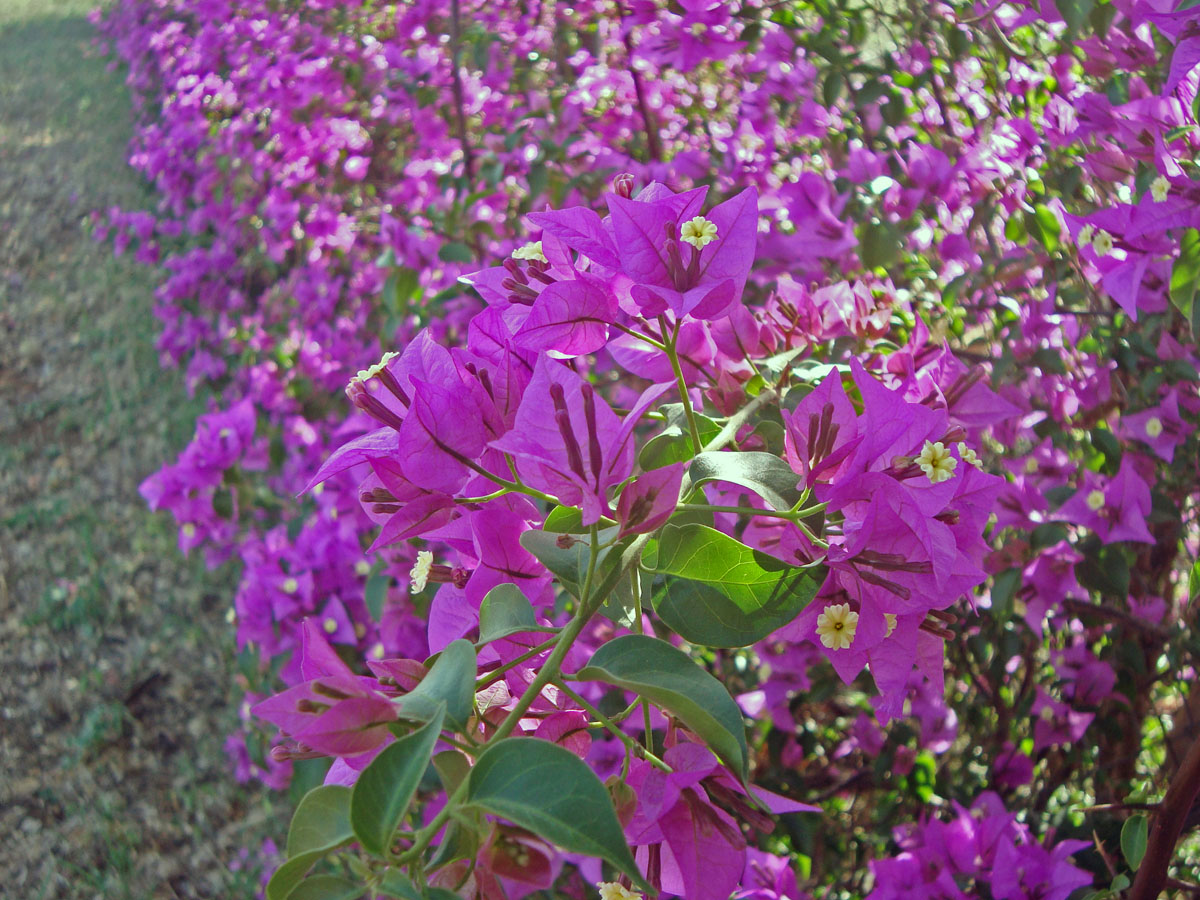
Description: “The genus Bougainvillea, in the Nyctaginaceae (Four-o’clock) family of plants, has 14 species,” with three that are widely cultivated: “B. spectabilis Willdenow, B. glabra Choisy, and B. peruviana Humboldt and Bonpland” (Kobayashi et al. 2007). Numerous crosses among the different species have produced novel ornamental hybrid cultivars. Bougainvillea spectabilis, is a common tropical ornamental in many tropical areas, is a perennial, vine-like, climbing plant. It can grow to heights of 1-12 m (3-40 ft) depending upon soil and other conditions. Its leaves are simple, alternate and oval to elliptical in shape, tapering to a point. Leaf size ranges from 4-13 cm (2-5 in) long and 2-6 cm (1-2 in) wide. The perfect flowers are small, tubular and white, typically in clusters of three, surrounded by three, often colorful “papery” bracts. These bracts vary in hue from magenta and purple to orange, white and yellow. The fruit of Bougainvillea is a five-ribbed, elongated achene, is evergreen where rainfall occurs all year, and deciduous where a dry season occurs.
Distribution: Originally, Bougainvillea spectabilis and a closely related species, B. glabra, were believed to belong to one species; however, in the mid-1980s botanists began to recognize them to be two distinct species. “In the early 19th century, these two species were the first to be introduced into Europe, and soon, nurseries in France and England did a thriving trade providing specimens to Australia and other faraway countries.” The native range of B. spectabilis is located within the Atlantic coast ecological region of Brazil, and because of its abundant and colorful flowering bracts this ornamental species is cultivated throughout many tropical and subtropical regions of the world. This decorative species is said to have been “developed from a specimen of Bougainvillea spectabilis collected by Philibert Commerson in Rio de Janeiro (where Captain Bougainville waited two months to meet up with his supply ship) and sent back to Paris in 1767” (K.R. Fortune in Lal 2000:36). In the process of growing up as a vine, Bougainvillea utilizes its thorns to cling to and climb up over others plants. It is evergreen where rainfall occurs all year, and deciduous where a dry season occurs. Bougainvillea plants grow best in dry soil where there is abundant sunlight and thrive with frequent fertilization; indeed, these plants require relatively small amounts of water once established and will not do well if over-watered. Bougainvillea plants can be propagated easily using plant tip cuttings (see Kobayashi et al. 2007).
Uses by Island or Island Group: As in many moderately wet to dry tropical areas beyond its native range of distribution in parts of tropical South America (see above), Bougainvillea spectabilis is also common as an introduced species, widely cultivated in many areas of Micronesia for its attractive floral display; indeed, a Federated States of Micronesia stamp features a drawing of this ornamental plant. It may be of current and future interest that recent research into the fabrication and characterization of a color dye produced from extracted material from Bougainvillea spectabilis, and associated with development of a dye sensitized solar cell by Narayan and Raturi (2010), has possible future energy use implications. This is relevant given the “huge gap between our present use of solar energy and its enormous potential [which represents] a grand challenge in energy research.” Using technology invented in 1991 by Micheal Grätzel, Narayan and Raturi, utilized “dye sensitization” in solar cells, one of “the most attractive methods currently being developed.” This involved the use of a 3rd generation, dye sensitized solar cell which appears to provide a promising means for the conversion of solar energy into electrical energy since it mimics photosynthesis. Using Magenta-colored pigment “Betalains (betanin),” Narayan and Raturi reported producing a constant voltage EPD utilizing TiO2 films prepared successfully from a Bougainvillea spectabilis-based dye sensitized solar cell which provided a “reasonable η of 0.380%.” Advantages of this energy conversion method include: not needing ultra-pure materials, being a low-cost process, and the abundant availability of Bougainvillea spectabilis.
Uses on Guam: Today Bougainvillea is cultivated widely in Guam and other Mariana Islands, where it this shrub is displayed in mass planting a ground cover, hedge, accent plant, and as a trained small tree.” A half century ago. in 1968, Bougainvillea spectabilis was designated as the official flower of Guam: “There shall be and is hereby adopted an official Territorial flower which shall be the local flower known as “Put tai Nobio” which means “it hurts not to have a boyfriend” in the Chamorro language" (McPherson 2013:109). However, in 2014, a political bill was introduced by Guam “Speaker Judith Won Pat” to remove Bougainvillea spectabilis as the official flower of the U.S. Territory of Guam, and adopt instead the native white-petaled “torchwood plant,” Gaosali (Bikkia tetrantra) as Guam’s “national flower.” At the time, Speaker Won Pat indicated that the South American plant, Bougainvillea spectabilis, “has no unique connection to Guam or the Mariana Islands,” and in this regard, the Speaker of the Territorial Legislature also referred to much recent discussion about “the need to preserve Chamorro language and ways of life” in the Mariana Islands (e.g. Pacific Daily News: June 21, 2014, http://www.guampdn.com; also see Frazier and Santos 2006).
Uses on Pohnpei When cultivated on this island, Bougainvillea spectabilis is commonly planted by roadsides, and otherwise used in landscaping as a decorative plant. During the Japanese occupation in much of the first half of the 20th century, it has been reported that “bougainvillea ran riot along the roadsides of Kolonia on Pohnpei” (Peattie 1988:201).
Uses in Kiribati: According to Thaman (1990) Bougainvillea spectabilis is reasonably “common cultivated ornamental in villages,” and its flowers and bracts are “used in garlands” (also see Moul 1957:22).
Uses in Nauru: Bougainvillea spectabilis isalso reported to be a planted as an ornamental on Nauru (Thaman et al. 1994).