
Aleurites moluccana (L.) Willd.
Family: Euphorbiaceae
(abui: Fiyaai)
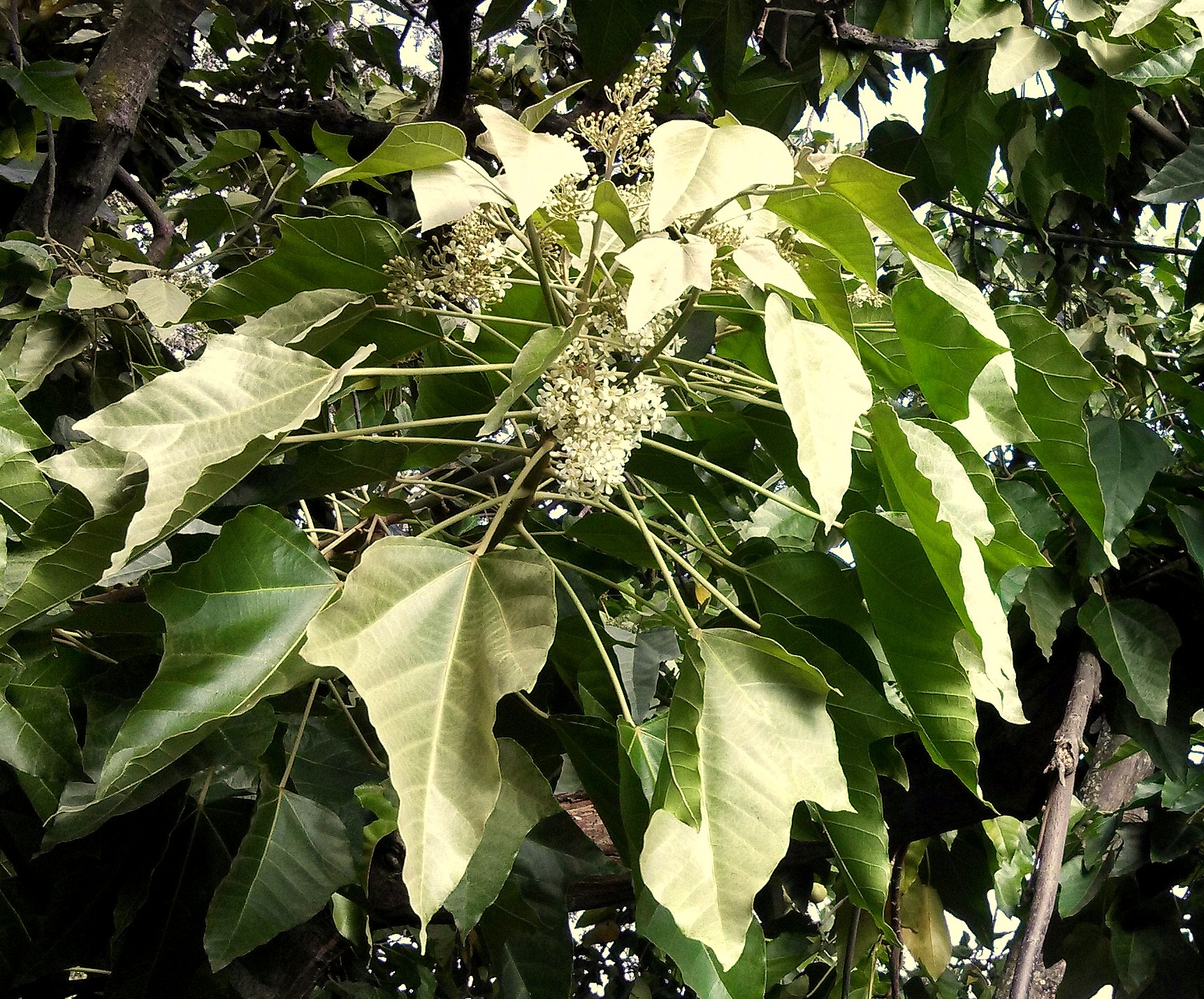
Aleurites moluccana image
Mark Merlin  
Introduced, Tree.

Tree 10 m tall or more, bark gray-brown to blackish; leaves and inflorescence with a mealy-scurfy whitish to light brown indument; leaves simple and ovate or trilobed or rarely 5-lobed, or sublanceolate, or subdeltoid, acute at apex, rounded, truncate, or subcordate at base, 3-5-nerved from the base, midrib thereafter pin- nately branches; blades mostly 10-20 cm long, on an equally long slender petiole; 2 glands at junction of blade and petiole; flowers small, greenish-white, in panicles, male and female on same plant; panicles 10-15 em long, many-flowered, terminal; petals pubescent, elliptic-spathulate; stamens of unequal lengths; ovary pubescent; fruit globose or bi-globose, 1-2-seeded, olivaceous, glabrescent, 4-6 em long, indehiscent, with bony endocarp and oily seeds. Native in Malaysia and W. Polynesia. A commonly cultivated tree in E. Polynesia. Said to have been introduced to Guam from the Caroline Islands (Safford); "raguar" is a Carolinian word. "Kukui" is the Hawaiian name. "Candlenut" refers to the use of the oily nuts as candles throughout Polynesia. The oil is similar to tung oil, produced from Aleurites fordii of China. This is a handsome tree, but it does not seem to thrive in Guam, and is quite uncommon. It does not occur on limestone but may be seen on farms in south Guam, as near Merizo (3921). The seeds are edible but purgative and cathartic so should be eaten only in small quantities. Seedling and juvenile leaves are mostly lobed; leaves of old trees are often simple, deltoid-ovate.

Hawaiian Islands:  

Distribution   
Native to Malesia, although its precise native range is essentially impossible to determine because of its early spread by man, now widespread in many tropical areas. In the Hawaiian Islands, a Polynesian introduction on Ni`ihau, Kaua`i, O`ahu, Moloka`i, Lana`i, Maui, Hawai`i.    

Habit
    Spreading trees 10-20 m tall, bark smooth, gray-brown; branches and leaves pubescent with stellate hairs at least on younger parts.

Leaves
    Leaves usually pale green, blades variable in shape, broadly ovate to rhomboid, cordate, or lanceolate, (7-)14-40(-61) cm long, (2.5-)8-15(-31) cm wide, pubescent with stellate hairs, especially on lower surface and when young, 3-5(-7) lobed or rarely unlobed, apex long acuminate, base truncate, cordate, or sometimes broadly cuneate, petioles (5.5-)10-16(-19) cm long.

Flowers
    Flowers numerous in terminal, paniculate cymes usually 10-15 cm long, pubescent with stellate hairs; staminate flowers with calyx ca. 3 mm long, petals white, 6-8 mm long, stamens 15-20, in 4 series; pistillate flowers with calyx ca. 6 mm long, petals white, 7-10 mm long, ovary 2 celled, ovules 1 per cell.

Fruit
    Fruit subglobose, 50-60(-70) mm in diameter, with 4 shallow furrows, indehiscent.

Seeds
    Seeds 1-2, (2.3-)3-4 cm in diameter, seed coat thick and very hard.
    
Chromosomes
    2n = 22, 44.

Notes
    Polynesian introduction, used medicinally and for seed oil.

Medicine