


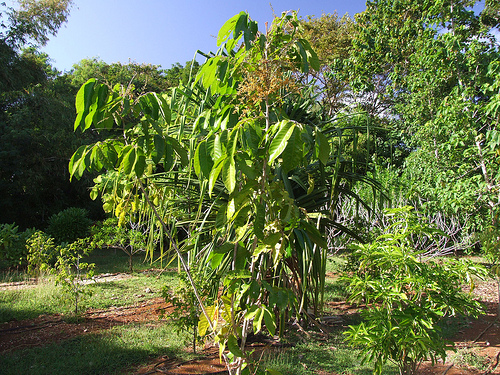
Micronesian Names by Island or Island Groups: Mesecheues (Palau), Mupunyao, Mapanao, Mapunyao or Mapunao (Mariana Islands), Ááppásew (Chuuk), Appaaw (Pulusuk), Apeu (Namonuito), Marasau or Karasau (Pohnpei).
Description: This native species of Aglaia is a small, understory tree 2 to 6 m (6-18 ft.) in height with rusty-brown, hair-like scales that cover the branches, leaves, and inflorescence. It produces alternate compound leaves that have leaflets arranged opposite along both sides of an elongated axis 60-80 cm (24-32 in.) long, with an unequal number of leaflets (9-13). New leaves are pale green, almost white, but darken as they get older. Its leaflets are oblong, 15-25 cm (6-10 in) long, and 6 to 8 cm (2.5-3.5 in) wide, acuminate at the apex, sometimes rounded toward base; lateral veins 12-16 in pairs. The young leaves appear like “prying hands covered with rusty-colored hair-like scales” and the very small, pinkish flowers are produced as elongated flower clusters that mature from the bottom upwards (terminal, axillary panicles) and are 3-15 cm (1-6 in) long; the one-seeded fruits are elliptical “in the long section and circular in the cross section,” about 2.5 cm (1 in) long and rusty or orange in color (Kitalong et al. 2008; Raulerson and Rinehart 1991).
Distribution: Aglaia is a genus of over 100 woody species mostly found in the moist tropics mainly in Southeast Asia and tropical Northern Australia. Aglaia mariannensis is generally found in a number of the tropical islands of Micronesia. In these islands, A. mariannensis occurs as “small understory trees with new growth that has a conspicuous reddish brown pubescence… [with the population in the Mariana Islands that is] restricted to limestone forest communities, while the Palau and Eastern Caroline populations are found on both volcanic and limestone forests” (Costion and Lorence 2012:80-81). Note: A. mariannensis was found to occur in relatively large numbers in non-limestone areas of the volcanically active Pagan Island, and in abundant association with the Partula gibba tree snail, a endemic invertebrate species rare elsewhere in the Mariana Islands (see Hadfield 2010).
Uses by Island or Island Group:
Uses in Palau: This small Algaia species (Mesecheues) is a native tree in Palau that grows in the understory of the primary forests on Babeldoab and the Rock Islands. “Several other members of the genus are used for timber in other locations, but Aglaia mariannensis is too small to heave sufficient bulk for timer. Forest birds that feed on the fruits are likely to disperse the seeds” (Kitalong et al. 2008).
Uses in Pohnpei: Kanehira (1935:30) referred to small native tree as “very common in thickets and forests from low altitudes up to the highest elevations on the island,” and indicated that its Pohnpeian name was “karashau.” In the past, the stems of this tree were used to catch feral chickens. It has also been used as firewood which burns rather slowly because of its relatively abundant resin. Aglaia mariannensis has also been used as a deterrent to keep rats out of crop areas on Pohnpei, and even as a kind of magic charm to protect people from spirits, as well as to ward off thieves trying to steal kava (sakau, Piper methysticum) or hinder people who eat other people’s yams or other crops. In addition, A. mariannensis has medicinal uses for treating amoebic dysentery and inducing vomiting (Balick 2009).
A small understorey tree up to 7-8 m tall, the youngest parts all conspicuously reddish brown or tawny-brown lepidote; branchlets soon glabrate; leaves alternate, leaves, at least half as long; flowers racemose, on pedicels up to 1.5 mm long; calyx brown-stellate-lepidote with 5 acute lobes, about 1 mm long; petals 5, glabrous, about as long as the calyx; staminal tube free from petals, shallow-cupuliform, 1 mm broad, 0.5 mm high, obscurely 5-toothed; the 5 anthers about 0.3 mm long; fruit ellipsoid to obovoid, densely lepidote, to nearly 2 cm long. Fig. 51, 52. Endemic in the Marianas Islands. Type G.E.S. 465. Restricted to limestone forest communities. Hospital Pt. above Ypao, Tumon (3889); Dos Amantes Pt. (4041); Yigo (4251); Ritidian Pt. (5038); Asanite Pt. (5260). The reddish-tawny-brown, stellate-lepidote indument, and the tiny flesh- or salmon-colored flowers make this an attractive wild tree.