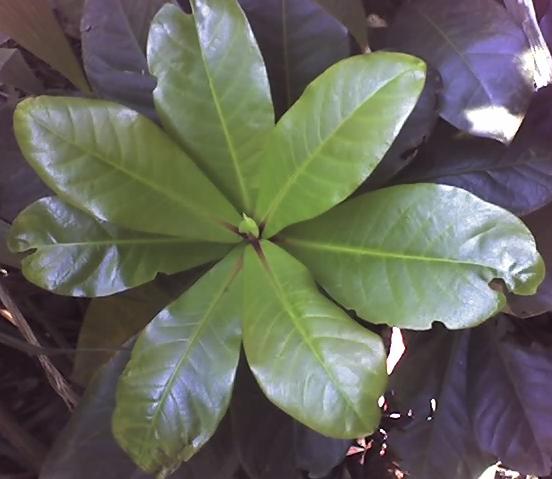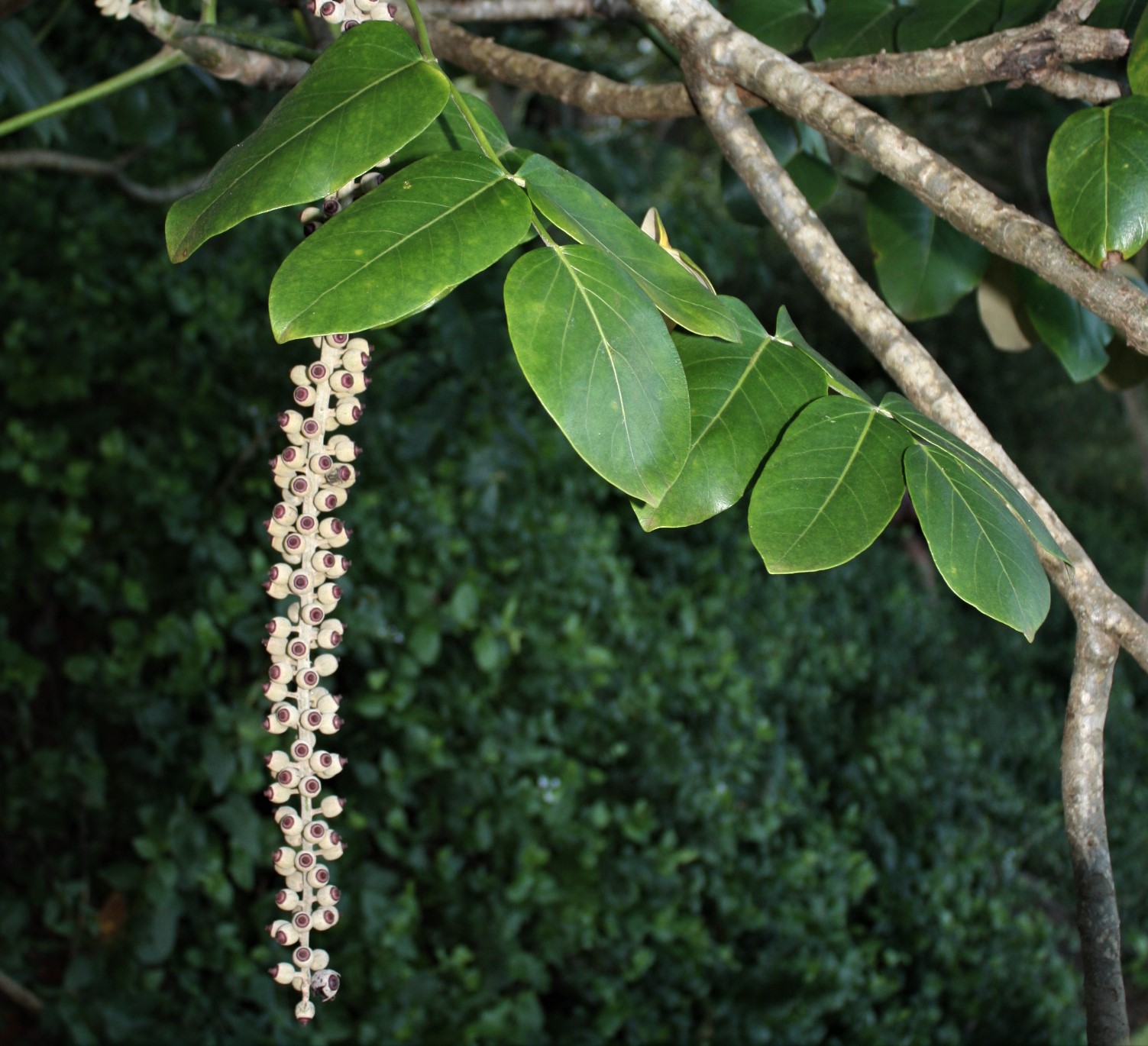
Description: Barringtonia racemosa is a small to medium sized tree with a straight, unbranched stem that leads to a rounded crown and is usually 4-8 m tall, (12-24 ft), but occasionally reaches 15 m (~45 ft) or taller. B. racemosa is apparently a native species on a number of Micronesian Islands. It has leaves 15-30 cm (6-12 in) long and 8-10 cm (3-4 in) across, and is wider at the base (obovate). The specific name racemosa refers to the long racemes on which the flowers and fruit are produced; indeed, many prominent white to pinkish flowers with four petals hang suspended from branches when the plant is in bloom. Its fruits, which are buoyant are dispersed by ocean currents, are ellipsoid in form and 4-7 cm (1.5-3 in) long.
Distribution: B. racemosa is a small tree found near the shore, behind mangrove swamps, and along or near streams. Indeed, it normally occurs close to water, along riverbanks and in freshwater swamps, and occasionally in the less saline areas of mangrove swamps, where it may develop pneumatophores (specialized aerial roots that enable plants to breathe air in habitats that have waterlogged soil). B. racemosa is adapted to a variety of wet tropical, moist topical and wet subtropical regions from east Africa through Indo-Malaysia to parts of Remote Oceania including islands in Polynesia and Micronesia.
Uses by Island or Island Group: B. racemosa is oftern regarded as a decorative tree, which grows easily and rapidly, it cultivated for ornamentation in some tropical and subtropical areas, and occasionally planted as a roadside tree. It also serves as a multipurpose tree in some areas; for example, it is sometimes harvested from the wild for local use as a source of food (young leaves), soap (seeds have been used traditionally as bathing soap), fish poison (seeds, bark, wood and roots contain the poison saponin and is used to stun fish), medicine, fiber (bark), firewood, construction materials and medicine (e.g., see http://www.worldagroforestry.org/). Medicinally, B. racemosa has been used for malaria, cough, asthma, jaundice, headache, eye inflammation, diarrhoea and sores, and a bark decoction is applied externally to treat rheumatism (e.g., see http://uses.plantnet-project.org/en/Barringtonia_racemosa; http://pza.sanbi.org/barringtonia-racemosa).
Uses in Palau: B. racemosa, known in Palau as Koranges, is a common lowland forest tree that grows along freshwater streams and swamps; and near the ocean adjacent to mangrove swamps B. racemosa is one of the most common woody species on Palau. According to Okabe (see Defilipps et al. 1988), parts of young breadfruit (Artocarpus species) including flowers or leaves, along with young leaves of Codiaeum variegatum and those of the brack-water or freshwater mangrove (B. racemosa) “are mixed and crushed, and the juice thus obtained is injected into the ear for otitis media [inflammation of the middle ear].”
Uses in Yap: In the past, B. racemosa, known in Yapese language as Wathol, was an important source of medicine and had many uses. For example, it is used to relieve pains after childbirth, and for earache. The seeds of Wathol were used traditionally as local bathing soap in Yap. “Children use fruits to produce soap bubbles” (Falanruw 2015:48). Wathol is closely related to Biuwol (Barringtonia asiatica, see above), which is usually found in the coastal strand vegetation near the ocean shore on Yap.
Uses on Guam: B. racemosa, known as Langasát or Langaasag in the Chamorro language, is a common native species found in riparian (or riverbank) forests along rivers and streams in the Mariana Islands. Safford (1905:195) noted that this B. racemosa was “not utilized by the natives” on Guam; however, it is reportedly used in more modern times in reforestation efforts along rivers.
Uses in Chuuk: B. racemosa, known as Sóón in Chuukese, was an important source of medicines in the past in Chuuk. The seeds of this woody species have been used traditionally as a fragrant bathing soap, and the flowers have been used in garlands and the wood is used for firewood. Before the Europeans arrived in Chuuk, the Chuukese of Romonum reportedly made pounders from heavy wood trees such as Sóón (e.g., see Merlin and Juvik 1996).
Uses on Namoluk Atoll: Marshall (1975) indicated that B. racemosa was uncommon on this atoll where he found it “growing in thick black mud in a small taro excavation near the middle of Namoluk Islet in heavy shade,” and listed its bark as having medicinal uses.
Uses in Pohnpei: B. racemosa, known as Wihnmar on Pohnpei is closely related to Wihnsed (B. asiatica). B. rasemosa (Wihnmar) is a very important source of medicines with many uses in Pohnpei. Similar to Yap, B. rasemosa is used on Pohnpei to relieve the pains after childbirth, and for relief of earache. A variety of the uses of Wihnmar are described below:
“The timber is used in construction…The fruits can be used as laundry soap…The small fruits are put into the mouth to soften, then used as airgun pellets…. [Medicinally, B. rasemosa (Wihnmar) is used on Pohnpei]: To treat soumwahu en kau (sickness caused by sorcery)…To treat soumwahu en nansapw (sickness from the cultivated fields…To reduce the need to go to the bathroom when a person will be attending a big funeral part and there will be too many people around…To stop diarrhea…to treat back pain…To treat headache…To treat poisoning caused by eating food and drink that may have been hexed by sorcerers…To treat soumwahu en ohl…To reduce a high fever…To treat or clean the uterus…To treat salengamat (ear infection) in babies (symptoms include a bad smell from the painful ear accompanied by copious amounts of white sticky fluid coming from the ear)…To treat babies with cracked skin where the ears join the head (there is not a local name for this illness)…To treat rash similar to chicken pox…To treat a rash on a child…To treat a bad rash given by a sorcerer due to jealousy…To treat skin rash…to treat itchiness…To treat soumeahu en ohl (men’s sickness)…To treat a fungal infection…” (Balick et al. 2009: 420).
Uses in Kosrae: B. racemosa is known as Kwenguhl or Kaiengal in Kosraean language. This tree (B. racemosa,) is a very important traditional source of medicines on Kosrae with many uses. For example, it is used to relieve pains after childbirth, and for earaches. The seeds of Kwenguhl were used traditionally as bathing soap. Kwenguhl is closely related to Pucspucs (B. asiatica) which is usually found in the strand vegetation near the ocean shore on Kosrae and other Micronesian Islands.