


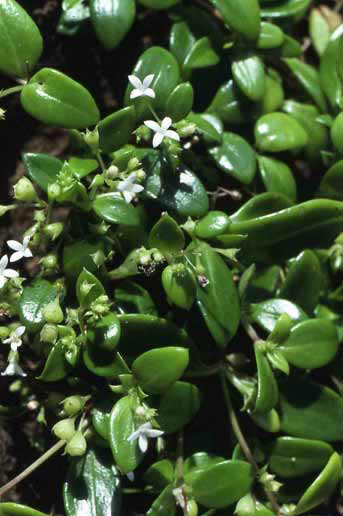
Description: Hedyotis biflora is small, creeping or slightly erect, weak-stemmed herb that may grow to heights of about 40 cm (16 in) with quadrangular, glabrous stems and spreading branches. The opposing leaves are elliptical to oval in shape and about 1-6 cm (0.4-2 in) long. The delicate flowers are tiny, white and tubular; the small, dry fruit capsules are borne on a long, thin stalk and contain many tiny black seeds. It should be emphasized that the taxonomy of this species and the genus Hedyotis in general is complex and still in need of much more research and probably revision. Wikström et al. (2013) refer to confusing and basically subjective aspects of the taxonomy of the genus Hedyotis:
“Following the first description of Hedyotis by Linnaeus (1753), there have been continuous disagreements over the delimitation of the genus, particularly with respect to Oldenlandia. The two genera have often been treated as congeneric, and to make things worse, they have variously been treated as either Hedyotis… or Oldenlandia …. Consequently, species described under one generic name (i.e., Hedyotis) almost certainly have a synonym under the other (Oldenlandia) and by what name an individual species should be referred to is an almost subjective choice.”
Distribution: Here we refer to this species as H. biflora which is widespread in the tropical Pacific and can be found as far away as tropical Asia and Mauritius in the Indian Ocean.
Uses by Island or Island Group: Reportedly has medicinal uses in parts of South and Southeast Asia (e.g., see Quattrocchi 2012:2677; http://www.stuartxchange.com/Pisek.html).
Uses in Yap: Referring to “Oldenlandia sp.” with a local name of Bukbukginin or Bukbukuginin in the “Giripes Dist.” on Yap, Okabe (see Defilipps et al. 1988:20)
noted that “the leaves and stems [of “Oldenlandia sp.” or Hedyotis sp?] are crushed and mixed with coconut oil and spread onto sarcoma [cancerous growth?].”
Uses in Namoluk Atoll: According to Marshall (1975:46), Hetyotis biflora is known as “alou mach.” Marshall collected specimens of H. biflora on Namoluk Islet of this atoll, “both from a shaded area in a path and from the taro swamp.” Furthermore, Marshall indicated that all parts of this plant have “medicinal uses,” even though the local Namoluk “alou mach” refers to it smellinbg “like feces.”
Uses Satawal Island: Fosberg (1969:12) reported that Hedyotis biflora could be found commonly along “paths and in village” on Satawal Island.
Uses in Chuuk: Manner (2013:247), in his study of the flora and use of plants on Romonum Island in Chuuk Lagoon, listed Hedyotis biflora (known locally as “opwowusón”) as an “Ornamental tree[?] said to bring good luck to the house” (Manner 2013:247).
Uses in Marshalls: Hedyotis biflora is known as Kinoj or Kinwōj in the Marshall Islands where it is used medicinally for several purposes, such as overcoming lethargy, restoring energy and treating concussion (Taafaki et al, 2006:127-129). is also reportedly used as pig feed in the Marshall Islands. Today, H. biflora is now less common in the Marshall Islands, especially on Majuro Atoll, where it occurs “in disturbed sites near coast and as a weed in houseyard gardens and waste places; seems to be slowly replaced by introduced weedy species.” H. biflora is more abundant in rocky areas on some of the outer atolls of the Marshall Islands (e.g., see Vander Velde 2003:119; Taafaki et al. 2006:127). The origin of this small herbaceous species in the Marshall Islands is not fully known. It may not be a native plant; in other words, it was possibly introduced by people before or after European contact (probably accidentally by inadvertent transport of its very small seeds). H. biflora has been reported from the following Marshall Islands: Ailinglaplap, Arno, Jaluit, Likiep, Majuro, Mejit, and Wotje.