


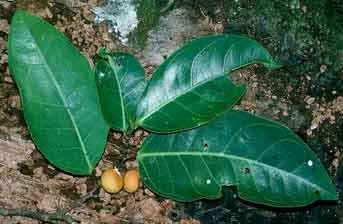
Description: There are more than 750 species of fig (genus Ficus) trees in the world, known from many tropical and subtropical countries. All of them are woody. Some are trees; others are shrubs to climbers. Many fig trees begin their lives epiphytically on other trees and then send down aerial roots to reach the ground; others climb up trees by means of clasping roots; and still other have extensive root systems, either above or in the ground, or both. Ficus tinctoria is a very variable evergreen woody species, occasionally as a scandent shrub with long leaning limbs only a meter tall, in other situations it can develop into a small tree; however, F. tinctoria can also grow to become a large tree with a spreading crown that can reach heights of up to 25 m (~80 ft); sometimes the trunk can be as much as 3 m (~10 ft) in diameter (e.g., see Smith 1985). More often, F. tinctoria is forms into a relatively small, pendulous, native fig tree up to 18 m high with alternately arranged, oval leaves that are glossy dark green above, pale green below oval, have entire margins, and are up to 20 cm (8 in) long and 9 cm (3.5 in) wide. F. tinctoria bears red flowers and has thorns near the leaves; it also produces copious milky sap, yellow to bright orange or even reddish fruit that are commonly eaten by birds, and is known in English as “Dyer’s Fig” or a variety of other names.
Distribution: Ficus tinctoria is native to many tropical areas from the Philippines on many of the tropical Pacific islands. Both Ficus prolixa and F. tinctoria and native fig tree species are widely found on many high, tropical volcanic islands in the Pacific all the way to the Marquesas. Although F. tinctoria can germinate on rocky ground or outcrops on mountain ridges, it often starts its life as an epiphyte growing on another plant. As this fig tree increases in size, it produces many slim aerial roots that grow downward from the branches. When these adventious roots reach the ground they root into the soil and further enlarge, providing extra nutrients to the fig plant, which subsequently develops much more robustly. Over time the roots of the fig plant surround and squeeze the trunk of the host tree; and at the same time the emerging canopy growth minimizes light that can reach the host tree. Over time this leads to the death of the host tree.
Uses by Island or Island Group: Although Smith (1985) treats Ficus prolixa and Ficus tinctoria as indigenous in Fiji and Polynesia, he also concluded that Corner (1975) might be correct in his suggestion that these two fig tree species were Aboriginal Introductions (i.e., “Canoe Plants”) because their fruits and young leaves could have been an emergency food. Corner also noted that Ficus tinctoria was the most widespread banyan fig species found in India, southern China, Indonesia, northern Australia, and several islands in Remote Oceania, incluing Micronesia. Thaman (1992:51-52) described some of the traditional applications of this useful fig tree in the tropical Pacific region, pointing out that F. tinctoria is widely cultivated and propagated vegetatively as a minor staple food plant in Micronesia and some nearby atolls. For example, green or ripe “fruits” are cooked or processed numerous ways and used to produce a minor staple food or made into puddings and sometimes dried to serve as a preserved food in Micronesia and Tuvalu. In addition, the wood of this fig tree is occasionally used in light construction for “digging sticks, canoe connectives, fishnet frames, fishtrap parts, earth sieves and for firewood…. [and its fiber rich] branches used to clean teeth” (also see Clarke and Thaman 1993).
Uses in Palau: Wilkinson and Elevitch (2000:87) list the “fruit” of the Dyer’s Fig, F. tinctoria, as used for food. According to Tuyama (1941), a person “can make strong rope from the bark of this plant.”
Uses in Yap and associated atoll islands: The fruits of Wacheguy (F. tinctoria) are sometimes collected in Yap, put in a pot, boiled, and eaten. This fig tree also has medicinal use on Yap; for example, Okabe (see Defillips et al. 1988:18) reported that parts of the root, with the skin removed, are ground together with coconut oil, mixed with coconut, and given to women during childbirth.
Uses in Ulithi: On this atoll, the wood of Howel(F. tinctoria) is used in canoe construction (“to make outrigger connectives”) and to build fires; in addition, fishing lures are made from the bark on Ulithi (Lessa 1977; also see Thaman 1992a:51-52)
Uses in Ifaluk: On this atoll, the wood of Gawann or Hawan(F. tinctoria) is used to make small house rafters from the wood of this fig tree; in addition, fishing lures are made from the inner bark of the roots (Lessa 1977:152; also see Thaman 1992a:51-52).
Uses in the Mariana Islands: Stone (1970:251) characterized F. tinctoria that he observed on Guam as a “native” woody species that was rather common in coastal or inland places, generally on limestone as a “small tree, seldom more than 8 m tall, a strangling epiphyte at first, but often growing on cliffs, where it produces long proproots, often branched, which may climb up or down the cliff-face for long distances.” F. tinctoria is known as Hoda (or other local names)in the Mariana Islands where native birds feed on its fruits; for example, Stone (1970:251) noted that its “ripe fruits are relished by the sali bird (Aplonis opacus guami) according to E. H. Bryan Jr. (Guam Daily News, Dec. 4, 1958).” F. tinctoria has been reportedly used for medicinal purposes in the Mariana Islands (e.g., see Zarones 2014a).
Uses in Satawal: According to Fosberg (1969:6), on the low coralline island of Satawal F. tinctoria is known as “Awan” or “Awal” and is a common as a shrub in the central forests of the islands and a small tree in less disturbed forests toward the southeast part of island….”
Uses in Puluwat: F. tinctoria (known on this atoll as bero) is a dominant tree, along with F. prolixa and a few other woody plants in the interior forest of islets of Puluwat; and F. tinctoria a “an important food crop” on Puluwat (Manner 1994:2), where it also used “to make ropes for fish drives (laale) in Puluwat from the rope-like aerial roots” (Thaman, 1992a:51-52).
Uses in Chuuk: The fruits of Awén (the Chuukese name for F. tinctoria) can be eaten raw or boiled, but they are, according at least to some, as not being very tasty, and thus in Chuuk they are usually only consumed when famine occurs. The wood of this fig tree has been used for fire ploughs (to start fires), firewood, and to make house posts. The round, orange fruits have been used to play a game of “marbles,” and the leaves are used medicinally to relieve swollen eyes; crushed leaves are rubbed above and below the eyes (see Merlin and Juvik 1996).
Uses in Losap Atoll: F. tinctoria is reportedly a common tree of islet interiors on this atoll where it reportedly known locally as Awen and used in traditional medicine (Manner and Sana 1995:62).
Uses in Pohnpei: This native fig tree, F. tinctoria (known in Pohnpeian as Nihn), has edible fruit. It is also used as a source of medicine. During earlier times, its bark was used for making cloth (as was breadfruit, Artocarpus, fiber). Nihn, Keleu (Hibiscus tiliaceus), and Topwuk (Premna obtusifolia) were reportedly used to start fire by rubbing pieces of their woods together. Balick and his colleagues (2009:446-448) provided more information about traditional uses for this fig tree on Pohnpei:
“Hunters know that “black birds” and other forest birds eat the yellow fruits, so they hunt in the area … It was said that in the past, when there was no food and a person was hungry, they could eat the fruits of this species… To make liep (a cord looped around ankles to climb a coconut tree) … The bark can be used to make rope similar to the way that kolou (Hibiscus tiliaceus) is used … The bark is used as cordage as a local “belt” (rope) to tie firewood up to be carried. It is said to be stronger than the fiber from kolou bark … [F. tinctoria is also used] To make fish bait … To use to attract fish … To make a fishing lure, specifically for [certain fish such as] ahl [skipjack] … The stems are used as construction material for small structures, such as imwen kuk (cookhouses) … The tree, when dead, is a good source of firewood … [The plant can be used in a variety of practical and magical remedies for diverse ailments, e.g.,] in sorcery to chase ghosts away from a sick person because it is a powerful plant …To treat nervousness, four leaves are chewed and swallowed to calm a person in a big crowd ofpeople and in playing games or sports…. To treat a possessed person … To treat soumwahu en naniak (mangrove sickness) … To treat joint pain in the arm … To make a baby strong … To use to treat sick dogs with a skin rash and falling hair … To treat cuts and dry wounds … To treat earache … To treat saleng medek (earache caused by insects crawling in the ear, water getting in, a blow to the head, or just proneness to earache) … To treat a skin rash or skin disease…” (see Balick et al. 2009:446-448 for more detail)
Uses in Kosrae: The brightly colored fruit of this native strangler fig tree (F. tinctoria), which is known in Kosraean as Shrah, Srah orShara, are commonly eaten by birds. The fine fibers extracted from the bark of this fig tree are traditionally used for fish bait; and arts of the plant are also used as a source of medicine (Merlin et al. 1993).
Uses in Marshall Islands: Tōpodo (as F. tinctoria is known in Marshallese) is native to many tropical areas from the Philippines through much of the Pacific island region, possibly including the Marshall Islands. However, it is said on Majuro that the plant was brought there from Kiribati (Gilbert Islands); and the Marshallese-English dictionary refers to the name, Tōpodo, as derived from the Kiribati name “te bero.” (e.g., see Vande Velde 2003:110; also see Fosberg 1990). Indeed, the restricted distribution of this fig tree in the Marshalls to Ailinglaplap, Majuro, and Jaluit, and its limited use suggests that it may be a relatively recent introduction from some other island group such as Kiribati. The fruits of Tōpodo are boiled as a food in the Marshall Islands where it has been observed as an occasional tree in the vegetation; On Majuro, it reportedly occurs as a cultivated “food tree surrounding taro pits in Laura and in scattered private gardens throughout the atoll, including Aeaiien” (Vande Velde 2003:110).
Uses in Kiribati: It is within the “harsh conditions and a paucity of flora to choose from, that the I-Kiribati (people of Kiribati) have evolved their distinctive agroforestry system,” and dispersed all through this natural and human-induced milieu of vegetation strongly dominated by “coconut or te ni (Cocos nucifera) are pandanus or te kaina (Pandanus tectorius), breadfruit or Te mai (Artocarpus altilis), and the native fig or te bero (Ficus tinctoria), along with a wide number of pantropical strand species, such as Scaevola [taccada], Tournefortia argentea, Guettarda speciosa, and Pemphis acidula” (Thaman 1990:7). Te bero(F. tinctoria)is a supplemental food in many areas of Kiribati, but in the drier, limestone islands of southern Kiribati with their less diverse flora, F. tinctoria is a major part of the human diet (Thaman et al. 1994). According to Baiteke (1994), the “native fig” is cultivated “throughout Kiribati and is very useful food supplement during drought and bad weather.”
“Commonly cultivated and propagated vegetatively by planting branch cuttings around villages and occasionally in plantation areas; branches sometimes used in house construction, especially in roof framing; fibrous twigs used for cleaning teeth; roots used as scoopnet frames; leaves fed to pigs and sometimes used as babai compost; fruits an important staple in the drier southern islands being picked when ripe and sometimes when green, cooked, crushed in a pestle into a puree which can be eaten after being sweetened with toddy molasses (kamaimai) or sugar and grated coconut or preserved by drying in the sun on Guettarda speciosa leaves which are changed every day as long as the paste remains sticky; then when dried this ‘fruit’ paste is then referred to as kabuibui ni bero; [F. tinctoria] reportedly bears many times throughout the year; considered a pauper’s or famine food in many areas; fruit formerly used to dye hats, mats, etc. Te bero dye was preferred to that extracted from te non (Morinda citrifolia); young leaves used in treating boils and watery inner bark used in treating sore eyes” (Thaman 1990:20; also see Luomala 1953, Parkinson 1955:61-73, Catala 1957:76-78, 94, Moul 1957, Small 1972, Thaman 1992).
Luomala (1953:70) described the controversial local attitudes about using F. tinctoria (bero) as a food source:
“The fruit is boiled and added to grated coconut and coconut molasses (te kamaimai) to make what older people consider a tasty dish. It also prepared in other ways. Mention of te bero arouses hearty laughter, embarrassed snickers, or defensiveness. It is famine and pauper food, people say. A Taku village expert on bero would tolerate no joking about the tree from curious bystanders who listened while he told me of the wonders of bero. He said it was a good friend in need, and he used it also for medicines. During World War II, people dried bero leaves and smoked them, just as they tried every other kind of leaf as a tobacco substitute. An old man who said that Beru and Nikunau people like the taste of bero as a food, but that Tabiteueans, with some exceptions, prefer babai, meant his remark as a slur.”
In a recent publication Thaman and Tye (2015:56) described the relatively recent introduction, cultivation and use of the Dyer’s or Pacific Fig, (F. tintoria) in Kiritimati (Christmas) Atoll in the Northern Line Islands (i.e., Kiritimati, a large dry atoll is now part of the Micronesian Republic of Kirimati):
“Present in the 1970s and in cultivation around settlements in 1982. Now planted as a food tree and ornamental in houseyard and public gardens in London, Tabwakea and Banana [settlements on Kiritimati Atoll]. An important supplementary staple food crop; the ripe figs are cooked and crushed to make a flour, which can be made into a pudding after sweetening with toddy syrup (kamaimai) or sugar, or made into a preserved breadlike substance, kabuibui ni bero, which, after complete drying, can be stored in tins for several months; fruits also used in the past in the Gilberts [Kiribati] for dying objects such as hats, mats, etc.; leaves fed to pigs and sometimes used in composts; branches used in building houses, especially as supports for roof thatching”
Uses on Nauru: According to Thaman et al. (1994:173) Dyer’s fig (F. tinctoria)is a “recent introduction” to the raised-reef (makatea) island of Nauru:
“Fruit eaten cooked; fruit also cooked and mashed and mixed with boiled coconut syrup (kamimra, kamerara) to make a pudding (dedengan). Plant introduced from Kiribati where it is a supplementary staple in many areas and a major staple in the drier islands of southern Kiribati. Use learned by some Nauruans from I-Kiribati, but recipe essentially the same as used by Nauruans for F. prolixa” [native banyan, a large Ficus tree].
Uses on Banaba: Thaman and Samuelu (2015:19) commented on the origins and use of F. tinctoria on Banaba Island where this fig tree is known as Te bero: “It is stressed that important food and multipurpose plants listed under indigenous species, such as Pandanus tectorius, Ficus tinctoria and Morinda citrifolia, are undoubtedly also represented by aboriginally or recently introduced varieties that are deliberately cultivated as food, handicraft or multipurpose plants.” Thaman and Samuelu (2015:76-77) referred to the occasional occurrence of this fig tree species on Banaba: “A number of [F. tinctoria] trees seen directly behind the main harbor planted at residential housing and in houseyard gardens. Although possibly originally native to Banaba, it could have also been an aboriginal introduction and, like in Nauru, is now found only in cultivation. The fruit is cooked and pounded to make a traditional staple pudding or drink (te berobero); the leaves and bark are used medicinally, the inner bast fiber is used as cordage by I Kiribati living on the island. The sap, branches, leaves and roots have important uses in traditional health care (traditional medicine).”