


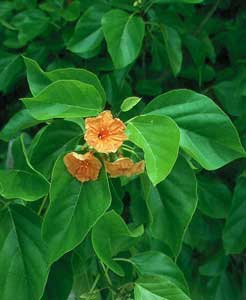
Description: Cordia subcordata is an attractive, more or less medium-sized tree with a dense crown that grows to heights of 10 m (35 ft) or taller with pale greyish, slightly fissured bark. C. subcordata produces broad, light green, ovate, pointed leaves up to about 30 cm (12 in) in length on long petioles; the attractive flowers are orange and trumpet-shaped. The clustered fruits are broadly egg-shaped, 2-4 cm (1 in) long, turning pale-grayish brown and woody when mature, and containing 2-3 corky seeds.
Distribution: C. subcordata produces floatable fruits and durable seeds, and because of this is has apparently experienced long distance dispersal throughout much of the Tropical Pacific; indeed, it is considered to be indigenous from the Indian Ocean and tropical Asia in all the islands of Microneisa and Polynesia. However, it may have also been introduced to some islands by people because of its varied cultural utility (e.g., see Mueller-Dombois and Fosberg 1998, Thaman et al. 1994:25; Burney 2011). This tree thrives in coastal forests and thickets, often near the shoreline, but can grow at elevations up to about 150 m (~500ft). It is not common on some of the larger Micronesian Islands (e.g., on Yap proper or the main islands of Palau), but is frequently found on outer islands, particularly on atolls. It is planted through both seeds and cuttings. It was formerly common in coastal strand forests, especially in disturbed sites, but is now “increasingly scarce due to overexploitation of wood for carving” and can sometimes be found “in some home gardens on atolls or occasionally as a roadside tree” (Clarke and Thaman 1993; also see Friday and Okano 2006b).
Uses by Island or Island Group: Cordia subcordata has many uses among the Pacific Islanders, including the Micronesians. In addition to its usefulness as a shade tree, windbreak and soil stabilizer in coastal areas, its wood is highly esteemed for making handicrafts, and house posts made from the timber of this tree reportedly can last up to 100 years. The wood will not split when a nail is driven through it. Commonly, the soft but very sturdy, chocolate brown and blond colored wood of C. subcordata is “used in general construction and is among the most favoured carving woods; also used for making canoe hulls, thwarts, rudders, weather platforms, outrigger booms and paddles, furniture, headrests, bowls, trays, plates, combs, food stirrers, food containers or boxes, airtight reef boxes for fishing equipment, fishnet floats, fishing rods, tools, coconut-climbing sticks, toys, drums and slit-gongs, tobacco pipes, images of gods (tiki), and other carved objects for sale to tourists; young saplings used for fishing rods and flutes” (Clarke and Thaman 1993; also see Friday and Okano 2006b).
Uses in Palau: C. subcordata is “used to decorate the mother during first birth ceremony (Ngasch) for certain families [of specific clans]” in Palau (Cynthia Chin, Personal Communication, 2001). According to Tuyama (1941), wood from C. subcordata has been traditionally used in Palau for building material.
Uses in Yap: The light, but fairly strong, fine-grained wood of C. subcordata (Gonow, Guguw or Wapof) is used in Yap to make canoe paddles, and in home construction. The fruit has a small “nut” which is edible and the flowers are used for both head and neck garlands. Compared to Wa'ab (Yap proper), where it also has some use in traditional medicine, this coastal tree is more important as a general resource on the outer islands. Indeed, Falanruw (2015:56) advocated for more planting of this attractive tree with its “soft but durable” wood that has “alternating light and dark bands,” from which “interesting carvings” can be made.
Uses on Ulithi Atoll: Lessa (1977) provides a description of the use of C. subcordata on Ulithi Atoll:
“The leaves of this plant also have medicinal uses, and the bark is used in a preparation given to babies following their meals to make them grow. The branch tips are mixed with other ingredients as medication for filariasis [a parasitic disease commonly known as elephantiasis], said to result from the entrance of “sea spirits” into the body. Canoe parts, handles of adzes, tatooing tools, and occasionally the Ulithian wave magician's spear have been made out of this wood.”
Uses on Ifaluk Atoll: C. subcordata provides a number of uses on Ifaluk Atoll. It is the favored wood for house posts, and is also used to make canoe parts. Children on Ifaluk eat the seed within fruit, the orange flowers are used in garlands, and a medicinal drink is made out of the leaves, which is consumed by navigators to treat a sickness caused by the navigation god.
Uses on Losap Atoll: Manner and Sana (1995:70) referred to C. subcordata as having a small edible nut and recorded its local name as “anikat” on Losap Atoll, where it has been a common tree in the coastal strand vegetation, especially “on Lewel Islet, but rarer on Losap Islet.”
Uses on Namoluk Atoll: Marshall (1975:44) provides a description of the use of C. subcordata on Namoluk where its local name isAléu or Anau:
“These trees, which may reach a height of 8 or 9 meters, usually grow in thick stands; the specimen collected was taken from a mixed forest of Cordia subcordata and Pemphis acidula near the ocean side of Töinom Islet…. The wood [of C. subcordata] is carved into canoe paddles and prows, poles for poling canoes, and also provides a general building materials. The flowers were sought for leis, and the bark and leaves have medicinal uses.”
Uses in Chuuk: The light, but fairly strong, fine-grained wood of C. subcordata (known on Chuuk as Anné) is used traditionally in small boat construction, to make canoe paddles, canoe floats, and in house construction. The small edible nut (seed) of this tree is highly prized, especially by children; in fact, Anné, means “delicious, tasty, savory” (another name for this tree, Anaw, is also refers to the yellow- to orange-colored, parasitic, creeping vine, Cassytha filiformis, especially common on low coral islands, see above). The flowers of C. subcordata have been used in both head and neck garlands; and “its flowers are used as a medicine to cure stomach disorders and to clear the minds of students, dancers, fighters, athletes, and carpenters so that they will perform better” (Goodenough and Sugita 1980:12). As noted above, the small seeds of this coastal tree are also eaten, mainly by children, on atolls and reef islands of the Carolines such as Ulithi, Ifaluk and Puluwat.
Uses in Pohnpei: This tree provides wood for small boat construction and the making of paddles on Pohnpei Island. Although many assume that this species is native to Pohnpei Island and the atolls of the Eastern Caroline Islands, it may have also been introduced, at least in some areas or islands, by the early Micronesian settlers. Balick and his colleagues (2009:342) provide information about the medicinal and some additional uses of C. subcordata on Pohnpei:
“The ripe fruits are eaten as food…. The wood is used as firewood…. The flowers are used in mwaramwar (head garlands or leis)…. To add fragrance to body oil, as many flowers as needed are placed in coconut oil (Cocos nucifera) and boiled or heated in a pan…. To stimulate a child’s appetite…To close an open cut, the pounded bark is put on the cut…. To protect a child from any type of sickness…. To treat a baby’s mouth rash…. To stop the bleeding from a cut and to relieve the pain, the bark scrapings are pounded, wrapped in a piece of cloth, and squeezed onto the cut….”
Uses in Marshall Islands: C. subcordata (known in Marshallese as Kono) is particularly common in coastal forests, especially on the lagoon sides of [outer] atolls in the Marshall Islands where it has a number of traditional uses. Indeed, Kono is a prized tree due to the high demand for its many useful products. The light, but very hard, fine-grained wood is used in small boat construction, especially as the keel of canoes and to make canoe paddles; and in home construction the durable, striped, dark purplish brown heartwood has been traditionally used “for decorative purposes [e.g., in houses] and for making small furniture” (Okabe 1941a:6). House poles made from the wood of Kono are said to last up to 100 years! Kono is also regarded as the best wood for making model canoes [Mark Merlin was given one of these handsome and accurately proportioned model canoes by a teacher-student in his college course held in Majuro in 1984]. The wood of C. subcordata, as noted above, is easily worked and will not split when a nail is driven through it. As in many Micronesian Islands, the fruit small edible nut of this tree is consumed, and the flowers are used for both head (ut) and neck garlands (arar). In addition, the flowers and leaves have medicinal uses such as for “womens health after delivery, male virility, lumps and tumors in the stomach, fish poisoning, and for internal cleansing” (Taafaki et al, 2006).
Uses in Kiribati: According to Luomala (1953:85), C. subcordata (Te kanawa) “…is regarded as indigenous, and an elderly man told her “there were few trees, that the flowers were used for wreaths and the stalks for fish floats and nets.” According to Catala (1957:90) twigs of this tree species have traditional medicinal use in Kiribati; for example “the bark is peeled off and the stems scraped,” and these “scrapings are squeezed with water (rain water if possible) by hand”…produce a liquid that can be given as a “drink to people afflicted with persistent diarrhea.” Catala, also use of the wood of this tree as “mostly used for canoes, especially for the key piece of bow and stern (te karetaba),” and that the wood was also “used in fishnet floats,” while useful fishing poles could be made out of stems taken from the plant when it was in a shrubby stage. Thaman (1990:23, also see Clarke and Thaman 1993) referred to the past and current distribution of C. subcordata (known as te kanawa) as well as several uses of this coastal/lowland tree in Kiribati:
“Occasional in coastal forests and in villages; reportedly more common in past in interior before coconut plantings were extended; attractive wood highly valued for canoes, especially for the key pieces of the bow and stern, for fishnet floats, tobacco pipes, and smaller saplings for fishing poles; inner bark used as pregnant woman’s girdle to give magical protection; dry bark used in making fire; innerstem used medicinally as an astringent and cure for diarrhea when mixed with rainwater, leaves used in treating fever and stomach disorder; leaves added to babai compost; attractive orange flowers highly valued for garlands; the te kanawa is totem of the Karongoa clan and features in Kiribati legends.”
Uses on Nauru: C. subcordata is a rare to occasional medium-sized indigenous tree on Nauru where it is found on the coastal strip near human settlement areas. It is both planted and protected as a native tree. Its relatively soft, durable wood is recognized by the people of Nauru to be “excellent timber for woodcarving, boatbuilding, construction and furniture; leaves crushed and mixed with coconut milk to prevent baldness; flowers used in garlands” (Thaman et al. 1994:106).