


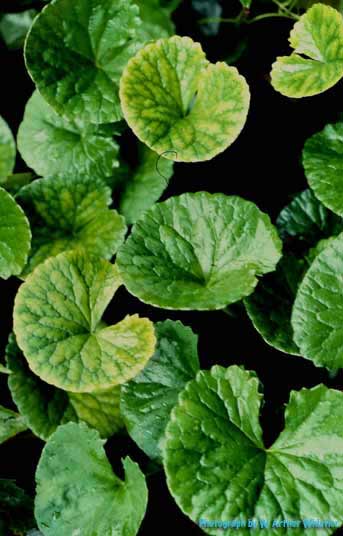
Description: Centella asiatica is a small low-lying herbacaeous plant with creeping stems and many small, kidney-shaped, serrated leaves 2-5 cm (3/4-2 in) wide. New individuals of this plant are produced both by seeds and by runners (clones) at the nodes. The inconspicuous flowers are small, white, and clustered in groups of 3-4.
Distribution: This little, sometimes weedy plant is widely distributed in many tropical areas of the world, including those in the Pacific region. It is common in shady, often swampy areas near the coast, and to a certain extent in inland locations up to about 300 m (~1,000 ft) above sea level. Fosberg et al. (1979) and other have listed this creeping plant as native in Micronesia.
Uses by Island or Island Group: The Asian pennywort, Centella asiatica, has been used in folk medicine in some places for hundreds, perhaps thousands of years, and has become relatively important in scientifically-oriented medicine during more recent times. Parts of this herbaceaous plant are said to have a direct action on lowering the blood pressure and are reputely a rejuvenating medicament. Eaten raw or finely cut, the leaves of C. asiatica can be roasted with scraped coconut, and it is believed by some that these prepared leaves can purify the blood and relieve indigestion, nervousness and dysentery. Indeed, C. asiatica, with its long history of its widespread therapeutic use in Asia, is now becoming popular in other areas of the world for a variety of medicinal purposes:
“Triterpenoid, saponins, the primary constituents of Centella asiatica are manly believed to be responsible for its wide therapeutic actions. Apart from wound healing, the herb is recommended for the treatment of various skin conditions such as leprosy, lupus, varicose ulcers, eczema, psoriasis, diarrhoea, fever, amenorrhea, diseases of the female genitourinary tract and also for relieving anxiety and improving cognition” (Gohil et al. 2010:546)
C. asiatica has long been commonly used by Pacific Islanders traditionally in Polynesia (e.g., Tonga, see Yuncker 1959:208) as well as in Micronesia (see below).
Uses in Palau: C. asiatica is reportedly used for medicinal purposes in the treatment of scabies on the southwest Palauan island of Hatahobei (Tobi Island) where this small, low lying species is known as Hacherent (Black 1968). For more on the potential therapeutic value of this plant in Palau as well as elsewhere in Microneisa see Bagnol (2011).
Uses in Guam: According to Stone (1970:462), C. asiatica is “probably indigenous in Guam, occurring in a variety of open situations both coastal and inland,” and the leaves of creeping herbacaeous plant are “edible, and tender young ones make a nice addition to a green salad.”
Uses on Namoluk Atoll: According to Marshall (1975:43), C. asiatica, known as Mwoi on Namoluk, is an herbaceous species that part of the ground cover in wet shady places and it used medicinally on this atoll: “When burned on a fire, the leaves are used to treat a skin ailment also called ‘mwoi’ on the underside of the foot.”
Uses in Chuuk: The leaves and taproot of C. asiatica (known as Nikótókót in Chuuk), are used in traditional medicine to treat pain in the legs, and the leaves are mixed with the fruit of Nopwur (Morinda citrifolia) to reduce swelling caused by the sting of a porcupine fish. Nikótókót is also used in a medicine for young children. On Puluwat Atoll, this small plant is also said to be used in traditional medicine.
Uses in Pohnpei: On this island the prepared leaves of C. asiatica are reportedly used as food in soups and as medicine for babies and others for a variety of ailments including diarrhea, dysentery, “stomachache when feeling nauseous” as well as burns, a type of skin fungus infection (see Balick 2009: 281, 328-329). In addition, placing drops of juice extracted from pounded leaves of C. asiatica (known as Liwadawad marer on Pohnpei) is reportedly a used to make infants “less afraid of hiccups,” because, in both Pohnpei and Kosrae Islands, hiccups are a sign of a healthy baby” (e.g., see www.comfsm.fm/~dleeling/ethnobotany/centella_asiatica.html, Coltrick Albert, February 2004).
Uses in Marshall Islands: Known in these atoll islands as Mariko, C. asiatica is occasionally found in shady sites near roadsides or paths, often at the bases of coconut palms, but also in home gardens. Although it is now increasingly rare on urbanized islets such as some on Majuro atoll, it is still often abundant on outer islets such as on Kalalen Islet, and on may of the wetter outer atolls. This small plant is used in some therapeutic preparations; for example, it is utilized “medicinally to treat infant jaundice, strength and energy levels of children, and a child’s cough” (Taafaki et al. 2006).