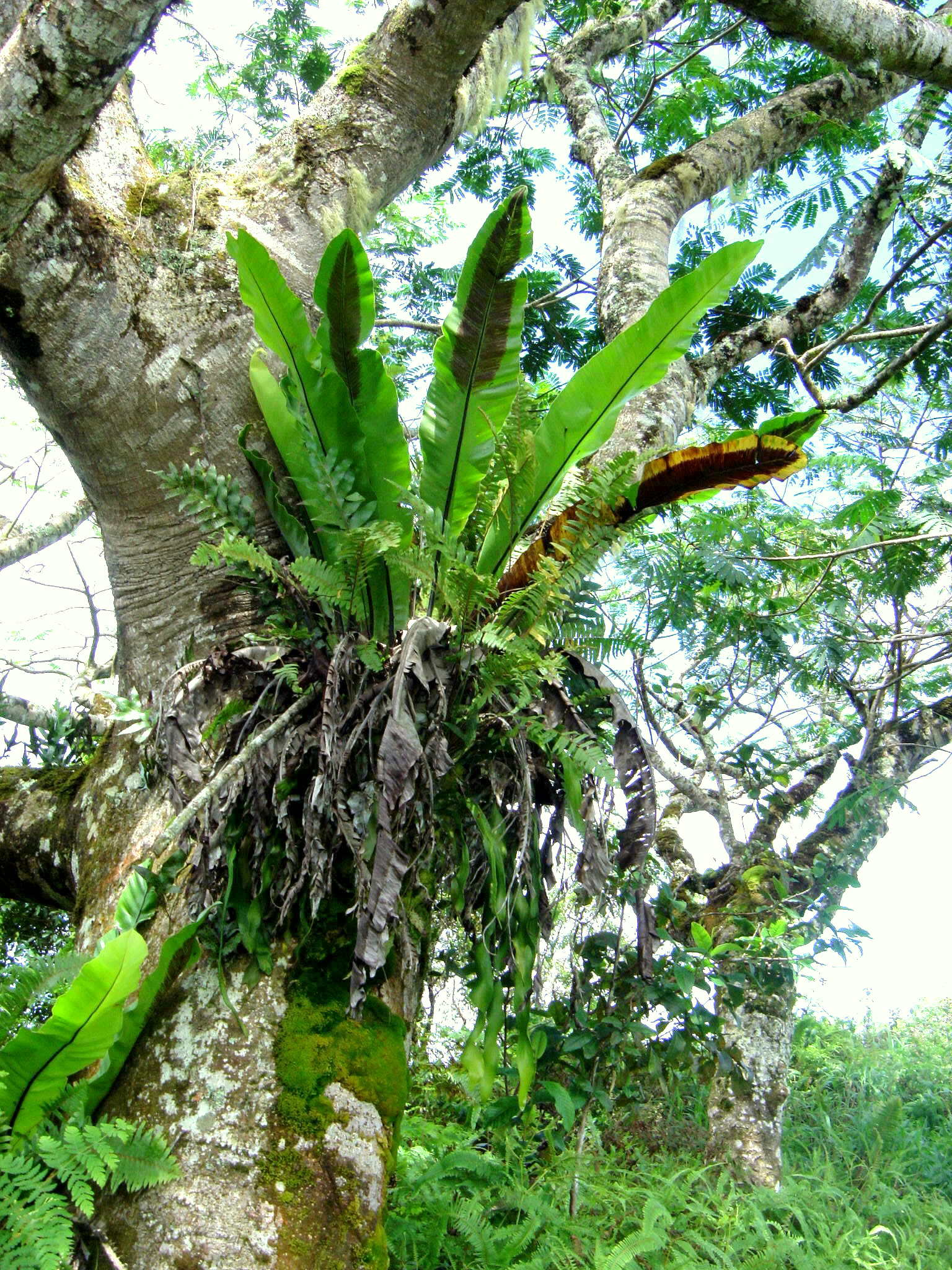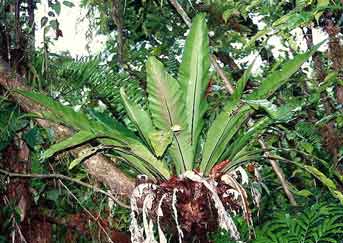
Description: This large, relatively slow growing fern (Asplenium nidus), in the spleenwort family, Aspleniaceae, is known widely in English as the “Bird’s Nest Fern,” developes as an epiphytic (air-plant), perched above ground on other plants, especially trees but sometimes on rocky surfaces which have very poor or no soil; however, it sometimes growths directly on the ground in appropriate terrestrial environments. It can reach heights of 1.2 m (4 ft). It produces a light to dark green rosette or cluster of long, overlapping fronds (leaves) that are smooth, leathery or glossy, and narrow-oblong with undulating, entire margins. The fronds are usually 0.5-1 m (2-4 ft) or more in length, 5-20 cm (3-8 in) wide, with a prominent, well-rounded, dark midrib underneath. Spreading upward and outward, the fronds form a roundish, bird’s nest-like receptacle into which organic matter including leaves of surrounding plants naturally collect. The spore cases have a linear arrangement along the veins on the underside of the fronds.
Distribution: The Bird’s Nest Fern is apparently indigenous to many tropical rainforest areas of Southeast Asia, Australia, Madagascar or beyond to parts of eastern Africa, as well as in many islands in near and remote Oceania, including the islands of Micronesia. It occurs in tropical rain forests at various elevations preferring shady locations from sea level lowland rain forest areas to the upland montane rain forest regions. This fern is also used as a decorative house plant in some temperate countries.
Uses by Island or Island Group: In some areas of Micronesia, especially on atolls, the small, young leaves of the Bird’s Nest Fern (Asplenium nidus) provide ingredients for medicine and for soup. For example, parts of this fern are reportedly used for contraception are in Vanuatu, in eastern Melanesia (e.g., see Bourdy et. al 1996). According to Barrau (1961:57), the young leaves of this fern “are sometimes utilized as food during periods of shortage in Micronesia, the Marshalls, and the Carolines.” In addition to its use as a casual and famine food (also see Thaman 1994:172) and medicine, the large, attractive fronds of this fern are also used as an ornamental, as well as a source of material to line the bottom of preserved breadfruit pits and as temporary roofing for short-term shelters.
Uses in Palau: Bird’s Nest Fern, Asplenium nidus, is known as Bukl or Buklbelúu in Palauan. Bukl means hill or mound of earth in this language, and in Palau (Belau) the Bird’s Nest Fern is often observed “growing out of [a] mound on [a] tree trunk” (Josephs, L.S. 1990:29). The young leaves of this fern are reportedly used medicinally to treat indigestion in Palau (Salsedo et al. 1987).
Uses in Yap and some outer island atolls: Known as Chath in Yap proper, “When bitten by a centipede, fronds [of A. nidus] are pressed and the sap is applied to the bite” (Okabe, see Defilipps et al. 1988). On Ulithi atoll, the Bird’s nest fern (known there as Rokhtaf)reportedly can be used to bring on menstruation, and when combined with the leaves of the large native fig tree (Ficus prolixa), it is used “to treat a serious disease called mai, said to be caused by possession by a tree spirit” (Lessa 1977). On Ifaluk atoll, sections of the roots of the Asplenium nidus (known as Ulenug on that atoll) are pounded together with the husk of the coconut, then heated and used to as a compress to treat anal discomfort due to dysentery; and young girls traditionally used sun-cured fronds of this fern to cover parts of their bodies by tucking them under their belts in front and behind.
Uses in the Mariana Islands: Leaves and roots of the Bird’s Nest Fern have been used in local medicinal preparations in the Mariana Islands, at least on Guam; for example, McMakin (1978:43) reported tentatively that Asplenium nidus (Galak Feda as it is known in the Chamarro language) was one of several species from which parts were used in “Amot tabadiyo, a traditional medicinal combination for the treatment of stroke.” McMakin indicated that the leaves of Galak Feda, the Bird’s Nest Fern, were used in this traditional preparation. Asplenium nidus has also been used as a decoration for wedding parties and for religious rituals known as Novenas in Guam (Moore and McMakin1979). Because it can be transplanted easily and grows well in shady habitats, it has been harvested (even over harvested), on some Pacific Islands such as Hawai’i).
Uses in Chuuk: In addition to its natural growth in rainforest areas of Chuuk, the Bird’s Nest Fern (known in Chuuk as Nnúk) is also planted in lines along the edges of paths as an ornamental, and the leaves can be used to line the bottom of preserved breadfruit pits in Chuuk, and on the outer islands such as Puluwat and Namoluk; today, however, plastic is widely used in place of leaves. In Chuuk the large leaves of Nnúk are sometimes used to make temporary shelters during visits to uninhabited reef islands (Mahony 1973). On Namoluk atoll the leaves are also used to wrap food and in traditional medicine. On Puluwat, tender, young leaves of this fern are occasionally eaten.
Uses in Pohnpei: Parts of the Bird’s Nest Fern (known in Pohnpei as Tehnlik), such as the dark green leaves are consumed “as food and contain a medium amount of provitamin A and a high content of lutein and zeaxanthin” (Engleberger et al. 2003). The leaves of this fern are also used to line breadfruit (mahr) pits to preserve the fermented breadfruit. Epiphytes, such as the Bird's Nest Fern, not only help make cultural offerings more attractive, but also present a larger, more impressive gift; for example, the entire plant is used to decorate yams (Dioscorea sp.) at yam festivals and for kava (Piper methysticum) at sakau festivals. In some cultural events such as feasts, birthday celebrations and burial ceremonies, whole Bird’s Nest Ferns are tied onto the yam. Medicinally, this fern has been used as a contraceptive as well as to treat boils, diarrhea, a pregnant woman’s labor pains and to speed up and ease the birthing process. The fern is also used to treat excessive stomach or uterine pain in both men and women, as well as painful and discolored urination in women (Balick 2009:223-234).
Uses in Kosrae: In the past, similar to Pohnpei, it was important to include parts of or a whole plant of the Bird’s Nest Fern (known in Kosraean as Mihlihklihk) in presentations of prestige items such as kava (Suhka or Seka) and yams (Muhtah). For example, Tehnlik refers to a Bird's Nest Fern which is attached, and may be growing as an epiphyte on kava shrubs or yams vines. Individual ferns of this species were taken from the forest and attached to kava or yam plants to take hold and grow on the new host. These epiphytes not only helped make the offering more attractive, but also present a larger, more impressive gift. The leaves of Mihlihklihk are also used as emergency wrappers on Kosrae.
Uses in Marshall Islands: Small, young leaves of Bird’s Nest Fern (known in the Marshall Islands as Kartōp)provide ingredients for a famine food and a source of medicine. If the leaves of taro plants are not available, the mature leaves of this fern may be used as a wrapping for fish baked in the earth oven (um). Kartōp is also planted in lines along the edges of paths as an ornamental plant in some settled areas of the Marshallese atolls.
Uses in Nauru: An indigenous epiphytic fern on Nauru, The Bird’s Nest Fern (A. nidus) was probably much more common in the past before severe deforestation and excavation for guano deposited greatly altered the plateau in the central part of this raised reef island: “Reported by Burgess as an epiphyte on Calophyllum inophyllumin 1935, but seen only as an ornamental by Thaman, Hassall, and Manner in 1980 and 1981: (Thaman et al. 1994:34).