


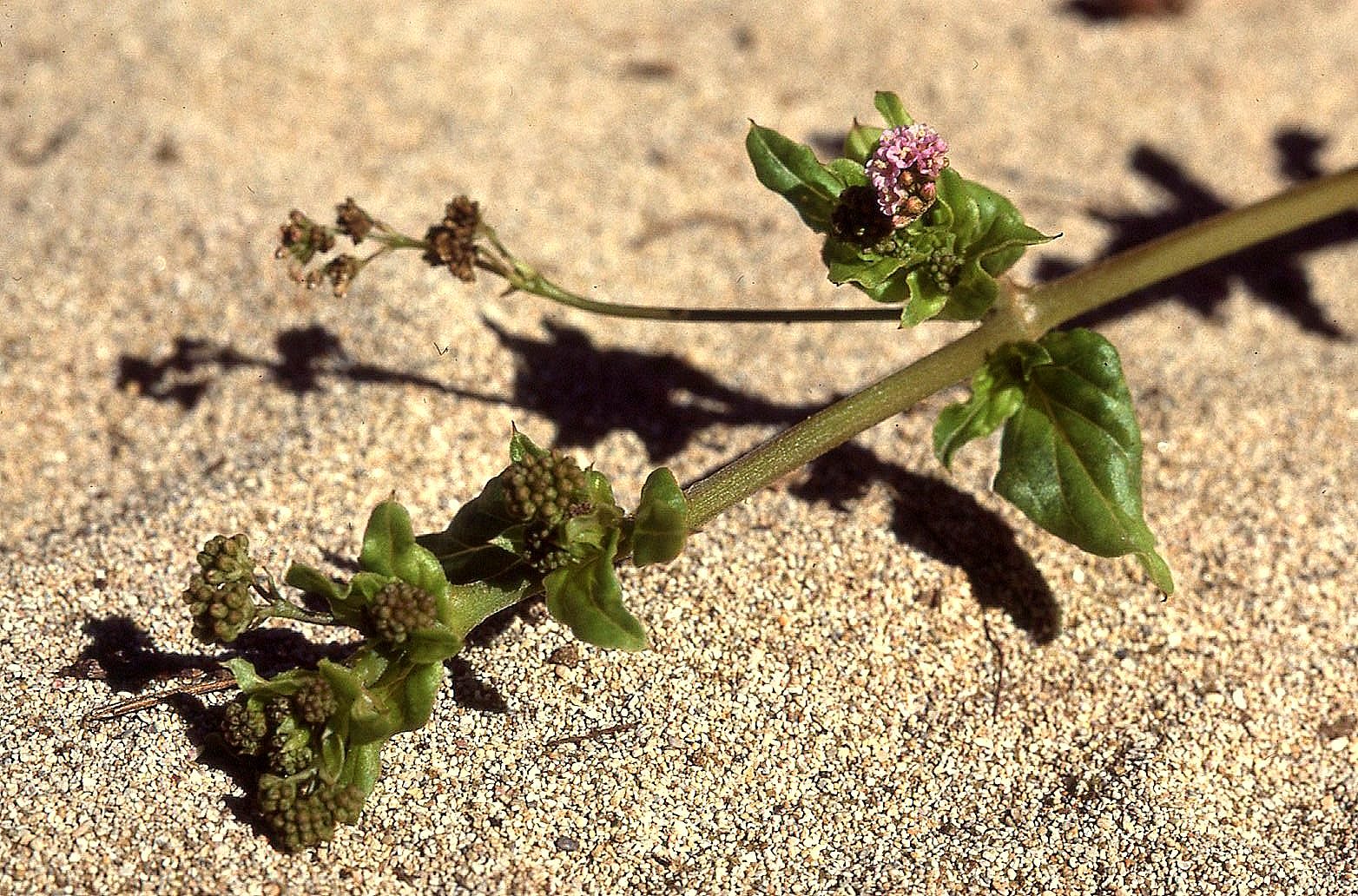
Description: This slender, low-lying Boerhavia herb produces mats of stems up to 1 m (3 ft) long from a thick taproot. It has tiny, lavender to white or pink flowers.
Distribution: This low-lying herb is a member of the "four o'clock family," Nyctaginaceae. On the atolls of the Marshall Islands there are reportedly three species of Boerhavia which are all supposedly native to these islands: B. tetrandra (found on most atolls); B. repens (found on several atolls); and B. albiflora (only found on a few atolls). These species are all common in many tropical regions of the Pacific, where they grow in sandy or rocky places near the shore. B. diffusa is widely dispersed in tropical and subtropical habitats, occurring, for example, throughout much of South Asia, the Pacific, and southern United States. Its wide spread distribution is largely due to its small fruit, which are very sticky and grow close to the ground, and therefore become stuck to small migratory birds or other animals such as humans rather easily as they walk over or close to these plants.
Uses by Island or Island Group:
Uses in Marshall Islands: Dāpijdekā (Boerhavia sp.) is used for medicinal purposes in the Marshall Islands. The Marshallese name for this herbaceous species (Dāpijdekā), refers to its small pink flowers, which are regarded as similar in color to corned beef.
Uses in Kiribati: “B. diffusa and B. tetrandra are used as food for hogs” (Moul 1957). Catala (1957) refers to B. diffusa as plant used to feed both pigs and chickens, as well as a drug for medicine and poison; for example, in treatment of a disease called Te ba (rickets?), leaf petioles are crushed and boiled in toddy. In addition, the leaves of this plant are utilized in compost prepared for cultivation of babai (large swamp taro, Cyrtosperma merkusii).
Uses in Banaba: Thaman and Samuelu (2016:87) refer to the Boerhavia species on Banaba as indigenous “Boerhavia repens L. Synonym: Boerhavia diffusa sensu auct non L.” with a Banaban name of “te wao” (the same as their listed Kiribati Name: “te wao”); Thaman and Samuelu note that this Boerhavia species is an occasional weed found in “houseyard gardens, food gardens, roadsides, waste places, and ruderal sites.” These authors also indicate that this Boerhavia species is fed to pigs and “used as a vegetable in time of food scarcity,” while the leaf petioles are “crushed and boiled in toddy to treat te ba (rickets?).”