Micronesian Names by Islands or Island Groups: Bambuu or Esel (Palau), Moor (Yap), Pi’ao, Piao Paloan or Patnitos Piao (Mariana Islands), Iich or Pwaaw (Chuuk), Pehri or Pehri en sapahn (Pohnpei), Bambu or Alkasrem (Kosrae), Bae, Koba (Marshall Islands), Te kaibaba (Kiribati), Embarabaraba (Nauru), Ebarabaratu (Banaba)
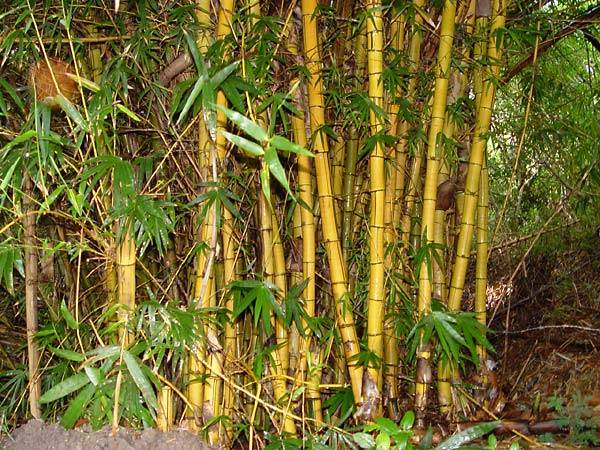
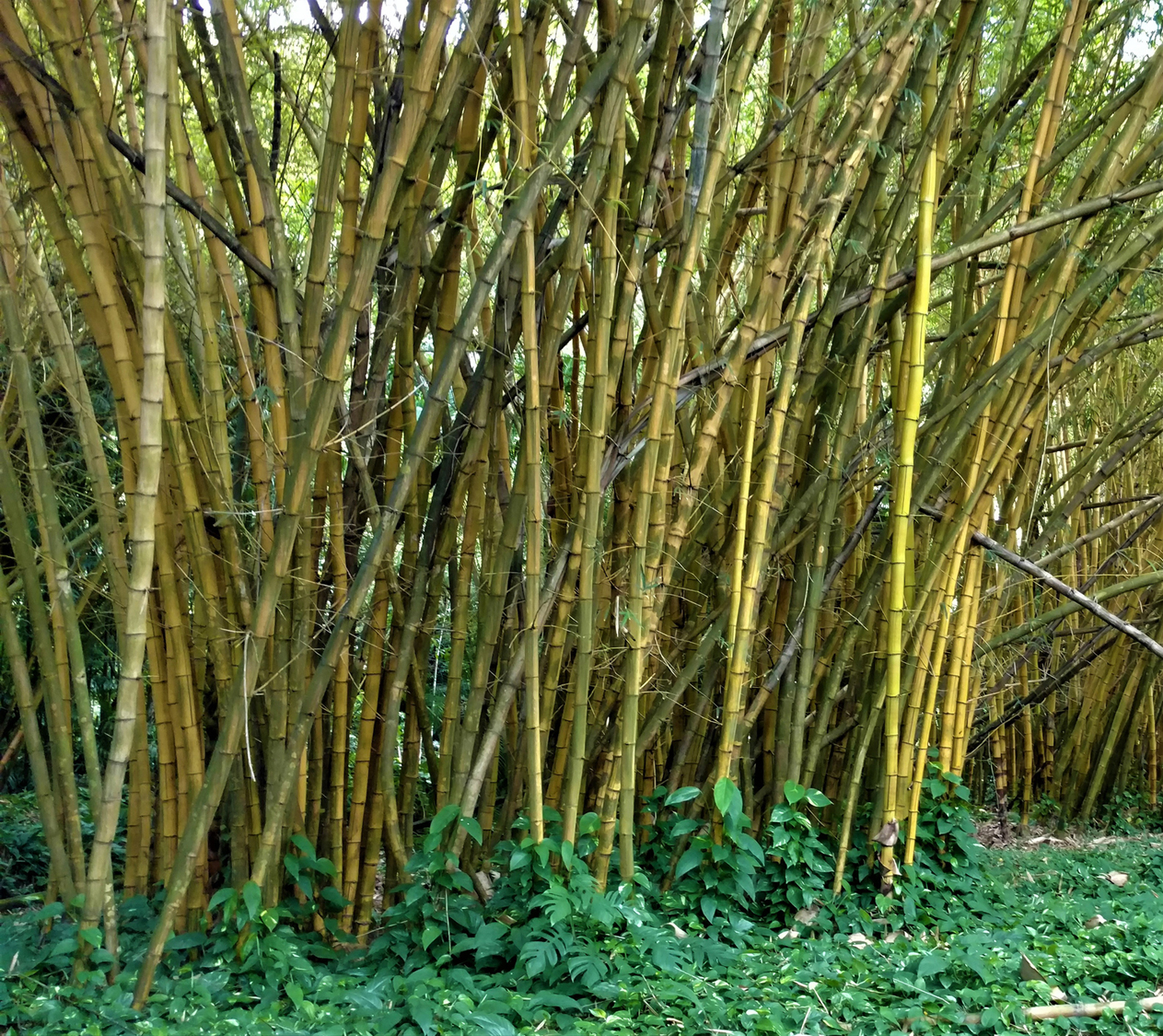
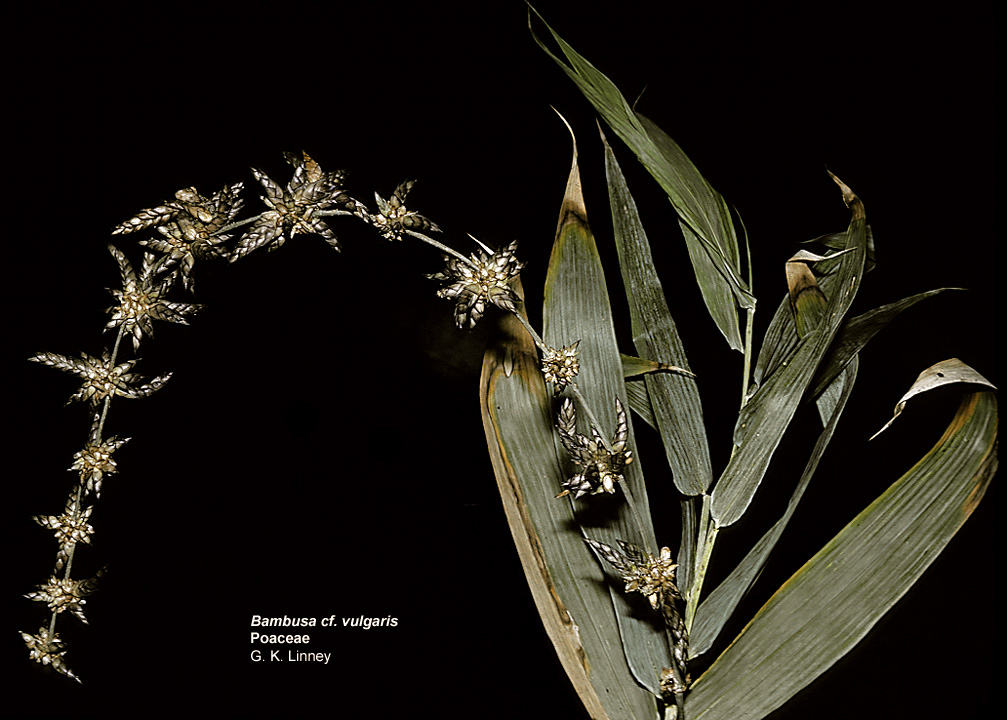
Description: All bamboos belong to the grass family. Bambusa vulgaris is a common, large-stemmed bamboo in the Pacific. This huge, woody, segmented, perennial grass grows in clumps and has short, thick rhizomes. Its green to yellowish stems usually grow erect but sometimes arching to heights of approximately 15 m (50 ft) and are about 10 cm (4 in) wide with moderately thick walls, no spines, and slender branches. When this bamboo does flower (which is only very occasionally), it produces large, leafy floral clusters at the stem nodes.
Distribution: This large, useful bamboo species is native to tropical Asia and was probably brought to Yap and other tropical Pacific Islands soon after the early arrivals of Europeans. It is planted and in some situations has become naturalized (growing and reproducing on its own), often forming large stands, especially in areas with alluvial soils and sufficient available water. Schizostachyum lima (Puw) is a smaller species of bamboo that is native in Belau and Yap. Cultivated widely in warm regions, this species probably originated in India or in Indonesia.
Uses by Island or Island Group: Bamboo plants have an extraordinary number of uses in the tropical areas where they occur. The bamboo’s woody stems are widely used in construction, fencing, handicrafts, making rafts, cages, knives, net-mending needles, fishing poles, floats for fishing nets, fruit-picking poles, irrigation conduits, musical instruments, fencing, containers for food, water, cooking food over an open fire, and as fuel wood (e.g., see Clarke and Thaman 1993). In addition, some parts of bamboo are used medicinally; for example in areas of the Federated States of Micronesia leaves of the Bambusa plants are commonly used to stop bleeding (Wilkinson and Elevitch 1994).
Uses in Palau:According to Otobed (1968), bamboo stems, including those of Bambusa vulgaris have been used traditionally to make the walls and floor of bub a Palauan fish trap:
“After the frame is put together, bamboo strips are strewn on about one inch or less apart from one another. These strips are held together by either coconut cordage, or the stems of the pitcher plant.”
Informants told Johannes (1981) about rafts, generally made with large bamboo stems, and how they have been traditionally used in Palau:
“Palauans use two types of rafts, and they are mainly just for fishing activities near the shore. We don’t use rafts offshore, offshore we would use a canoe. Rafts are very good because they can go in inches of water. And it’s very stable and practical. Fishing on the raft, you are wet all the time— is pretty much just going through the water—so you have an elevated platform where put your gear. One kind is more for large community-oriented activities, and the other is just a smaller, more individual one for father or son to go fishing. That is mainly a utility transport for spear fishing, harpooning and such. Then there’s one we call olechútel, that’s a larger one to carry either the coconut fronds that’s used for sweeping the fish, or they’re used to carry stones to build weirs. It’s a utility transport.”
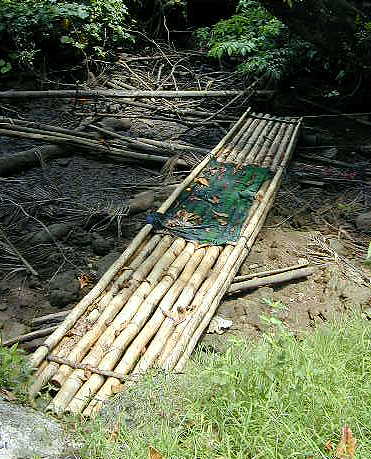
Uses in Yap: The long wide stems of this common bamboo (Bambusa vulgaris known as Moor on Yap) are used to make the two basic types of common rafts, wupqeb - the large bamboo raft for heavy loads, and faafat, the small bamboo raft for smaller loads. These rafts are sometimes used for fishing or scuba diving. Sections of bamboo stems are also traditionally used as containers (also known as moor) for lime used in the process of “chewing" betel nut in Yap. Fish traps (saagel) and net spacers (yir) are also made out of bamboo, and the end of bamboo “sticks” (chapin) are used in Yapese stick dances. Falanruw (1992) referred to the protective treatment of bamboo stems used in the making of fishing nets; the stems are submerged in salt water for “about a week to a month,” but if they remain submerged “too long they will spoil.”
Uses in the Mariana Islands: Thompson (1945) referred to use of bamboo poles in rafts and house walls on Guam:
“My informants in Guam said that rafts made of bamboo slats, lashed together, were used to cross rivers, until the recent construction of bridges by the Naval Government. I saw no such rafts on the island. Probably the bamboo raft was a survival from ancient times...and house walls were constructed of planks of split bamboo.”
Thompson (1945) also referred to special traditional structure made by the native Chamorro people of the Mariana Islands:
“The sadigane is a double lean-to, with the ridgepole supported by two median posts. The coconut-leaf thatch is lashed to bamboo rafters, extending from the ridgepole to the ground. The floor is composed of bamboo or betel palm logs.”
According to Moore and McMakin (1979:86), durable poles of B. vulgaris bamboo were previously used extensively in hose construction, but are still utilized to construct temporary “fiesta” structures as well as for fencing and fishing poles. It has also been reported that fish traps in the Mariana Islands were often made from bamboo (species?) stems “that have been heated over hot charcoal and then stretched into the proper shape” (Anderson-Taft 2015).
According to Moore and McMakin (1979:86), “the young shoots of bamboo are edible, but must be boiled and drained several times to release an irritant contained in the tissues.” In addition, McMakin (1978:43) reported tentatively that Bambusa vulgaris (“Patnitos Piao”) was one of several species from which parts were used in “Amot tabadiyo, a medicinal combination for the treatment of stroke.” McMakin indicated that the “sprout” of this bamboo species has been used in this traditional preparation.
Uses in Chuuk: Bamboo (Iich or Pwaaw) was introduced to Chuuk because of its many uses. For example, the stems of bamboo are used to make rafts, water catchment materials, whistles, sleeping platforms, fishing poles, floats for fishing nets, and boat poles.
Uses in Pohnpei: For food in Pohnpei, young stems of bamboo are cleaned, cut up, and mixed into soups, and the young shoots are also eaten. The long stems are used as pipes to move water from one place to another. In addition, mature bamboo stems are used to make in rafts and fishing poles. The young stems are used as a trellis to support growing yam (e.g., Dioscorea alata) plants “Sharpened tips of the stems were used in traps for enemies during war and small stems were used as the barrel of airguns,” and parts of bamboo are used as a contraceptive as well as to make hair grow thick, shiny, and healthy (see Balick 2009).
Uses in Kiribati: The long, flexible bamboo stems of this giant grass species are used to make “fishing rods for very small fish” and serve as floats for fishing nets. (Catala 1957; Merlin 2002).
Uses on Nauru: The giant clump-forming Bambusa vulgarisis known on Nauru as Embarabaraba. It appears to have been introduced before World War II. It is cultivated on the coastal strip. Its woody stems are “used in the construction of perches for pet frigate birds, for fishing rods, net handles for noddy-bird nets and reef and flying-fish nets,” while splinters extracted from the stems of this bamboo species have traditionally been “used in the past to mend fishing nets,” and parts have been “used medicinally” (Thaman et al. 1994).
Uses on Banaba: A species of Bambusa, “probably Bambusa vulgaris Schrad. ex J. C. Wendl. which is the most common bamboo in Fiji and elsewhere in the Pacific,” is a recent introduction to Banaba Island where it is relatively uncommon; this huge grass species has been observed “growing in a number of houseyard gardens in the main settlement and in villages on the southwestern side of the island,” and its long stems are “used to make fishing poles and bird nets” (Thaman and Samuelu 2016:47).