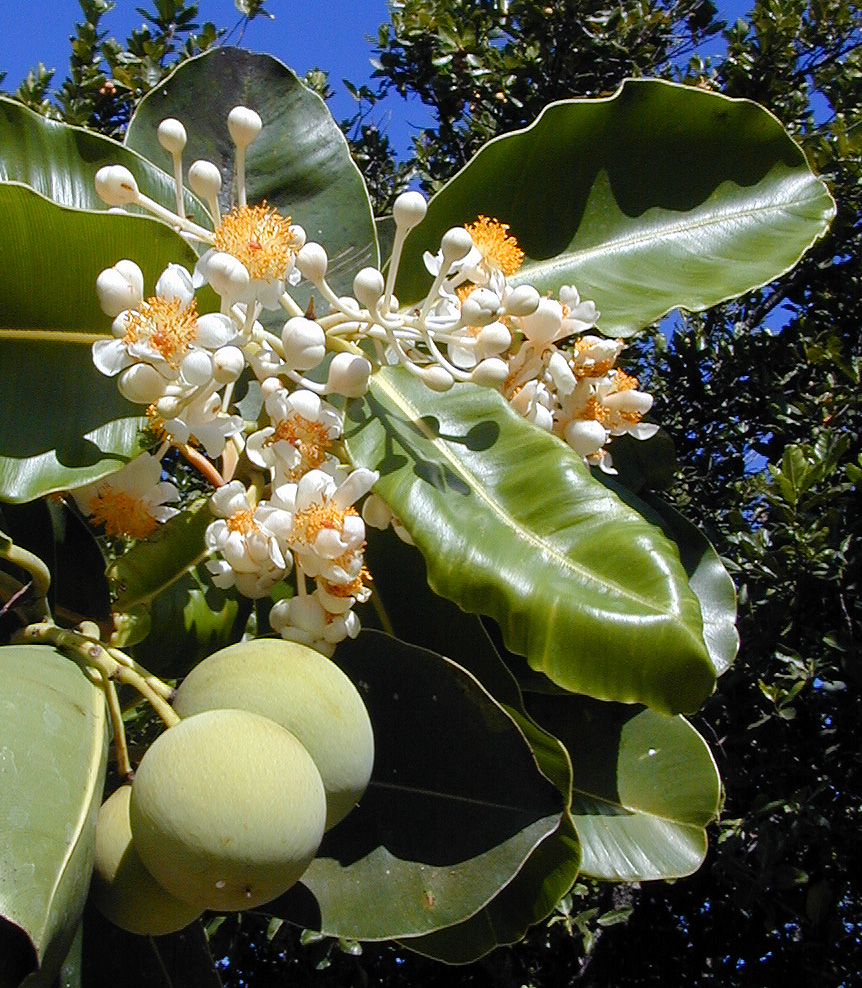
Description: Calophyllum inophyllum is a medium-sized to large, slow-growing tree with very hard wood that can reach heights of 20 m (65 ft). Typically, this tree species produces a broad, low-branching, spreading crown. The simple, glossy leaves have many parallel, obliquely lateral veins; and the fragrant flowers are white with yellow stamens (male sex organs) in the center. The spherical fruits are about 2.5 cm (1 in) or more wide and hard like golf balls. The green fruits turn yellow when mature with a thin leathery skin covering a “bony shell” (Taafaki et al 2006). The kernel of the fruit is somewhat toxic and oily.
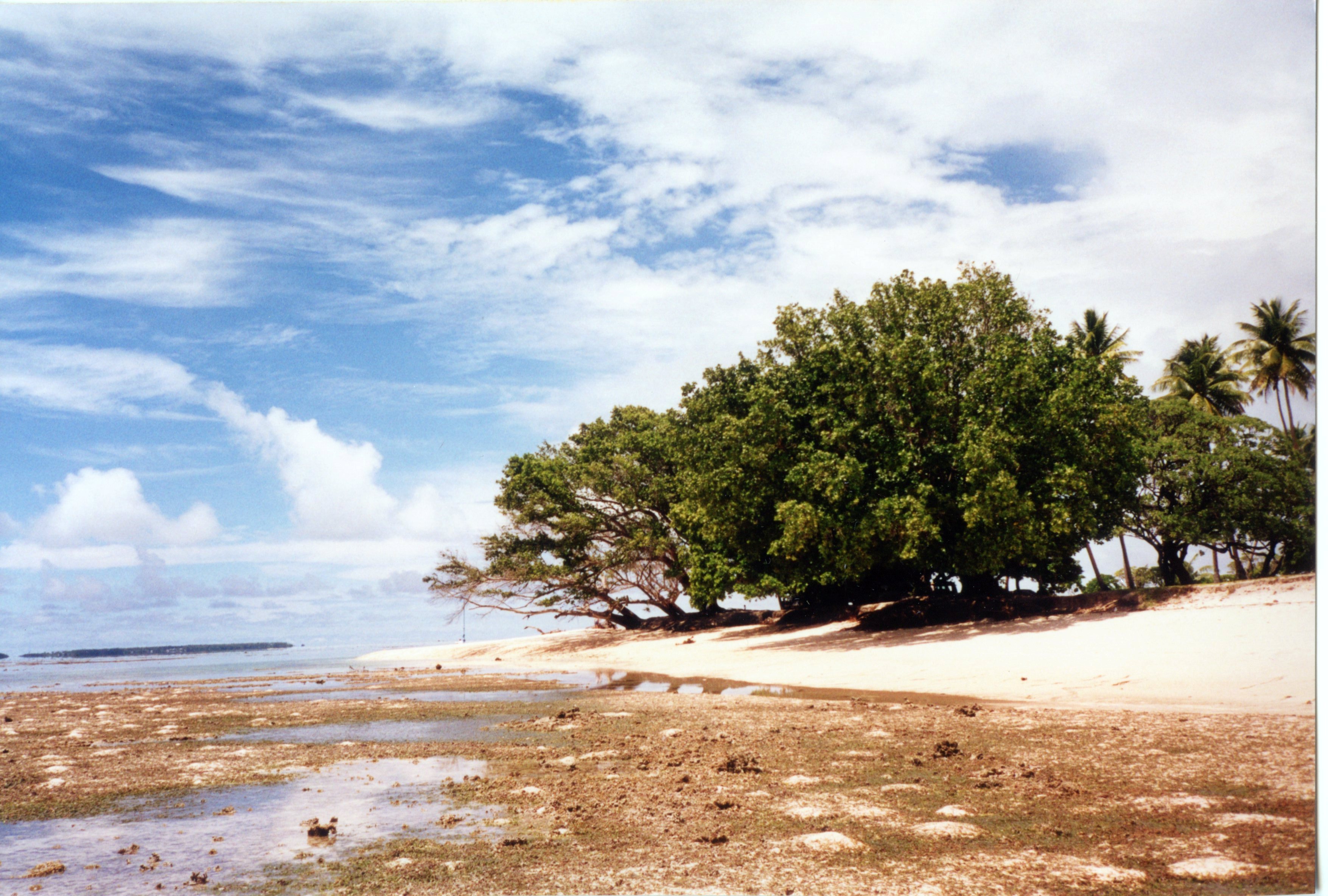
Distribution: Calophyllum inophyllum is a widespread, useful tree believed to be a wide ranging indigenous tree species “from tropical Africa to eastern Polynesia and Micronesia, but is possibly an aboriginal introduction to some islands” (Clarke and Thaman 1993). Indeed, it probably was brought to more than one of the islands of Remote Oceania, including some in Micronesia, by early humans who discovered and settled these far flung islands. On the other hand, in the case of islands in the western regions of Micronesia, this tree may have been native and dispersed by large bats such as “flying foxes” (Pteropus spp.). For example, we know that the Marianas flying fox (Pteropus mariannus, an endangered species, primarily due to human consumption) has been a primary disperser of large fruits on Pacific Islands where they exist, or did in the past (e.g., see photos of feeding on C. inophyllum fruit on the island of Guam: https://www.sciencesource.com/archive/Marianas-flying-fox-(P.-mariannus)-with-fruit-SS2726980.html). In any case, C. inophyllum grows equally well in the strand vegetation close to ocean shores or in lower elevation locations inland, developing best in well drained, sandy soils (e.g., see Friday and Okano 2006a). Traditionally, C. inophyllum is a very important plant on atolls where it is often planted by seed as a windbreak near both the ocean and lagoon sides of the islets providing relatively easy access to a valued timber resource.
Uses by Island or Island Group: This ethnobotanically important, but slow growing tree is common to abundant in coastal forests and is the dominant component of the pre-phosphate-mining vegetation of Nauru, Banaba (Ocean Island), and Makatea (in the Tuamotu Archipelago). It also occurs in somewhat lowland forests on atolls and high islands; and occasionally C. inophyllum is “planted or protected in inland gardens and home gardens and planted along roadsides” (Clarke and Thaman 1993). This tree species provides good timber for construction of several things including, very significantly, canoes (especially on atolls); and its leaves and the oil extracted from its seed, have some medicinal qualities that were widespread in their applications within traditional Pacific cultures. Furthermore, preparations using latex extracted from its bark is reportedly used in some areas to poison rats and stun fish; however, today C. inophyllum is best known in some areas as a large, hardy ornamental plant because of its decorative leaves, fragrant flowers and spreading canopy crown that provides shade (e.g., see Friday and Okano 2006).
Uses in Palau: The hard, durable wood of C. inophyllum (Btaches as it is known in Palauan) is used for canoe building and reportedly trees of this species have been cultivated especially for materials to make canoes, coconut husking sticks, and swamp taro harvesting implements. In addition, the fragrant C. inophyllum flowers are occasionally are used in garlands or leis (Cynthia Chin, personal communication, 2001, also see Tuyama 1941). Today it is used as a favorite wood source to make traditional story boards in Palau (Friday and Okano 2006). According to Okabe, the young leaves of this tree “are eaten to relieve stomach ache” (see Defillips et al. 1988).
Uses in Yap: C. inophyllum is known as Biyuch or Biyuuch in Yapese, and “the name ‘ftow’ is applied to a locally recognized form” in Yap where this tree has been referred to as the “most important hardwood species” (Falanruw 2015:68). As a coastal, lowland woody species, C. inophyllum provides excellent timber used in construction of canoes and other types of boats, as well as to make coconut husking sticks, grater frames (Choi') for coconut (Niiw) and pandanus fruits, pounders for taro, banana, and breadfruit, house frames and pillars, pig and chicken pens, and in the fabrication of many types of handicrafts. In addition, on Yap, the bark of C. inophyllum is used as shingles for house walls (Friday and Okano 2006) and its timber is also used for firewood. Furthermore, parts of this tree are also used as a source of medicine, and the attractive smelling flowers are sometimes woven into garlands. In addition, children are said to use the smooth, round fruits to learn how to juggle, and some of the largerC. inophyllum trees “served for many generations as markers of boundaries and historical sites until they were recently cut down for sawmills” (Falanruw 2015:68).
Uses on Ulithi Atoll: The wood of C. inophyllum is used traditionally on Ulithi Atoll (or by Ulithians living on Yap proper) in canoe construction which is “the highest expression of Ulithian craftsmanship.” In addition, the wood of C. inophyllum tree is used to make tattoo instruments, adze handles, and the traditional spear used by the Ulithian wave magician; Lessa (1977:165) also reported the following uses of C. inophyllum on Ulithi Atoll:
“Smoke from the burning nuts of the tree is caught on wood and used as a tattoo pigment. The gum of the tree is sometimes used for “shaving,” being put on the fingers and face to pull out beard hairs. The fruit is one of eight fruits placed in the ‘flying fish bundle’ offered to spirits by public fish magicians during their lengthy annual ritual.”
Furthermore, the bark and leaves of C. inophyllum are also reportedly used in traditional medicine on Ulithi Atoll.
Uses on Ifaluk Atoll: In addition to being a very important source of wood to make “houses, food bowls, canoe hulls and endpieces, outrigger booms, paddles, and mast heads,” on Ifaluk Atoll, the flowers of C. inophyllum are used in garlands, while “the leaves are used to wipe off excess breadfruit gum caulking from canoes,” and the bark is used medicinally for fever or general weakness (Lessa 1977:165-166).
Uses on Guam: In Guam, Safford (1905:385) reported that C. inophyllum wood “was used to make “the solid wheels of the carts drawn by bullocks and carabao,” and because it “is durable in water, but is so rigid that it cannot bend.” The wood of this coastal tree is also used for carving in Guam, as well as construction of buildings (Thompson 1945) and canoe parts, and because it is said to be highly typhoon resistant, C. inophyllum is regarded as an excellent wind break. This ethnobotanically important tree is also reported as present in some of the Northern Mariana Islands.
Uses in Chuuk: The hard, durable wood of C. inophyllum (known in Chuukese as Rakich) provides excellent timber used in construction of canoes and other types of boats. It is also used to make coconut husking sticks, frames of coconut and pandanus graters, pounders for taro, banana, and breadfruit, house frames and pillars, pig and chicken pens, and in the fabrication of many types of handicrafts, including chairs, tables, and musical instruments. In addition, in Chuuk, Rakich wood is used to make large ceremonial bowls used in the inauguration of a new chief (or governor in modern times), as well as to make breadfruit pounding boards, clubs, and canes. The fragrant fruit is used in garlands and the crushed leaves are rubbed on the outside of a new canoe hull after it is painted to secure the fresh paint. The bark is used for medicine to “keep evil spirits away.”
Uses on Namoluk Atoll: According to Marshall (1975), on this atoll, the wood of C. inophyllum (known on this atoll as Rakich) also has many traditional uses in construction of “canoe houses and dwellings, carved bowls, goggles for spearfishing, canoe paddles, outrigger struts, and certain other canoe parts,” and the “soot from the wood is rubbed into tattoos; the flowers are used in leis and to scent homemade perfume; [and] the leaves and bark are employed medicinally.”
Uses on Puluwat Atoll: On Puluwat, like many other islands in Micronesia, the wood of C. inophyllum is used to make some parts of canoes and for several other uses; and the flowers are strung into garlands.
Uses in Pohnpei: Besides providing excellent timber, the fragrant flowers of C. inophyllum (known as Isou in Pohnpean) are used in mwaramwar (garlands worn on the head) and its sap is applied as glue. In a Pohnpeian chant for breadfruit, Mei, the fruits of Isou (C. inophyllum) are said to resemble small breadfruit. Some believe that this culturally important tree was introduced to Pohnpei by people because the word sou means “migrant.” As suggested above, this tree, a source of very hard and useful wood, may have been brought to Pohnpei and some other Micronesian Islands by either the early humans who discovered and settled on these islands, or by early European settlers. On Pohnpei, the sap or latex from a large stem of this tree is sometimes “boiled and used as glue to seal the glass in making diving goggles (the ones with a wooden frame),” and sap is also “used as a type of caulk” presumably for canoes (e.g., see Balick 2009).
Uses on Pingelap Atoll: According to St. John (1948), the vernacular name for this tree on Pingelap Atoll is Sepang,which“may be geographic, referring to Saipan Island.” St. John noted that C. inophyllum was relatively rare on Pingelap, found on the upper margin of the beach; he also reported that the wood was used in canoe hull construction and the fruit had medicinal use and was “a source of oil.”
Uses in Marshall Islands: On these reef islands, planting C. inophyllum (known as Lukwej or Lueg in Marshallese) for the purpose of providing shade and shelter was systematically encouraged during German times. This tree is still often planted for cover and timber along settled lagoon shores. The hard, durable wood of C. inophyllum provides excellent timber that is used in the construction of canoes and other types of boats in the Marshall Islands. It is also used to make coconut husking sticks, frames for coconut (Ni) and Pandanus (Bob) graters, pounders for cooked taro, bananas and breadfruit, house frames, pig and chicken pens, and in the fabrication of many types of handicrafts including chairs, tables, and ukuleles. Furthermore, it is also important source of firewood. The fragrant Lukwej (C. inophyllum) flowers are used in garlands, as well as being added, for its scent, to coconut oil. Children sometimes use the hard, round fruits of this tree in games or as toys. The leaves of Lukwej are sometimes used in a medicinal eye wash preparation; in this case, its leaves are mixed in a bucket of cold water, then each morning and evening for three days the afflicted person puts his or her face under the water in the bucket and opens his eyes. Some people believe that “ghosts” live under Lukwej trees.
Uses in Kiribati: Thaman (1990) reported on the distribution and uses of C. inophyllum (known as Te itai on the atolls of Kiribati):
“Occasional around villages and towns, reportedly much more common in the past; a sacred tree in the past on Tabiteuea; wood used for bow pieces and ribs of canoes, canoe paddles, diving goggles, and in house construction; stems for scoop net frames; tissues inside nut are crushed for the oil which is spread on sores; juice from the roots used to cure headaches; fruit also used medicinally for morning sickness, chicken-pox, and conjunctivitis; skin and outer flesh of fruit eaten; fragrant flowers used in garlands and to scent coconut oil.”
Moul (1957) also indicated that the lumber from C. inophyllum was formerly used in canoe building, e.g., to make the keel and stems of a canoe, but because of the relative scarcity in “modern times [middle of the 20th century], it is being used only for canoe paddles.” On the other hand, according to Luomala (1953), “sticks from this tree species were used to make scoop net frames for fishing, the fragrant flowers were used in garlands, pipes were sometimes made for the wood, and its leaves were put into an infusion used for drinking or bathing to cure fever.” In addition, Catala (1957) referred to C. inophyllum as a tree used in Kiribati as a building material for houses, canoes, fishing rods, diving goggles etc., as well as for medicinal and ornamental purposes mainly for making leis.
Uses in Nauru: C. inophyllumis a still very abundant tree in Nauru where it was the “dominant large tree” in the forest vegetation of the original pre-mining plateau (“topside”) of the island, especially “on escarpment slopes and on coastal strip.” Wood from this tree “provided the best wood for house posts (iyor, yor), furniture, woodcarving and for canoe hulls in the past; [its] sticky sap (erebeniyo) was used for caulking canoes; [the] kernel of [its] green and mature fruit (i kuan iyo) [were] crushed to yield oil…applied to hair to make it long and black; [and its] old decayed fruit [were] skewered on coconut midribs (engow) in past and burned as traditional Nauruan light [while its] mature fruit [were] burned as a mosquito repellent” (Thaman et al. 1994:115).