


Family: Malvaceae
Devil's Cotton
[Abroma augusta (L.) L.f.]
Mark Merlin
Common or English Name: Devil’s Cotton
Micronesian Names by Islands or Island Groups: Lab (Palau), Rap (Yap), Tupunuwon, Tupuol (Chuuk)
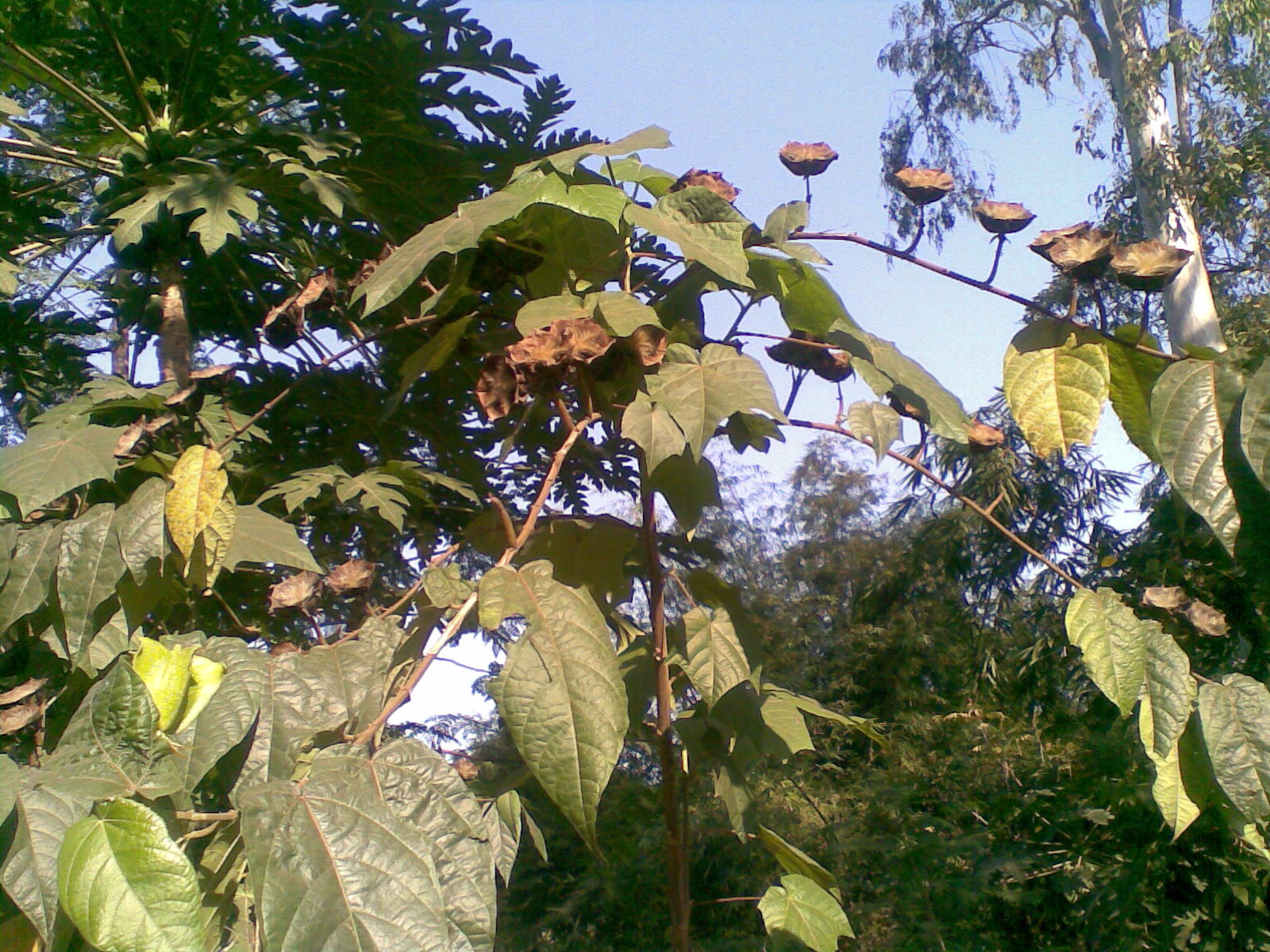
Description: Abroma augusta, or Devil's Cotton, is a shrub or small evergreen tree that can reach 2.5 m (10 feet) in height with very little canopy spread. The leaves can be up to 20 cm (8 inches) across and are 3-5 lobed with very distinct palmate veins. The leaves and stems are covered with soft bristly hairs that are very irritating when touched. The bark yields a jute-like bast fiber which is collected from the phloem - the “inner bark” or the skin of the plant. A. augusta can be cultivated: it needs full sun to partial shade with a rich well-drained soil mix. It is very fast growing, but during the winter months, water should be somewhat restricted, however not to a point where the tree loses leaves. Plants normally bloom from late spring to early summer, producing dark maroon flowers growing into terminal panicles. Individual flowers are up 7.5 cm (3 in) wide.
Distribution: Abroma augusta is a shrub or small tree indigenous in tropical regions of Southeast and South Asia to Australia, and possibly to the Western Caroline high islands (e.g., see Space et al.). Kanehira (1933:368) noted that A. augusta could be found in Micronesia “in thickets and waste places at low altitudes.”
Uses by Island or Island Group: The root bark of Abroma augusta is used in a uterine tonic and for a variety of menstral problems regulating irregular menses and pain in some tropical regions. In addition to the use of fresh viscid juice of the root bark, the leaves and stems, petioles and leaves of A. augusta are used medicinally in areas of tropical Asia and also reportedly in some parts of the Western Caroline Islands of Micronesia. In addition, in the bast (inner stem bark) fibers of A. augusta was used traditionally in the weaving of women’s skirts (see below) in some Micronesian societies.
Uses in Palau: Although the use of the commercially produced cotton and other types of yarn has more or less eliminated the tedious collection and preparation of natural fibers obtained from locally growing plants species in Palau, the bast fibers of the small Abroma augusta tree were used in production of traditional Palauan grass skirts:
“In Palau, in [the] late 1800’s, Mr. Johann S. Kubary, the Polish ethnographer wrote: ‘the most important banch of the fiber industry is making the ‘kariuth’, the women’s skirts. They make up the entire dress of women; are made in many different patterns, being characterized by their appropriatness, as well as by excellence of the work. In this respect, by their variety, they far surpass similar products of the other ilsands of the Pacific known thus far” (Salmi-Saslaw 1988:195, Citing Kubary 1885:212).
During the time that Salmi-Saslaw (1988) carried out her research on these skirts for the Palau Museum (1975-1977), the use of the traditional cheriut skirt was restricted by then to certain ceremonies such as “the first child ceremony, ngásech and dance performances.” Salmi-Saslaw (1988:198) described the basic parts of these skirts and the highly desirable bast fiber extracted from A. augusta bark or other sources for making these traditionally important garments:
“The Palauan skirt has a front half, medal a cheriut (Plate I, Figure 2) and a back half, btil a cheriut (Plate I, Figure 3). Both parts have a center section, chelechedal, and appendages, olodelel, at either side. The back half also has two special appendages, olbingkill, shaped into knots, delibuk, near the top. Materials for these parts differ with few exceptions. The most valued fiber for appendages comes from lab, a Cocoa family tree (Abroma augusta), if available” [note A. augusta is now lumped into the Hibiscus family, Malvaceae, to which the more readily used fiber tree, noted below, also belongs]. The more easily available fiber is processed from chermdáll, Sea Hibiscus tree (Hibiscus tiliaceus). Sometime lab [Abroma augusta] is replaced by chucháb, (Columbia burrettii) and chermdáll by chelsáu (Trichospermum ledermannii). All of these trees provide a fine bast fiber which can be back-combed to attain the desired wispiness for the appendages [Salmi-Saslaw (1988:205) also noted that the Lab tree, A. augusta, “is well known on Peleliu and Angaur” two raised coral reef island of Palau].
In addition to its traditional importance in construction of Palauan skirts, the roots of A. augusta have medicinal uses; for example, Okabe (1941-43; see Defilipps et al. 1988) referred to the use of its roots for disease and as a kind of stimulant in Palau. However, its spines are reportedly poisonous and should be avoided.
Uses in Yap: According to Okabe (1941-43; see Defilipps et al. 1988),parts of A. augustatree have also been use medicinally in Yap. For example, according to Okabe (1941-43; see Defilipps et al. 1988:18-19), in Ugiri District of Yap, “As an emetic, the hard leaves” of Eugenia javanica Lam. [“Rose Apple,” syn. Syzygium samarangense] “are crushed together with old leaves of Abroma augusta, and the sap is taken with coconut milk from time to time.”
Micronesian Names by Islands or Island Groups: Lab (Palau), Rap (Yap), Tupunuwon, Tupuol (Chuuk)
Description: Abroma augusta, or Devil's Cotton, is a shrub or small evergreen tree that can reach 2.5 m (10 feet) in height with very little canopy spread. The leaves can be up to 20 cm (8 inches) across and are 3-5 lobed with very distinct palmate veins. The leaves and stems are covered with soft bristly hairs that are very irritating when touched. The bark yields a jute-like bast fiber which is collected from the phloem - the “inner bark” or the skin of the plant. A. augusta can be cultivated: it needs full sun to partial shade with a rich well-drained soil mix. It is very fast growing, but during the winter months, water should be somewhat restricted, however not to a point where the tree loses leaves. Plants normally bloom from late spring to early summer, producing dark maroon flowers growing into terminal panicles. Individual flowers are up 7.5 cm (3 in) wide.
Distribution: Abroma augusta is a shrub or small tree indigenous in tropical regions of Southeast and South Asia to Australia, and possibly to the Western Caroline high islands (e.g., see Space et al.). Kanehira (1933:368) noted that A. augusta could be found in Micronesia “in thickets and waste places at low altitudes.”
Uses by Island or Island Group: The root bark of Abroma augusta is used in a uterine tonic and for a variety of menstral problems regulating irregular menses and pain in some tropical regions. In addition to the use of fresh viscid juice of the root bark, the leaves and stems, petioles and leaves of A. augusta are used medicinally in areas of tropical Asia and also reportedly in some parts of the Western Caroline Islands of Micronesia. In addition, in the bast (inner stem bark) fibers of A. augusta was used traditionally in the weaving of women’s skirts (see below) in some Micronesian societies.
Uses in Palau: Although the use of the commercially produced cotton and other types of yarn has more or less eliminated the tedious collection and preparation of natural fibers obtained from locally growing plants species in Palau, the bast fibers of the small Abroma augusta tree were used in production of traditional Palauan grass skirts:
“In Palau, in [the] late 1800’s, Mr. Johann S. Kubary, the Polish ethnographer wrote: ‘the most important banch of the fiber industry is making the ‘kariuth’, the women’s skirts. They make up the entire dress of women; are made in many different patterns, being characterized by their appropriatness, as well as by excellence of the work. In this respect, by their variety, they far surpass similar products of the other ilsands of the Pacific known thus far” (Salmi-Saslaw 1988:195, Citing Kubary 1885:212).
During the time that Salmi-Saslaw (1988) carried out her research on these skirts for the Palau Museum (1975-1977), the use of the traditional cheriut skirt was restricted by then to certain ceremonies such as “the first child ceremony, ngásech and dance performances.” Salmi-Saslaw (1988:198) described the basic parts of these skirts and the highly desirable bast fiber extracted from A. augusta bark or other sources for making these traditionally important garments:
“The Palauan skirt has a front half, medal a cheriut (Plate I, Figure 2) and a back half, btil a cheriut (Plate I, Figure 3). Both parts have a center section, chelechedal, and appendages, olodelel, at either side. The back half also has two special appendages, olbingkill, shaped into knots, delibuk, near the top. Materials for these parts differ with few exceptions. The most valued fiber for appendages comes from lab, a Cocoa family tree (Abroma augusta), if available” [note A. augusta is now lumped into the Hibiscus family, Malvaceae, to which the more readily used fiber tree, noted below, also belongs]. The more easily available fiber is processed from chermdáll, Sea Hibiscus tree (Hibiscus tiliaceus). Sometime lab [Abroma augusta] is replaced by chucháb, (Columbia burrettii) and chermdáll by chelsáu (Trichospermum ledermannii). All of these trees provide a fine bast fiber which can be back-combed to attain the desired wispiness for the appendages [Salmi-Saslaw (1988:205) also noted that the Lab tree, A. augusta, “is well known on Peleliu and Angaur” two raised coral reef island of Palau].
In addition to its traditional importance in construction of Palauan skirts, the roots of A. augusta have medicinal uses; for example, Okabe (1941-43; see Defilipps et al. 1988) referred to the use of its roots for disease and as a kind of stimulant in Palau. However, its spines are reportedly poisonous and should be avoided.
Uses in Yap: According to Okabe (1941-43; see Defilipps et al. 1988),parts of A. augustatree have also been use medicinally in Yap. For example, according to Okabe (1941-43; see Defilipps et al. 1988:18-19), in Ugiri District of Yap, “As an emetic, the hard leaves” of Eugenia javanica Lam. [“Rose Apple,” syn. Syzygium samarangense] “are crushed together with old leaves of Abroma augusta, and the sap is taken with coconut milk from time to time.”