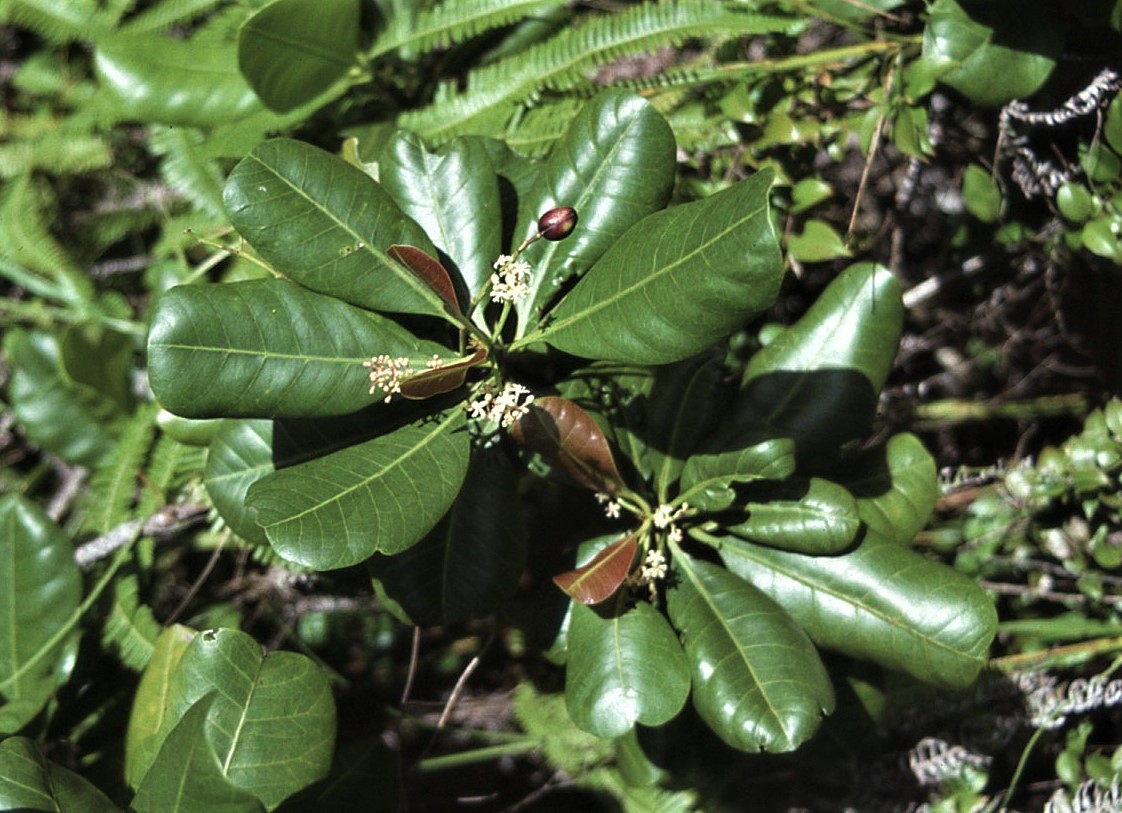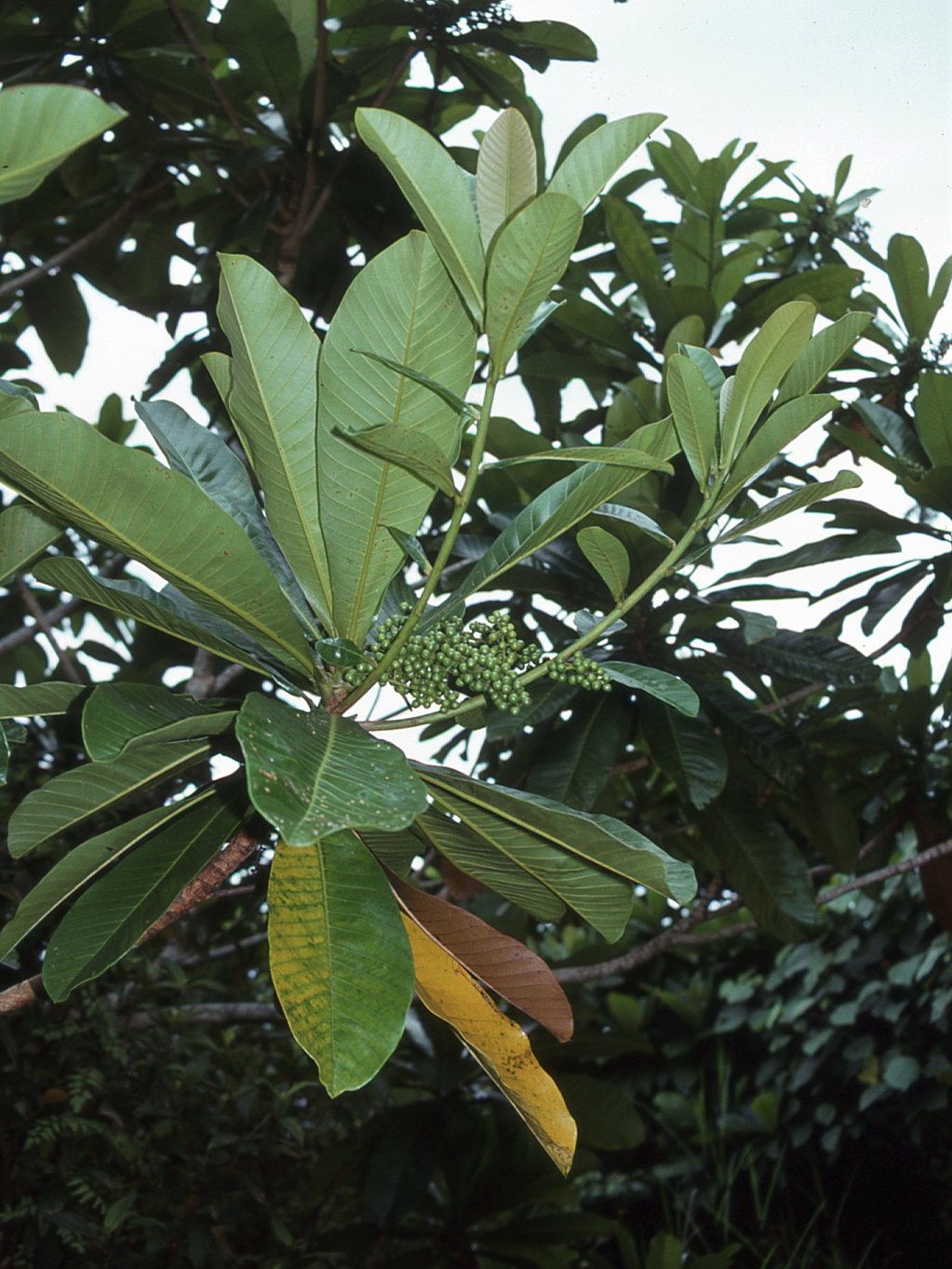
Description: Campnosperma brevipetiolata is a large, native tree that is a common and sometimes dominant species in the upland forests of the Micronesian high islands (with the exception of Chuuk), and is a tree that has potential use for lumber and reforestation efforts within the Federated States of Micronesia (see Sheely and Meagher 1996). It is a fairly rapid growing, straight tree reaching heights of approximately 30 m (~l00 ft), with large leaves that are mainly located at the tips of the branches. The flowers and fruits of the tree are quite small. The small fruits are round, about 0.5cm (~1/5 in) across and contain relatively large stones or pits. The small fruits are a greenish-yellow color at first, becoming dark-colored when they mature. The peak fruiting period is in March and typically the trees mature in about four years.
Distribution: Campnosperma brevipetiolata is a tree species that apparently originated in the Indo-Malaya region and dispersed throughout its native range. It has been suggested that the early human colonizers of the Caroline Islands brought this species with them on canoe voyages. However, this tree is probably native to and commonly found on the high islands throughout Micronesia (as noted above, with the exception of Chuuk); C. brevipetiolata is also native in the Solomon and Bismarck Islands, New Guinea and the Moluccas. Indeed, the fruit of this wet forest tree is food for the Micronesian Imperial-pigeon, Ducula oceanica and other forest birds which may have dispersed the plant to some islands of Remote Oceania. In Palau, this is a species associated with mid-successional to mature forests and is an important component of the forest canopy, especially in mid-successional vegetation. C.brevipetiolata naturally regenerates both within the forest matrix and in hightly disturbed areas, like roadsides and forest clearing areas (e.g, see Endress 2002, Canfield et al. 1992).
Uses by Island or Island Group: “Fruit of [C. brevipetiolata] eaten and transported by birds; a timber species with some potential as it grows readily in forest gaps and open areas” (Falanruw 2015:24). Indeed, this relatively large native tree species could serve as a good landscape or reforestation tree in some areas of Micronesia.
Uses in Palau: C. brevipetiolata isan important timber species throughout its Micronesian range, including Palau, where it is known as Kelel a charm or other local names. As noted above, the fruit of this tree is food for the Micronesian Imperial-pigeon, Ducula oceanica (locally known in Palau as Belochel) and other forest birds. In Palau, Kelel a charm produces wood used for many purposes, including as firewood and for house construction. Although some have referred to its good quality wood, Tuyama (1941) referred to its wood as “white soft and liable to split,” but did indicate that it was being used in Palau for “building material and canoe building.”
Uses in Yap: Similar to Palau, in Yap, C. brevipetiolata (where is it known as Ramluw in Yapese) produces desirable wood used for many purposes, including firewood and house construction. Parts of the tree are also used in traditional medicine. This large native tree is easily damaged by fire; and as elsewhere in its Micronesian range of distribution, some native birds such as pigeons commonly eat its fruits.
Uses in Pohnpei: C. brevipetiolata is often one of the largest and most common plants in Pohnpei where it is known in Pohnpeian as Dohng. It is stronger but heavier than Sadak (Elaeocarpus carolinensis), another common native forest tree on the high island forests of Pohnpei. However, although it produces good quality wood used for many purposes, including logs for canoe bodies, this outstanding tree is easily damaged by fire. Occasionally yams vines are trained to grow up into the open canopy of Dohng. The large leaves of Dohng are sometimes used for food plates, fans and to cover transplanted seedlings, as well to build pig pens. Since birds such as Mwuroi, the Pohnpeian name for the Micronesian Imperial Pigeon (Ducula oceanica), eat the fruits of Dohng, Pohnpeians have used these fruits to trap birds, especially Mwuroi. Pohnpeian bird hunters traditionally place their traps up in the Dohng trees where the fruits are produced, and when the Mwuroi birds come to feed on the fruits, they get caught inside the traps. Unfortunately, due to increasing human population, clearing of native forest and excessive hunting the Micronesian Imperial Pigeon now has brought the pigeon to “Near-Threatened” status on the IUCN Red List. Parts of the tree such as the bark are used in traditional medicine; indeed, the medicinal uses of Dohng in Pohnpei are apparentaly diverse. For example, according to Balick and his colleagues (2009:323-323):
“To treat cuts, bark is scraped into a clean cloth and juice is squeezed onto the cut to stop the bleeding and clean and treat the cut…To treat diarrhea, the bark scrapings are wrapped in a piece of cloth and squeezed to extract the liquid, which is then consumed only once…To treat tuberculosis, the bark is pounded, wrapped in a piece of cloth, squeezed into… water, and consumed…The plant is used as a painkiller for toothache...To treat the pain from a broken tooth….”
Uses in Kosrae: C. brevipetiolata (known in Kosraean as Elahk)produces high quality wood used for many purposes, including canoe hulls. Similar to Pohnpei, occasionally yams vines are trained to grow up into the open canopy of Elahk. The large leaves of this tree are sometimes used for food plates, fans and to cover transplanted seedlings on Kosrae. Various parts of the tree are also reportedly used in traditional Kosraean medicine (e.g., see Merlin et al. 1993).