


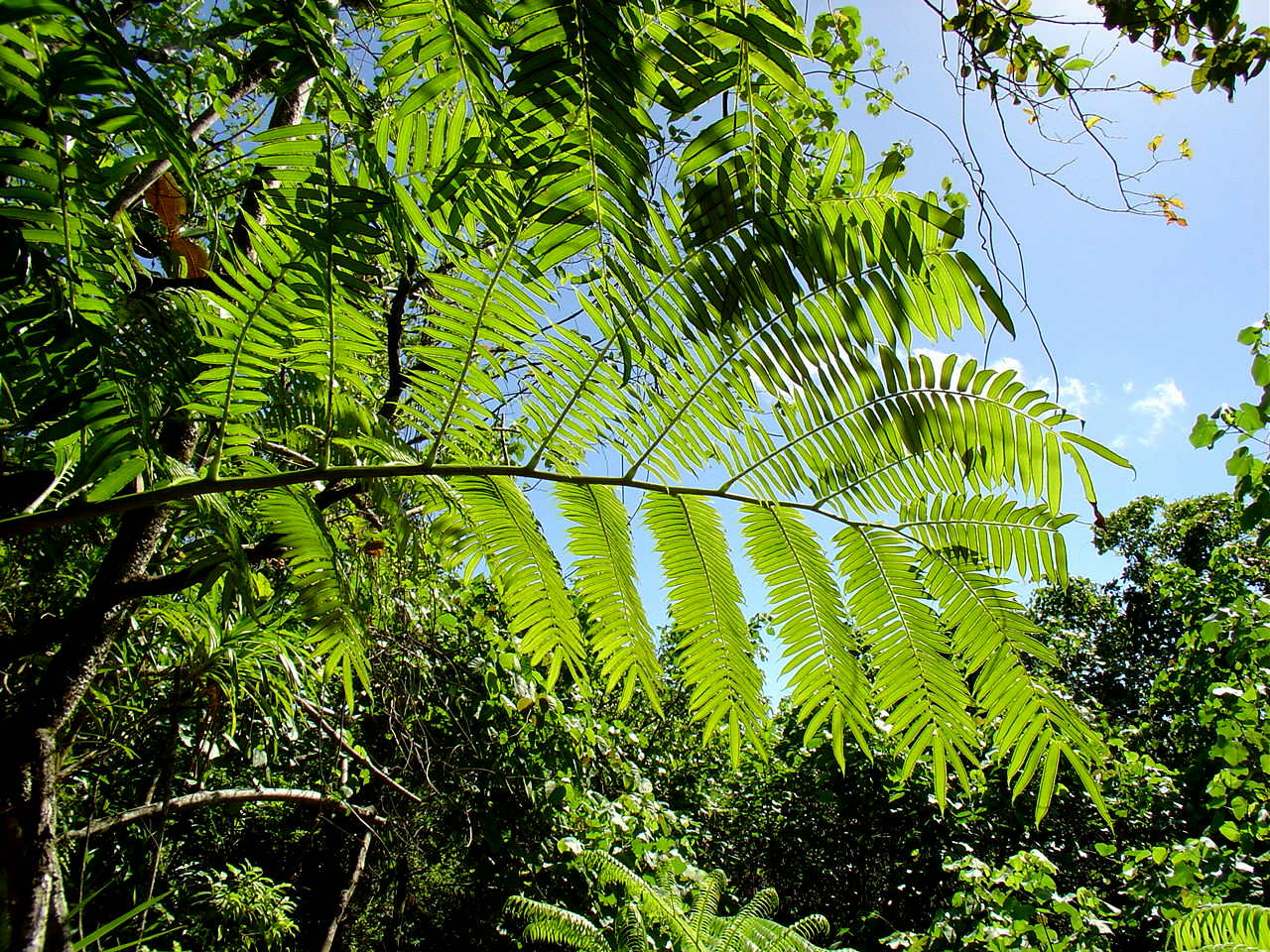
Description: Angiopteris evecta is an enormous perennial fern with a massive rhizome (or caudex) at its base which is a somewhat spherical, trunk-like unit that can grow up to about 120 cm (~3.25 ft) tall and 100 cm (~3 ft) in diameter. This giant rhizome structure produces two flat, rounded, dark brown, leathery, stipule-like growths about 10-15 cm (4-6 in) long. These are found growing up on either side of the petiole or stalk that attaches the leaf or frond blade to the stem, and can bear many buds that may develop into additional plants when they break off. A. evecta also produces huge leaf blades from its base near the ground. These leaf blades are often taller than a person and can be up to 8 m (25 ft) long. The sporangia are clustered in short double-rows of three to seven with no indusium. This fern is apparently very long lived.
Distribution: Angiopteris evecta is reportedly indigenous to parts of northern and eastern Australia, as well as in various areas of the South Pacific, including Polynesia, Melanesia, Micronesia, and beyond in other tropical area. Unfortunately, this huge herbaceous species has established invasive alien populations in Hawaii, Costa Rica, and Jamaica (e.g., see Funk 1987, Christenhusz and Toivonen 2008); and thus its widespread cultivation as an decorative plant should be discouraged. On the other hand, A. evecta is now a rare plant in part of its putative native range in eastern and northern Australia. A. evecta occursin both tropical and subtropical forests, generally in moist areas and rainforest at low to middle elevations, but especially in ruderal or disturbed areas, and in wetlands. In Micronesia, it is known on Guam in the Mariana Islands as well as on Palau, Yap, Pohnpei, and Kosrae in the Carolines (Fosberg 1950).
Uses by Island or Island Group: The giant Angiopteris evecta ferns are said to remind people of “prehistoric forests” and are often cultivated in tropical gardens for their dramatic effect. Some botanical gardens plant them for their ornamental and educational value. A. evecta has also been used as a medicinal plant and famine food source in some of its assumed truly wild areas such as in some areas of New Guinea. It has also been spread by humans as a famine food to some areas such as in Jamaica (in the 18th century); however, it takes a lot of work to extract the starch from the rhizomes and thus this use is not common any longer. Although A. evecta has had these ornamental and famine food utilization, as well as yielding an aromatic oil that is reportedly used for perfuming coconut oil in some tropical Pacific Islands (e.g., see May 1978, Srivastava 2007), in areas where it has been introduced as an alien fern, A. evecta reportedly can establish dense stands that displace and shade out native plants and reduce biodiversity in ecosystems. Therefore, because these large ferns are known to alter the natural environment, which may reduce local biodiversity, and as noted above, “it is advisable to restrict the trade and spread of the species and to discourage its cultivation as an ornamental” (Christenhusz and Toivonen 2008:1215).
Uses inPalau: The leaves of the giant fern A. evecta are said to have been tied around a person’s head to cure a headache (see Okabe in Defilipps et al. 1988).
Uses in Yap: A number of uses of this huge fern A. evecta have been reported from Yap including those involving various specialized and more common medicinal applications as well as for ornamental purposes.
“This plant is very important because it is one of the common ingredients of the families' secret medicines. This plant is believed to be a pain reliever, and able to cool down the body temperature. The leaf can be gathered together [and laid] down on [a] mat. Any person who has backache can lay on it during the night sleep. It cools down the body temperature and at the same time it helps massage the body and relief the pain…. Other than that, this plant can be used for decorations especially at the graduations because it is such a beautiful type of fern. It is used also on parties in Yap as a gift (see e.g., http://www.comfsm.fm/~dleeling/botany/2000/vhp/mong.html; also see Okabe in Defilipps et al. 1988:6 for reference to the medicinal use of A. evecta in Yap).
Uses in Pohnpei: The huge fronds are said to be used in building temporary huts in forests as well as for bedding upon which to sleep in these short-term places of refuge. Medicinally, this giant fern is reportedly the source of therapeutic remedies for sicknesses caused by evil spirits or sorcerers and has been used to treat dizziness. It has also been planted as a shade provider near kava plants (Piper methysticum), known as Sakau in Pohnpei (Balick 2009).