


Family: Zingiberaceae
(palauan: Tuarechelid)
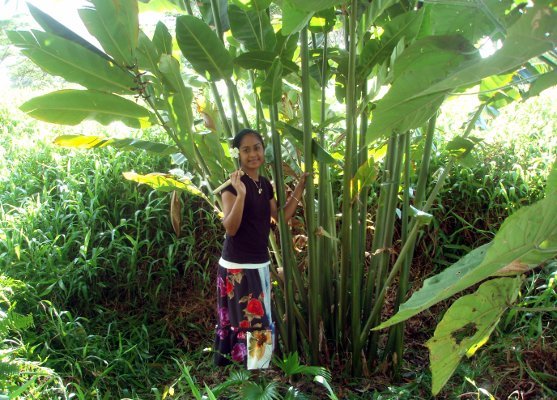
Mark Merlin
Micronesian Names by Islands or Island Groups: Tuarechelid or Tu al kiuid (Palau), Chifiif or Titif (Yap), Iuiu, Iou iou or Ieu ieu (Pohnpei)
Description: Alpinia carolinensis is a giant herbaceous species, one of the largest of the ginger family, Zingiberaceae. Like other gingers, A. carolinensis plants lack true stems, but the false or pseudostems of A. carolinensis, which are composed of overlapping leaf sheaths, can reach heights up to about 8 m (25 ft) tall. Its leaves are lanceolate to oblong in shape, and the plant produces large clusters of rounded, dry or fleshy capsule-shaped fruits that turn from green to bright red.
Distribution: Alpinia is the largest and most widespread genus in the ginger family. It has approximately 230 species distributed in the Asia-Pacific region, though recent studies indicate that it is a polyphyletic genus (Kress et al. 2005); a polyphyletic taxon is composed of unrelated organisms descended from more than one ancestor, whereas amonophyletic taxon is one that includes a group of organisms descended from a single ancestor. Alpinia carolinensis, a native ginger species on the volcanic islands of the Western Caroline Islands of Micronesia where it is a common component of the forest understory (e.g., see Costion and Lorence 2012:70). The ripe fruits of this large native ginger are eaten and presumably dispersed by birds, especially the Pohnpei Lory (Trichoglossus rubiginosus) and fruit bats (Pteropus spp.).
Uses by Island and Island Group: Many species herbaceous Alpinia species are popular as ornamentals such as, for example, two well-known ornamental ginger relatives of A. carolinensis: A. purpurata (red flowering ginger) and A. zerumbet (shell flowering ginger) are commonly cultivated in tropical environments for their attractive flowers and foliage. A. carolinensis, Micronesia’s “giant ginger,” is endemic to some high islands in Micronesia, but has, for the most part, not been exploited as an ornamental cultivated species though many plant enthusiasts express unreserved astonishment at its size. A. carolinensis plants are more or less aromatic because of their essential oils.
Uses in Yap: Known as Chifciif or Tifif in Yap, A. carolinensis has been reportedly used medicinally in some areas of Yap. Indeed, some parts of this herb are said to have been used alone or mixed with parts from other plant species for treating colds, sarcoma cancer and as an emetic or antiemetic (see Okabe in Defilipps et al. 1988:11).
Uses in Pohnpei: Known as Iuiu, Iou iou or Ieu ieu on Pohnpei, A. carolinensis, grows wild on this high island in the eastern Carolines, and provides a source of food for the local lorikeet. The large, banana‑like leaves of this plant are utilized as plates by people to cover the earth oven, uhmw, as well as for lining pits used to produce fermented breadfruit, Mahr. Therapeutically, A. carolinensis is also reported to have used on Pohnpei for treating arthritis and painful swollen joints, physical ailments said to be brought on by spells associated with a type of ghost sickness; A. carolinensis has other medicinal uses as well (Balick 2009).