


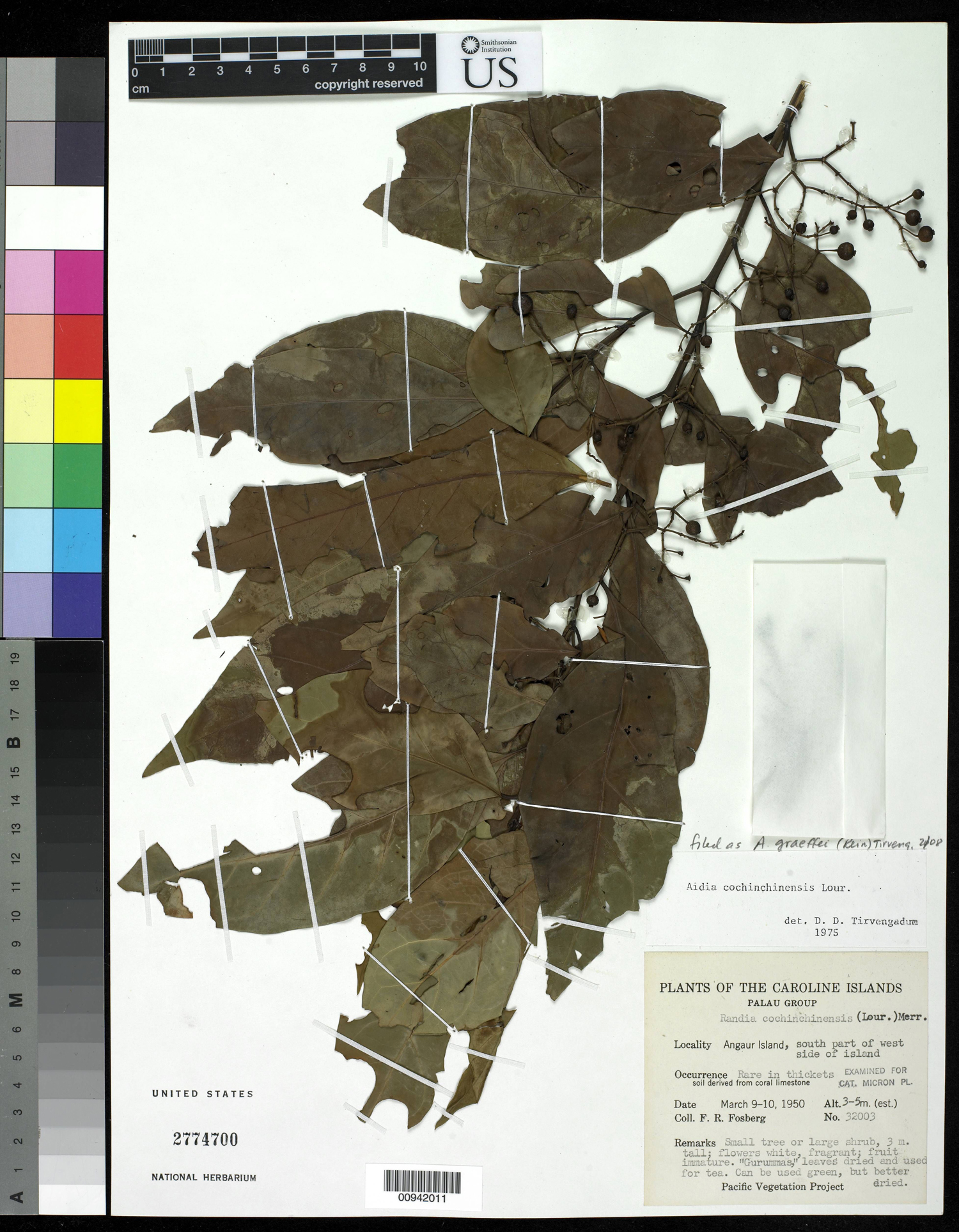
Micronesian Names by Islands or Island Groups: Kerumes, Chomáil or Gomáil (Palau), Gathimech or Gathemach? (Yap), Sumac or Sumak (Mariana Islands), Kehnmant, Kehnman or Kahmaut (Pohnpei), Kielomar (Marshall Islands)
Description: Aidia racemosa (formerly in classified in the genus Randia) is a native shrub or small tree in the Coffee family, Rubiaceae. It can grow to heights of about 15 m (45 ft) as an attractive woody plant with a layered growth habit. Like other members of the family Rubiaceae, the leaves of A. racemosa are oppositely arranged along the stems, and stipule scars frequently can be seen extending around the stems. The flowers are cream-colored, strongly scented and borne in small clusters along the branches. Its fruits are oval, about 1 cm (~1/2 in) long and bright red when mature; and these fruits as well as the flowers of A. racemosa attract birds and butterflies.
Distribution: A. racemosa is sometimes common in relatively undisturbed coastal or atoll scrub forests of Micronesia (or in coconut plantations, such as on Fais Island in Yap State, FSM). It is found in various areas of the Indo-Pacific region, including parts of Remote Oceania, and reaches as far as the southern Marshall Islands in Micronesia. It is reported in Marshall Islands only on Arno and Jaluit Atolls.
Uses by Island or Island Group:
Uses in Palau:The relatively strong, flexible, and elastic wood of Aidia racemosa (reportedly known as Kerumes in Palau) can be used for construction, and it is termite resistant. According to Tuyama (1941), “Randia racemosa”(a synonym of Aidea racemosa)is known on Palau as Chomáil or Gomáil, and its wood “is very strong,” and is thus traditionally used to make tool handles. Medicinally, according to Obake (see Deflipps et al. 1988), the leaves and stems of A. racemosa reportedly have been used in local Palauan medicine for treating syphilis. Kitalong et al. (2008) referred to A. racemosa as “an attractive plant which produces fragrant white flowers and would thus make an excellent landscaping species on limestone soils,” and could “also be a good species for restoration of vegetation.”
Uses in Yap: Aidia racemosa is reportedly known in Yap as Gathimech or Gathemach, a name which appears “to be applied or misapplied to more than one species” (Falanruw 2015:186). This small understory tree is also reportedly a source of medicine in Yap, where flowers, leaves, stems, and bark are used. According to Okabe (see Deflipps et al. 1988), in Ugiri District, in the treatment of “tuberculosis, the bark of this woody species is crushed together with the skin of betel nut fruit (‘kuruebuh’) and young sprouts of ‘buh’ (Schizostachyum lima or Areca catechu) and taken with coconut milk,” and in this case, “the green, unripe coconut of a green color (yowra) should be used. The strong wood of A. racemosa is used for small house construction on Yap as it is on some other Micronesian Islands.
Uses in the Mariana Islands: According to Moore and McMakin (1975:43), Randia racemosa (a synonym of Aidea racemosa)is common in the limestone community of Guam, frequently occurring on the western coast of this island; and its leaves and stems are reportedly “used in a medicinal combination made by the local curers.”
Uses in Pohnpei: Aidia racemosa, known on Pohnpei as Kehnmant (or a close variant that name) is used to treat an unspecified skin disease that afflicts children (Balick et al. 2009).
Uses in the Marshall Islands: Parts of Aidia racemosa, known as Kielomar in the low coralline islands of the Marshalls, are used in building construction; and Kielomar also has both decorative and medicinal uses on those atoll islands where it is found. Okabe (1941d:13) listed Randia reacemosa (synonym forAidia racemose)as being known as “Gaal” on Jaluit Atoll in the Marshall Islands where he noted it as being a timber source for making implements.
Uses in Nauru: Although Aidia sp. (A. racemosa or perhaps A. cochinensis Lour.), known on Nauru as “enga” or “enguh,” may be extinct or at least quite rare in escarpment forest of this island, the ripe fruit are or were reportedly eaten, especially by children (see Thaman et al. 1994:185-186). This Aidia species is reportedly not found today on the islands of Kiribati (e.g., see Thaman and Samuelu 2016).
Uses by Island or Island Group:
Uses in Palau:The relatively strong, flexible, and elastic wood of Aidia racemosa (reportedly known as Kerumes in Palau) can be used for construction, and it is termite resistant. According to Tuyama (1941), “Randia racemosa”(a synonym of Aidea racemosa)is known on Palau as Chomáil or Gomáil, and its wood “is very strong,” and is thus traditionally used to make tool handles. Medicinally, according to Obake (see Deflipps et al. 1988), the leaves and stems of A. racemosa reportedly have been used in local Palauan medicine for treating syphilis. Kitalong et al. (2008) referred to A. racemosa as “an attractive plant which produces fragrant white flowers and would thus make an excellent landscaping species on limestone soils,” and could “also be a good species for restoration of vegetation.”
Uses in Yap: Aidia racemosa is reportedly known in Yap as Gathimech or Gathemach, a name which appears “to be applied or misapplied to more than one species” (Falanruw 2015:186). This small understory tree is also reportedly a source of medicine in Yap, where flowers, leaves, stems, and bark are used. According to Okabe (see Deflipps et al. 1988), in Ugiri District, in the treatment of “tuberculosis, the bark of this woody species is crushed together with the skin of betel nut fruit (‘kuruebuh’) and young sprouts of ‘buh’ (Schizostachyum lima or Areca catechu) and taken with coconut milk,” and in this case, “the green, unripe coconut of a green color (yowra) should be used. The strong wood of A. racemosa is used for small house construction on Yap as it is on some other Micronesian Islands.
Uses in the Mariana Islands: According to Moore and McMakin (1975:43), Randia racemosa (a synonym of Aidea racemosa)is common in the limestone community of Guam, frequently occurring on the western coast of this island; and its leaves and stems are reportedly “used in a medicinal combination made by the local curers.”
Uses in Pohnpei: Aidia racemosa, known on Pohnpei as Kehnmant (or a close variant that name) is used to treat an unspecified skin disease that afflicts children (Balick et al. 2009).
Uses in the Marshall Islands: Parts of Aidia racemosa, known as Kielomar in the low coralline islands of the Marshalls, are used in building construction; and Kielomar also has both decorative and medicinal uses on those atoll islands where it is found. Okabe (1941d:13) listed Randia reacemosa (synonym forAidia racemose)as being known as “Gaal” on Jaluit Atoll in the Marshall Islands where he noted it as being a timber source for making implements.
Uses in Nauru: Although Aidia sp. (A. racemosa or perhaps A. cochinensis Lour.), known on Nauru as “enga” or “enguh,” may be extinct or at least quite rare in escarpment forest of this island, the ripe fruit are or were reportedly eaten, especially by children (see Thaman et al. 1994:185-186). This Aidia species is reportedly not found today on the islands of Kiribati (e.g., see Thaman and Samuelu 2016).