


Common or English Name: none
Micronesian Names by Island or Island Groups: Mesecheues (Palau), Mupunyao, Mapanao, Mapunyao or Mapunao (Mariana Islands), Ááppásew (Chuuk), Appaaw (Pulusuk), Apeu (Namonuito), Marasau or Karasau (Pohnpei).
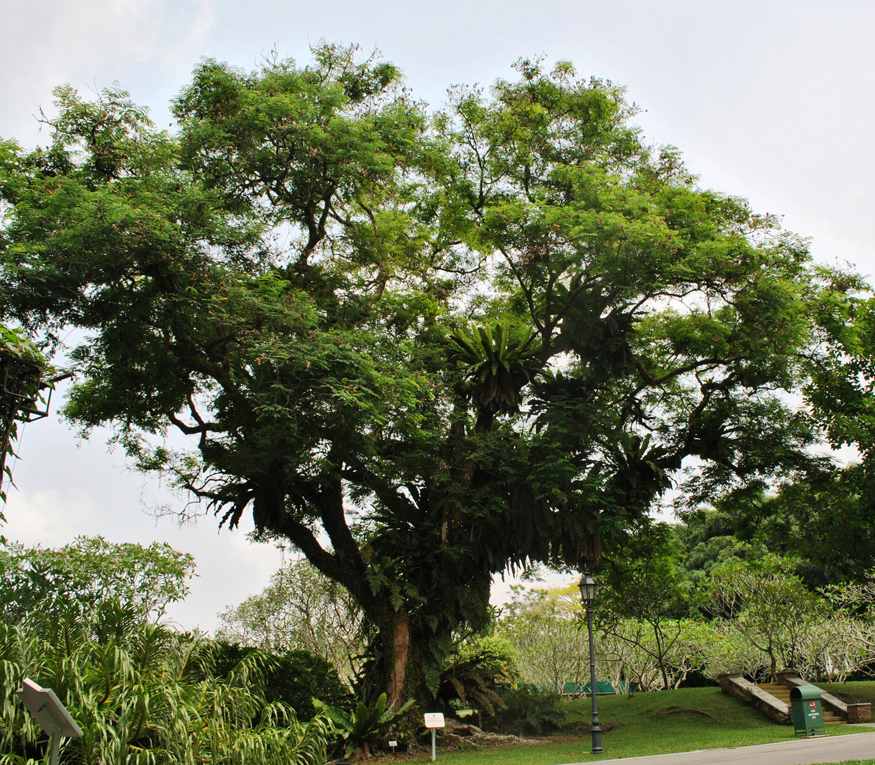
Description: Adenanthera pavonina is a tall, alien or introduced tree in Micronesia that reaches heights of 25-30 m. It is medium sized and deciduous with leaves that have 2-6 pairs of pinnae, 6-12 pairs of leaflets that are each 2-5 cm long, ovate, obtuse, glabrous, rather pale green and thin. The flowers are produced in slender, elongated racemes that are borne in axils. The flowers are yellowish and sweetly fragrant with 8-10 stamens. The calyx is 4-5-toothed and its pods are slender, linear, curved or contorted, dehiscent, thin, flattened, brown, smooth and shiny inside. The seeds (10-12 per pod) are lenticular, suborbicular, hard, dark or bright red and about 8 mm wide (Stone 1970). The trunk of this tree may appear twisted.
Distribution: Adenanthera pavonina is a large tree reportedly dispersed by birds and a wide native range in southeastern Asian, including areas in Australia (Northern Territory and Queensland), Bangladesh, Cambodia, China, India, Indonesia, Laos, Malaysia, Myanmar, Papua New Guinea, Solomon Islands, Sri Lanka and Vietnam; this distribution is especially well developed in areas where A. pavonina grows in the forests that experience humid or monsoonal tropical climate. Although this large tree has a putatively broad native range in Southeast Asia and parts of Oceania, it is possibly an aboriginal introduction to parts of Melanesia and western Polynesia, but was most likely only recently introduced to other areas in Remote Oceania. On some Micronesian islands, A. pavonina is found in abandoned agriculture areas; and it is also sometimes common in cultivation as a protected tree in garden areas and mature fallow forests of the tropical Pacific, but is not generally found on atolls.There are a number of introduced trees, in particular species in the bean family, Fabaceae, that, if left to their own devices, are gradually spreading in the vicinity of, into, or through native forests of high islands of Micronesia such as those of Palau and Yap; these include A. pavonina (Space and Falanruw 1999; Falanruw 2015:94). Today this bean tree grows well on a variety of soils in both seasonal and more permanently moist climates throughout the tropics where it produces large quantities of seed. In Fiji (see Smith 1985), it is naturalized thoroughly near roads, in dry forest, and sometimes in dense forest from near sea level to about 600 m (200 ft.). In Micronesia, A. pavonina has been introduced to islands in the Republic of Palau, the Mariana Islands, the Federated States of Micronesia, and the Republic of the Marshall Islands.
General Uses of Adenanthera pavonina: The heartwood of the larger trees of this species has a deep reddish color, and because it is considered to be hard and durable, in India it has sometimes been used as a substitute for true red sandalwood. Indeed, the tree yields a dye, which the Brahmins of India are said to use for marking their foreheads. According to Mazza (see http://www.photomazza.com/?Adenanthera-pavonina), A. pavonina has a wide variety of uses in its large established range of distribution; and these multiple uses have either traditional or more modern origins as ethnobotanical relationships:
“[Adenanthera pavonina, the coral bean tree] is utilized as road tree, due to its ornamental foliage, as well as shade tree in the plantations of cocoa, coffee and other crops. The hard, compact and long-lasting wood, is often utilized as a substitute of the red sanders (Pterocarpus santalinus) one for valuable furniture, floors, boats, in the constructions and for various handicraft products, besides as fuel and the red colour obtained from it was in the past used as colouring of textiles and in the cosmetics; the bark, containing saponins, was used as detergent. The seeds are utilized for necklaces, bracelets, rosaries and other ornaments; in some zones, due to the high contents of proteins, they are consumed grilled (they are toxic when raw) with the rice and the young leaves as vegetable. The seeds due to their uniformity of weight, about 0,25 g each, in the past were utilized as reference in the trade of gemstones, gold and silver. The oil gotten from the seeds contains appreciable quantities, about the 20%, of lignoceric acid, rarely present in those of other species. Various parts of the plant are used in the traditional medicine for various pathologies; studies on animals have shown antibacterial, anti-inflammatory, antihypertensive properties of the seeds extracts, which present also insecticidal properties.”
Uses by Island or Island Group in Micronesia: Besides its potential threat as an invasive species in those islands where it has been introduced in Micronesia, Adenanthera pavonina, the coral bean tree, also has a reputation of wood that splits rather easily, and is therefore is not regarded as a very useful source of lumber; however, it is also known that its green wood does burn, producing a very hot, useful fire. In additiona, its attractive glossy-surfaced red seeds have relatively recently been integrated into locally-made ornamental jewelry on some Micronesian Islands.
Uses in Palau: Adenanthera pavonina,known as Telentundalel or Telengtúngd in Palau, is invasive and has become common in secondary forests of these islands as it is now in many areas throughout the tropical Pacific region. Although the seeds are eaten and considered by some to be native to Palau, A. pavonina was most probably introduced into Palau by people after first European contact. This alien tree can grow up and cover over many native trees and eventually form monospecific (single) stands of this species. As noted above, tree of this species produce large quantities of seed and can grow in a variety of soils; if this invasive trend continues on Palau A. pavonina may eventually become much more widespread.
Uses in Yap: Adenanthera pavonina,known as Churruwa in Yap. According to Falanruw (2015:94), A. pavonina is “A somewhat invasive species that can form thickets where seed falls, but reported to be good for timber…. [and its] bright red seeds are used as beads.”
Uses in Guam: A. pavonina was introduced into Guam well over a hundred years ago, and by the 20th Century this alien tree became fairly well distributed over the island. “Its vernacular name, Kolales [in Guam] is an imitation of the Spanish ‘corales’ (coral beads), and is likewise applied to the smaller-seeded” Abrus precatorius (Safford 1905). According to Moore and Krizman (1981:21), A. pavonina “makes an attractive shade treeand of particular interest are the red seeds which are sometime sused making leis.”
Uses in Chuuk: A. pavonina (known in Chuuk as Kulales) was recently introduced and is now invasive in secondary forests and seen on Weno and Fefan. The red beans are used in handicrafts (Space et al. 2000a). Alien species such as this one in Chuuk and elsewhere in Micronesia could become a problem in the future because “there is often a long lag time between introduction and when a species begins to cause serious impacts” (Space et al. 2000).
Uses in Pohnpei: The wood of introduced A. pavonina (known on Pohnpei as Kaikes) is the main wood used today to heat the rocks in the traditional stone oven (uhmw). Nevertheless, since its roots are known to reduce soil fertility by using large amounts of the available nutrients (teksuwed), the tree is usually cut down. The seeds of this tree are said to be eaten by children and its wood is used as construction material for small structures, such as cook houses (imwen kuk, see Balick et al. 2009).
Uses in Kosrae: On Kosrae, the wood of coral bean trees (A. pavonina, known as Mwetkwem on Kosrae) is widely used to heat rocks in the traditional stone oven (um), as it is also used on Pohnpei. Because its roots are known to reduce soil fertility by using large amounts of the available nutrients, this alien tree species is often cut down and removed from where it has become established. The bright red seeds are sometimes used for making neck garlands.
Uses in Nauru: A. pavonina, known as Bin (“bean”) on Nauru, is a relatively recent introduced tree species that has naturalized forest located on the “escarpment and Buada forests and in older strip-mined areas” of the islands; its attractive red seeds are “used in necklaces and eaten by children” (Thaman et al. 1994:136).
General Uses of Adenanthera pavonina: The heartwood of the larger trees of this species has a deep reddish color, and because it is considered to be hard and durable, in India it has sometimes been used as a substitute for true red sandalwood. Indeed, the tree yields a dye, which the Brahmins of India are said to use for marking their foreheads. According to Mazza (see http://www.photomazza.com/?Adenanthera-pavonina), A. pavonina has a wide variety of uses in its large established range of distribution; and these multiple uses have either traditional or more modern origins as ethnobotanical relationships:
“[Adenanthera pavonina, the coral bean tree] is utilized as road tree, due to its ornamental foliage, as well as shade tree in the plantations of cocoa, coffee and other crops. The hard, compact and long-lasting wood, is often utilized as a substitute of the red sanders (Pterocarpus santalinus) one for valuable furniture, floors, boats, in the constructions and for various handicraft products, besides as fuel and the red colour obtained from it was in the past used as colouring of textiles and in the cosmetics; the bark, containing saponins, was used as detergent. The seeds are utilized for necklaces, bracelets, rosaries and other ornaments; in some zones, due to the high contents of proteins, they are consumed grilled (they are toxic when raw) with the rice and the young leaves as vegetable. The seeds due to their uniformity of weight, about 0,25 g each, in the past were utilized as reference in the trade of gemstones, gold and silver. The oil gotten from the seeds contains appreciable quantities, about the 20%, of lignoceric acid, rarely present in those of other species. Various parts of the plant are used in the traditional medicine for various pathologies; studies on animals have shown antibacterial, anti-inflammatory, antihypertensive properties of the seeds extracts, which present also insecticidal properties.”
Uses by Island or Island Group in Micronesia: Besides its potential threat as an invasive species in those islands where it has been introduced in Micronesia, Adenanthera pavonina, the coral bean tree, also has a reputation of wood that splits rather easily, and is therefore is not regarded as a very useful source of lumber; however, it is also known that its green wood does burn, producing a very hot, useful fire. In additiona, its attractive glossy-surfaced red seeds have relatively recently been integrated into locally-made ornamental jewelry on some Micronesian Islands.
Uses in Palau: Adenanthera pavonina,known as Telentundalel or Telengtúngd in Palau, is invasive and has become common in secondary forests of these islands as it is now in many areas throughout the tropical Pacific region. Although the seeds are eaten and considered by some to be native to Palau, A. pavonina was most probably introduced into Palau by people after first European contact. This alien tree can grow up and cover over many native trees and eventually form monospecific (single) stands of this species. As noted above, tree of this species produce large quantities of seed and can grow in a variety of soils; if this invasive trend continues on Palau A. pavonina may eventually become much more widespread.
Uses in Yap: Adenanthera pavonina,known as Churruwa in Yap. According to Falanruw (2015:94), A. pavonina is “A somewhat invasive species that can form thickets where seed falls, but reported to be good for timber…. [and its] bright red seeds are used as beads.”
Uses in Guam: A. pavonina was introduced into Guam well over a hundred years ago, and by the 20th Century this alien tree became fairly well distributed over the island. “Its vernacular name, Kolales [in Guam] is an imitation of the Spanish ‘corales’ (coral beads), and is likewise applied to the smaller-seeded” Abrus precatorius (Safford 1905). According to Moore and Krizman (1981:21), A. pavonina “makes an attractive shade treeand of particular interest are the red seeds which are sometime sused making leis.”
Uses in Chuuk: A. pavonina (known in Chuuk as Kulales) was recently introduced and is now invasive in secondary forests and seen on Weno and Fefan. The red beans are used in handicrafts (Space et al. 2000a). Alien species such as this one in Chuuk and elsewhere in Micronesia could become a problem in the future because “there is often a long lag time between introduction and when a species begins to cause serious impacts” (Space et al. 2000).
Uses in Pohnpei: The wood of introduced A. pavonina (known on Pohnpei as Kaikes) is the main wood used today to heat the rocks in the traditional stone oven (uhmw). Nevertheless, since its roots are known to reduce soil fertility by using large amounts of the available nutrients (teksuwed), the tree is usually cut down. The seeds of this tree are said to be eaten by children and its wood is used as construction material for small structures, such as cook houses (imwen kuk, see Balick et al. 2009).
Uses in Kosrae: On Kosrae, the wood of coral bean trees (A. pavonina, known as Mwetkwem on Kosrae) is widely used to heat rocks in the traditional stone oven (um), as it is also used on Pohnpei. Because its roots are known to reduce soil fertility by using large amounts of the available nutrients, this alien tree species is often cut down and removed from where it has become established. The bright red seeds are sometimes used for making neck garlands.
Uses in Nauru: A. pavonina, known as Bin (“bean”) on Nauru, is a relatively recent introduced tree species that has naturalized forest located on the “escarpment and Buada forests and in older strip-mined areas” of the islands; its attractive red seeds are “used in necklaces and eaten by children” (Thaman et al. 1994:136).