


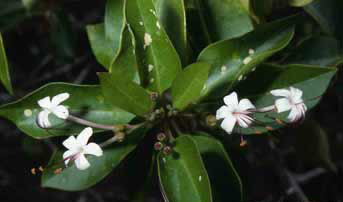
Description: Clerodendrum inerme (accepted as Volkameria inerme by some botanists) is a sprawling or climbing shrub that grows to heights of 2-8 m (6-28 ft), with woody, smooth stems up to about 3cm (>1 in) wide. The simple leaves are oppositely arranged and elliptical in shape with an entire margin and an acute to acuminate tip; they are about 5-10 cm (2-4 in) long, more or less glabrous with lateral, pinnate venation. C. inerme produces attractive whitish flowers 3.5-5.5 cm (1.5-2 in) in length, each with four long, reddish-purple stamens extending beyond the petals of the flowers; they are usually comprised of three flowers joined at a common base point. The ovary of C. inerme is inferior, and its fruits are oval-shaped, about 1-1.5 cm (0.5 inch) long, and split into four single-seed nutlets when mature.
Distribution: Seaside Clerodendrum, as one of its common English names suggests, grows well along tropical beaches where it tolerates the salt spray of the ocean and the harsh rays of the sun. Indeed, this widespread woody plant is an indigenous species found in the coastal vegetation from tropical Asia to western Polynesia, and in all the major island groups of Micronesia, alothough it may have been introduced by people nto some of these Pacific Islands areas. It grows at the landward edge of the mangroves, in some swampy areas, along lowland streams, and sometimes in secondary vegetation, as well as in rocky and sandy areas near the shore. Although Clerodendrum inerme is used in many places in landscaping, as a ground cover or a hedge plant, especially near the sea, it should be noted that C. inerme may develop “an aggressive growth characteristic, and is likely to become invasive in areas where it does not naturally occur, but where it has been planted,” such as in parts of the Hawaiian Islands; in other words, “it has the potential to form dense brambles smothering other plants, and would probably be difficult to remove” (Chethana et al. 2013:39).
Uses by Island or Island Group:As a cultivated hedge plant Clerodendrum inerme has been used traditionally for ornamental purpose in home gardens largely because of its profuse white flowers that form in clusters and are accented by delicate purplish protruding stamens. C. inerme is also used for a variety of medicinal purposes in various areas of tropical Asia; for example, it is used widely in India in Ayurveda and Sidha healing traditions, and where it has an incredible diversity of local names (e.g., see Quattrocchi 2012:1013). It is also used medicinally and planted as an attractive ornamental shrub in several tropical Pacific Islands including many in Micronesia. Indeed, some of the traditional uses of this plant species, such as its usage in wound treatments, etc., are to some degree supported by experimentally observed effects of scientific extracts; however, there as of yet “very few biological studies available on bioactive components of this plant” (e.g., see Chethana et al. 2013:39, also see under Palau below).
Uses in Palau: According to Okabe, who did his ethnomedicinal research many decades ago in Palau and Yap (see Defilipps et al. 1988, also see Tuyama 1941), the young leaves of C. inerme “are crushed, and the juice is drunk to cure stomach ache.” More recent research involving 22 notable medicinal plant species in Palau and other Micronesian Islands, referred to related scientific medicinal research involving C. inerme. “The goal of this study was to identify disease associations of plants identified within the Primary Health Care Manuals (PHCMs) of Palau and Pohnpei” (see Dahmer et al. 2012 and Lee et al. 2010). The research focused on Palau by Dahmer and his colleagues indicated that “Clerodendrum inerme, traditionally used to reduce stress, has been successfully tested for use against motor tics (Tic disorder) [Chen et al. 2012 and the] therapeutic role of hispidulin, a flavonoid isolated from C. inerme has been proposed in hyper-dopaminergic disorders [Huang et al. 2015].
Uses on the outer islands of Yap: Clerodendrum inerme is used medicinally on Ulithi; for example, the leaves of this plant are intergrated into the treatment of ringworm (khilsobou), which is “believed to be contracted by wind magicians and others who break food taboos” (Lessa 1977). On Ifaluk, parts of C. inerme are reportedly used to make fish traps, and the pretty white flowers are strung on garlands or lei.
Uses on Guam: Clerodendrum inerme,known as Lodugao in the Mariana Islands, “is an attractive plant that grows on rocky coasts, sometimes very near the sea or at the edge of the jungle” (Moore and McMakin 1979:124). Safford (1905) provided the following information regarding medicinal uses of this shrub on Guam and other places.
“The wood, the root, and the leaves are bitter, and are used by the natives of Guam, the Philippines, and Samoa as a remedy for intermittent fevers. The leaves, made into poultices, applied to swellings, prevent suppuration [formation of pus or an abscess]. A second species and variety of Clerodendrum is found in Guam with narrower leaves, possibly Clerodendrum nereifolium Wall. [this may be a synonym or variety of C. inerme?]. The leaves of this plant are preferred by the natives to the above as a febrifuge [to reduce symtoms of a fever].”
More recently, Moore and McMakin (1979:124) reported that on Guam the the crushed leaves of Clerodendrum inerme have been helpful in prevention of “swelling of bruises when applied topically,” and its “roots are used in the treatment to fevers.”
Uses in Chuuk: The bush or sprawling vine Clerodendrum inerme in Chuuk is known locally as Apwech or Apuoch (meaning “it’s white”); this name apparently is based on the masses of small, fragrant white flowers produced by C. inerme. These flowers are used in flower garlands, and it is believed by some that in a “magical way” they can stop hair from turning white. The flowers of C. inerme are also worn on the ear as a “signal in courtship.” The branches of Apwech are reportedly used to make traditional fish traps in Chuuk (compare with similar use on Ifaluk Atoll, see above).
Uses in Mortlock Islands: A student in an ethnobotany class at the community college on Pohnpei, reported in 2007 on some of the uses of C. inerme in the Mortlock Islands where this plant is known as Ulo or Uloo; this student also referred to the use of C. inerme to treat many “diseases,” including cooling down a fever by boiling its leaves in water, covering oneself in a blanket and breathing in the “steam from the infusion.” This student also noted that juice squeezed from pounded leaves could be used for “cleaning the eyes” or more specifically for “treating pink eye or conjunctivitis.” In addition, the student indicated that females have used a cold bath infused with boiled C. inermeleaves for treating “menstrual irregularity” (http://www.comfsm.fm/~dleeling/ethnobotany/healing_plants_presentations.html).
Uses in Pohnpei: The flowers of Ilau (Clerodendrum inerme) are used in mwaramwar (head lei) and parts of the plant are used in many traditional medicinal preparations on Pohnpei. For example, a student in an ethnobotany class at the community college on Pohnpei, from the Kitti District, reported in 2004 that Ilau “is used in medicine, decoration, and the black arts.” More specifically, this student reported that flowers and/or leaves of C. inermehave been used “to treat fever, skin rash, flu, headache, infected umbilical cord, eye infections, evil spirit prevention,” and, as an ornamental which can grow from cuttings, C. inermeis used for decorative purposes because it is “very tolerant of shaping and trimming to a particular shape”
(http://www.comfsm.fm/~dleeling/botany/1998/vhp/geenilau.html). Furthermore, Balick and his colleagues (2009:405) provided the following discussion of the uses of Clerodendrum inerme (Ilau) below:
“The leaves and flowers are used in mwaramwar (head garland or lei), put on a women’s comb to be worn in the hair, or worm directly in the hair…To use as a charm to keep a husband and wife together forever…to treat soumwahu en eni (ghost sickness)…To treat uterine infections…Alternatively to reduce high fever…To treat headache…To treat headache and weakness…To treat a newborn baby’s belly button…to take away the evil spirit that holds the baby back during labor…To treat coughing or a sore throat…to treat earache…To treat riphwin karakar (characterized by rash that children get between the legs, under the arms, and/or on the buttocks, with a fever)…To cool and treat inenkil (cellulites)….”
Uses on Pingalap Atoll: A student in an ethnobotany class at the community college on Pohnpei, reported in 2004 that Pingalapese people use Clerodendrum inerme “for fever and pink eye,” and that the leaves are used for treating “fever and cough.” This student also indicated that the leaves of C. inerme “are also used in conjunction with other plants leaves for ghost diseases” (http://www.comfsm.fm/~dleeling/botany/1998/vhp/geenilau.html).
Uses in Kosrae: The flowers of Kwacwak (as Clerodendrum inerme is known in Kosraean) are used in flower garlands on Kosrae, and parts of the plant are also used in many medicinal preparations. For example, parts of this plant are reportedly used with the leaves of Asengseng (Ipomoea mauritiania) and I (Morinda citrafolia) to prepare a medicinal drink to heal the womb for women who have just given birth on Kosrae; this drink is supposed to improve appetite and strengthen the body. The leaves of C. inerme are also used on Kosrae in medicinal steam baths for children to make them strong and to treat itches or rashes. For example, it was reported in 2004 that Kwacwack is used in a “Kosrae steam bath (swawuk) … by women during their monthly menstrual cycle” and in 2007 it was also reported that Kwacwack has been used on Kosrae in the making of “a local steam bath with the leaves help relieve painful menses [and the] steam bath is also used to treat itches and rashes in children [while the] leaf juice can be used to clean the eyes” (see http://www.comfsm.fm/~dleeling/botany/1998/vhp/geenilau.html; and http://www.comfsm.fm/~dleeling/ethnobotany/healing_plants_presentations.html).
Uses in Marshall Islands: The wood of Clerodendrum inerme (known as Wūlej or Ulej in theMarshall Islands) is used to make fishing poles and fish traps (along with parts of the Kōne and Kūtaak plants), and the flowers of Wūlej are used in flower garlands. As part of reconciliation, one may wreath the head of an offended person with a Wūlej garland. Thus there is the following Marshallese saying: “Wūlej in kaennōmman,” (Wūlej brings peace). One might also give a Wūlej lei to a person suffering from depression. Wūlej is a fragrant and attractive flower used to perfume coconut oil in the Marshall Islands, and its pleasant scent may symbolize good social relations and a peaceful state of mind. Wūlej growing in yards of Kwajalein Atoll, however, reportedly has no odor. Some say that fragrant Wūlej grows in the swampy interior, pat, of islands. Parts of Wūlej are also used in medicinal preparations. For example, Wūlej is an ingredient in a baby bath preparation intended to prevent body odor in later life. It is also used to restore a woman’s uterus after birth, to keep infants strong, as a deodorant, and to treat eczema and footaches. It is occasionally found in coastal vegetation and is sometimes planted as an ornamental in home gardens (Taafaki et al, 2006, also see Okabe (1941d:14) for reference to food use of young leaves on Jaluit Atoll).
Uses in Kiribati: Clerodendrum inerme is commonly planted as a hedge or ornamental plant and occasionally it is cultivated in plantations. Its leaves, bark and sap are used medicinally, and its white flowers and buds with their reddish bases are used in garlands or leis (Thaman 1990, Moul 1957). Luomala (1953) provided the following information regarding this plant:
“Leaves are entire and noticeably aromatic when crushed; the shrub has a slight perfume noticeable at night. It has a pear-shaped, black, four-parted fruit. Leaves are used for medicine; wounds are treated with mashed leaves. They are not eaten. Branches are used for fish trap and scoop net frames, according to one informant. He had heard of no use for roots and seeds. The shrub is regarded as indigenous.”
Catala (1957) referred to C. inerme as a plant species used as building material for houses, canoes, fishing rods, etc.; drug, medicinal and poisonous plants. Thaman and Samuela (2016:87) provided the following information regarding the distribution of this species (which they classified as Volkameria inermis L.) on Banaba, and included notes on its use in Kiribati:
“[Te inato, which is the local name on Banaba Islands, as well as the coral atolls of Kiribati, is a curving], scrambling shrub in coastal vegetation on limestone terraces [of Banaba] just inland from the coast, often climbing among shrubs; occasional in inland vegetation; occasional in houseyard gardens and around buildings and as a planted ornamental or hedge plant. In Kiribati the leaves mixed with coconut cream are applied to open sores and to treating prickly heat (te nimariri); dye from plant used as a hair dye to darken hair; leaves and flowers used in garlands.”
Uses on Nauru: C. inerme is common on limestone cliffs and pinnacles on Nauru, where it forms “luxuriant curtains near edge of escarpment and on parts of coastal strip in Anetan District,” and is occasionally a planted ornamental; in addition, its fragrant flowers are used in garlands, and the “leaves reportedly pounded and used as a cure for leprosy in the past (cure reportedly received in a dream)” (Thaman et al. 1994:204).