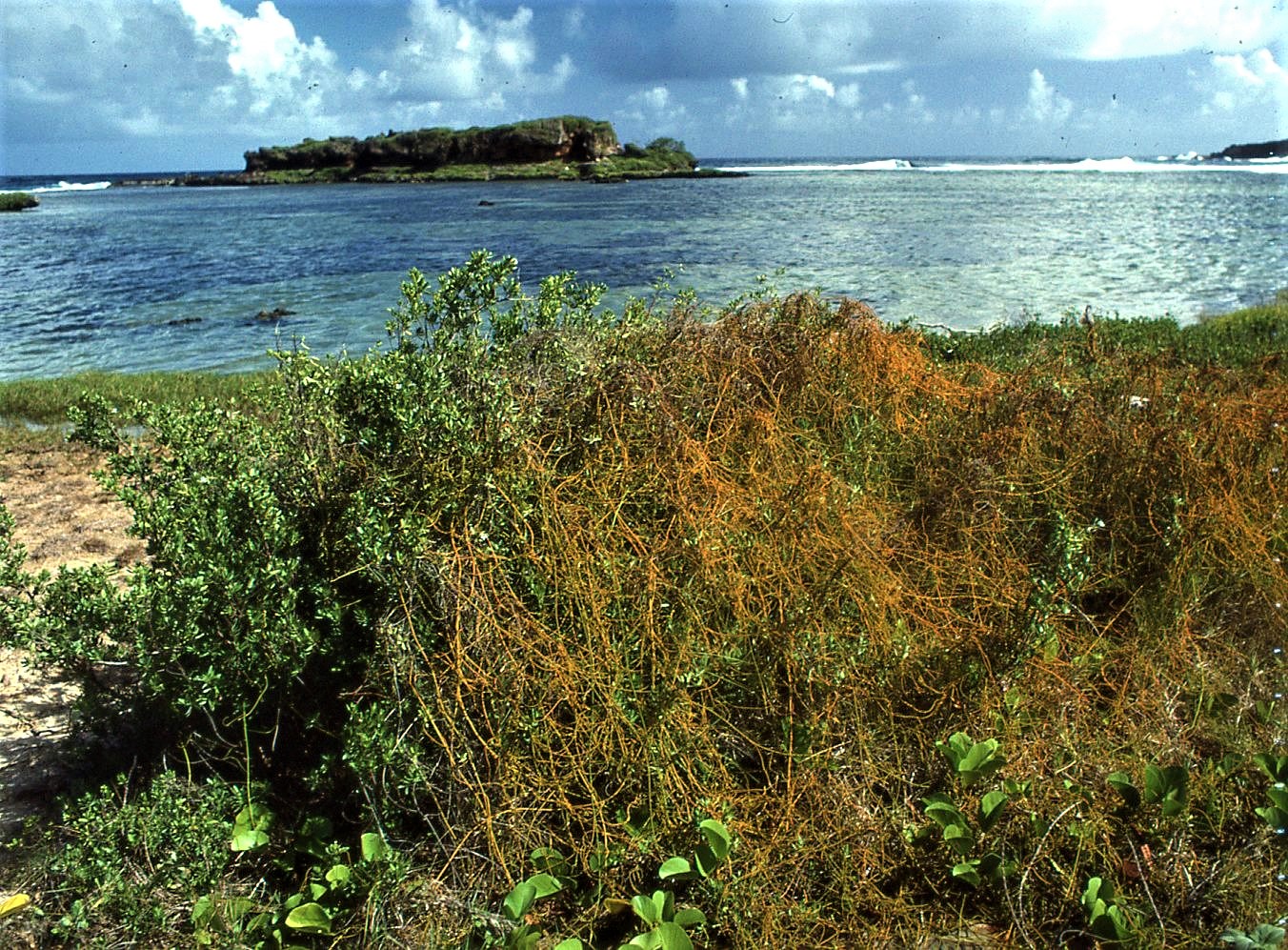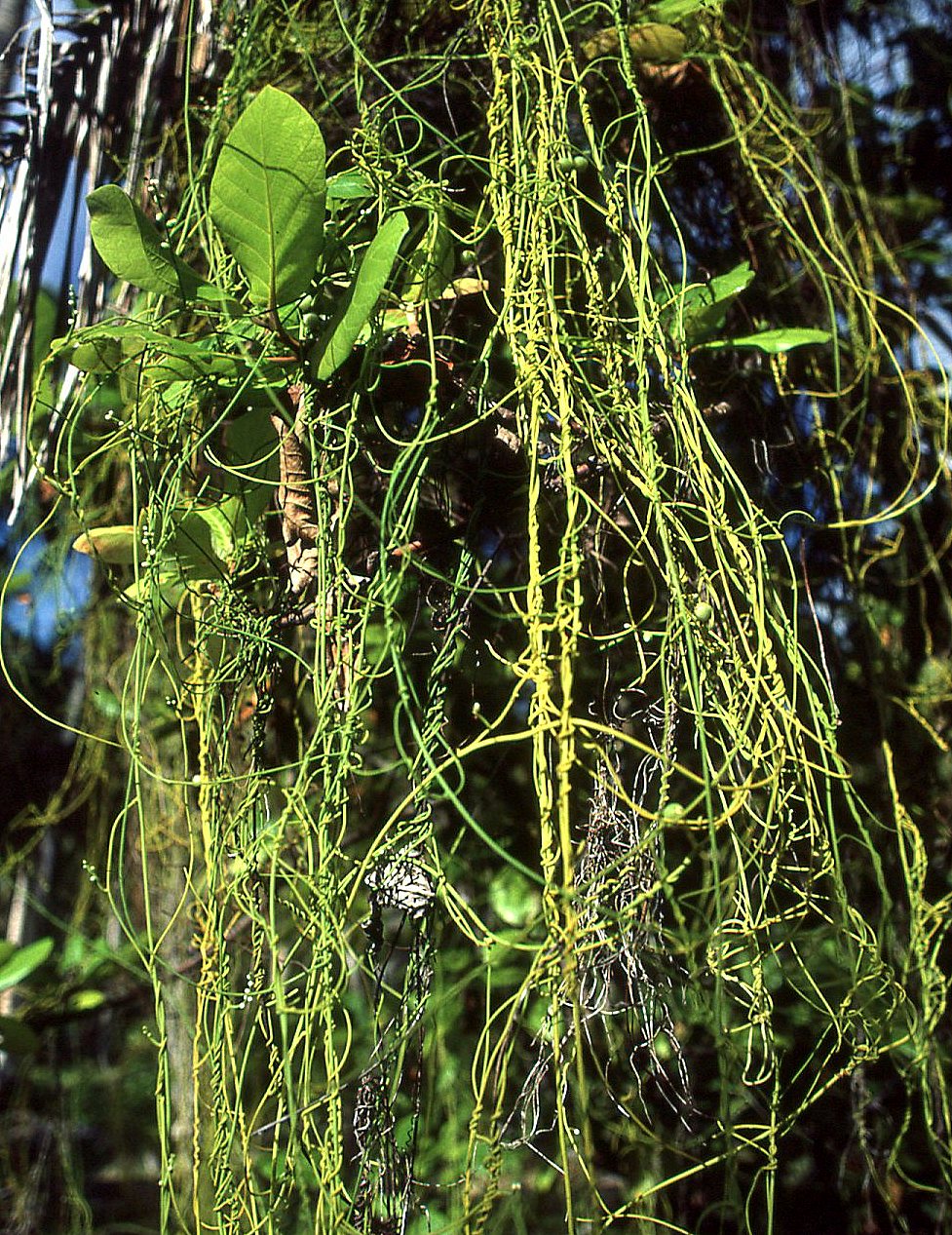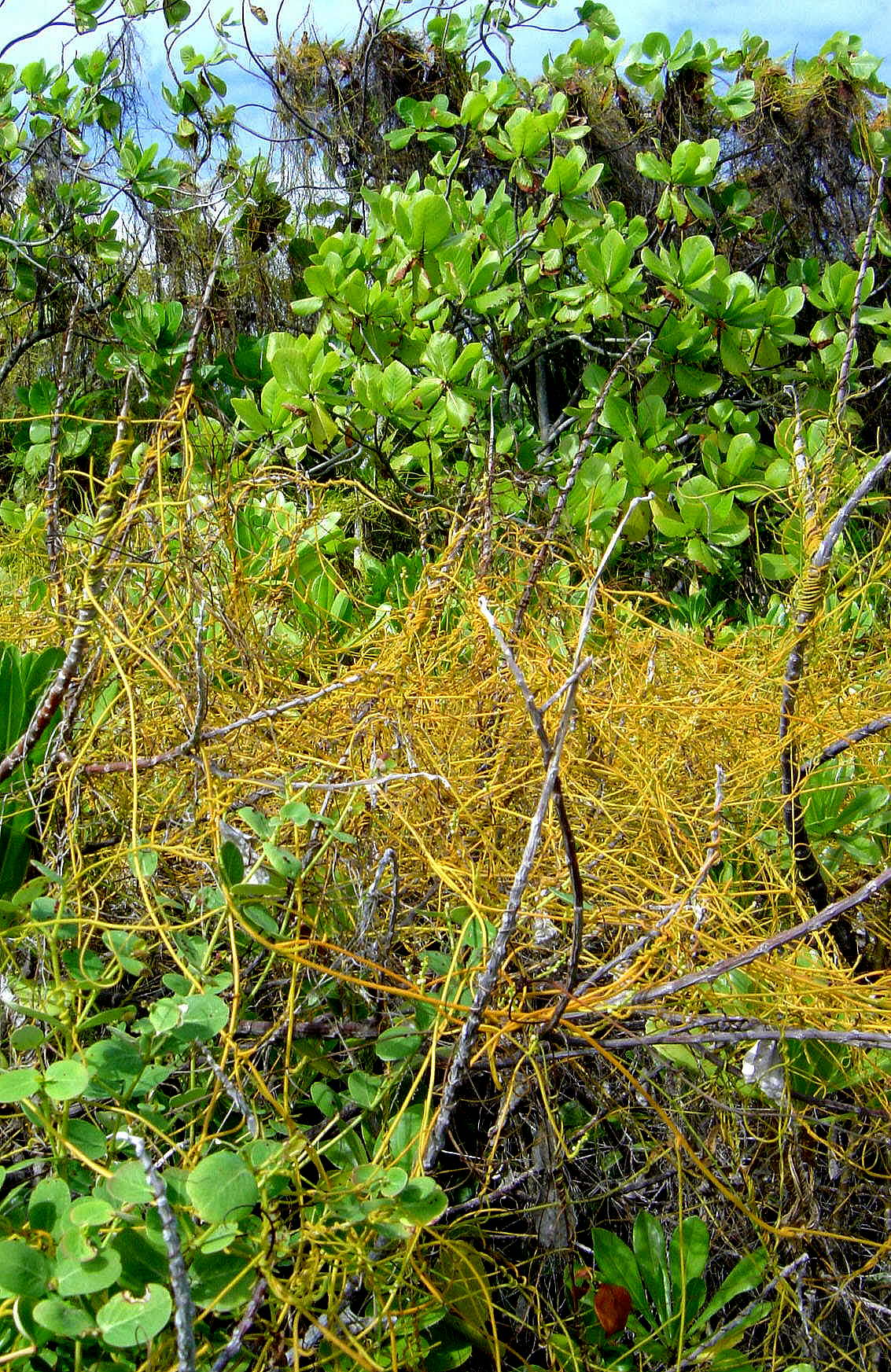
Description: Cassytha filiformis, a thin-stemmed, indigenous, tropical coastal vine, is a parasitic, herbaceous, and leafless species. It infests a wide variety of littoral plants in Micronesia as well as many other tropical shoreline areas of the world. The string-like, pale green to yellow or orange stems of C. filiformis attach themselves to other plants by suckers (known as haustoria) that take nutrients from the host plant. The many stems of this vine form dense, tangled mats that can climb over and almost completely cover a host plant. C. filiformis produces tiny greenish-white flowers clustered on short spikes, and its small white fruits are round and fleshy.
Distribution: There are about 20 species of Cassytha, of which “at least three species are locally important parasites of woody vegetation in some locations worldwide: Cassytha ciliolata Nees; C. filiformis L.; and Cassytha melantha R. Br.” (Nelson 2008:6). One of these, the tropical coastal vine C. filiformis is a native species in Micronesia. It spreads out over the ground and low-lying plants in the strand vegetation, and over taller plants near the shore and somewhat inland; occasionally it is found in the upland vegetation. It may cover shrubs and even some small trees with its dense masses of orange stems.
Uses by Island or Island Group: Scot Nelson (2008:1) refers to Cassytha filiformis as a being either a “blessing or a bane, depending on one’s perspective.” It is traditionally well-regarded with “diverse healing applications and with promise for modern medicine.” It also provides some food resources as well vine stems that are utilized in the construction in thatched roofing. And it also serves as a “potential biological control agent for invasive plants.” On the other hand, this relatively common parasitic vine can be a “pestiferous and pathogenic weed that is a threat to agriculture and endangered plants and is capable of transmitting other pathogens between plants.” Thaman (1994:168) referred to C. filiformis as one of those tropical coastal plant species found on many Pacific Islands that is “associated with revelry or ceremonial dress.” These and other uses of this native vine in Micronesia are listed below.
Uses in Palau: According to Okabe (see Defillips et al. 1988), Cassytha filiformis (known as Techelel a chull in Palauan), has been use to make medicine for gonorrhea. Tuyama (1941) also referred to C. filiformis as being used traditionally in Palau to treat gonorrhea and “may be useful as a diuretic.”
Uses in Yap: C. filiformis (known as Buk in Yapese) is reportedly used for medicine on Yap. For example, small children are sometimes given a remedy containing Buk for stomachache; Theth or Thoth (Scaveola taccada) is also used to cure stomachaches, but is too strong for children. According to Okabe (see Defillips et al. 1988), Buk is crushed and mixed with salt water and applied to bruises in Yap; and for nerve pain, leaves and stems are pressed, and the sap is consumed with coconut milk twice a day.
Uses on Ulithi Atoll: According to Lessa (1977:156), this orange, leafless, parasitic strand vine is used traditionally to feed infants:
“The mother may masticate the vine and transfer it directly to the baby's mouth from her own. The fruit is one of eight fruits put into the ‘flying fish bundle’ offered to the spirits by fish magicians. The tip of the vine is used to treat filariasis [leprosy] contracted by breaking taboos.”
Nelson (2008:9), probably based on Lessa’s research, referred to the fruit of C. filiformis being “used for fishing magic” as well as “a pre-masticated food for infants” on Ulithi Atoll.
Uses in the Mariana Islands: C. filiformis, known as Mayágas in the language of Chamorro people, occurs in open areas where it grows over strand vegetation in direct sunlight. “The stems are used as a medicinal ingredient in some of the medicines of the island’s traditional curers” (Moore and McMakin 1979:111). For example, McMakin (1978:25, 55) reported that the “entire [C. filiformis]plant except for the root is used” in an “all-purpose” medicinal preparation called “Amot Tinino.”This remedy was used by the local traditional healer, who brought together many freshly collected plants of particular species, including this indigenous vine, and boiled them to produce the desired therapeutic combination. In the Northern Mariana Islands, the “whole plant (stem)” of C. filiformis is reportedly used medicinally for “menstruation problems” (Nandwani et al. 2008:328).
Uses in Chuuk: According to Mahony (1973), C. filiformis, known asAnaw, Ótik or Acún on Chuuk, is regarded as a mysterious plant by some Chuukese. Since it has no visible origin in the ground or the vegetation on which it rests, the tangled and matted strands of the vine seem to form spacious nests that could not support any weight, but which are considered the sleeping place of those “sea serpents” [ghosts] called woos. According to Lessa (1977), in Chuuk this vine is used medicinally, and “in the low islands it is used as a pack in ovens.” The stem is also reportedly used medicinally on Namoluk Atoll. Manner and Mallon (1989) reported the use of C. filiformis fruit as a medicine, and “by children in popguns” on Puluwat Atoll.
Uses in Pohnpei: C. filiformis (known as Kotokotasahu in Pohnpeian) is used in making of head garlands or lei (mwaramwar) “to be worn as a badge of shame after not having caught any fish during a fishing contest” held twice a year on Pohnpei; one of these fishing contests is religious, and the other is “held by the municipal government in combination with the breadfruit festival” (Balick 2009). C. filiformis is also used in medicine to treat high fevers, pains in body and to grow long hair, and parts of this native vine are reportedly pounded and mixed in with water on Pohnpei to use as a shower, which is intended to restore memory or cure other mental problems.
Uses in the Marshall Islands: The stem C. filiformis (known as Kaōnōn in Marshallese) serves as a filter to strain prepared arrowroot (Tacca leontopetaloides) tubers by helping to separate the useless residue from the real food of the crop after it has been grated. The stems are also woven into ut (garlands). Kaōnōn has medicinal properties recognized by Pohnpeians as well. For example, during labor, a pregnant woman may bathe in water in which pounded Kaōnōn stems have been squeezed; this bath is said to provide the pregnant woman with strength and to reduce the pain of delivery. Pounded parts of this plant are also mixed into a potion that is applied to jellyfish stings. In addition, the pounded parts of Kaōnōn mixed with water are also used as a shower to restore memory or cure other mental problems. According to Marshallese traditional belief, Kaōnōn is used as protection from demons. For example, if one has to sleep alone in an isolated place, protection from demons can be obtained by covering oneself with Kaōnōn (e.g., Merlin et al. 1997; also see Taafaki et al, 2006, also see Balick et al. 2009).
Uses in Kiribati: According to the observations by Luomala (1953:104) on Tabiteuea Atoll in Kiribati, the leafless, parasitic C. filiformis vine (known as Te ntanini in Kiribati) only grows on the ocean side of the atoll and typically winds “round and round” the common Scaevola taccada (Te mao) coastal shrubs and sometimes around Guettarda speciosa (Te uri) and Pemphis acidula (Te ngea) trees. Luomala tells us that children consume the fruits of C. filiformis and are given credit for having learned that they are edible:
“Adults say that now they too gather and eat them when working in the bush. They have a slightly juicy, astringent taste and are really quite refreshing and thirst quenching. Tabiteueans regard the plant as indigenous, and say the name means ‘to go round and round.’ The vine is worn in dances as necklaces and head wreaths and is crossed over the chest and wrapped around the arms. Men also use it in love magic; women use it to dye their skirts black.”
Catala (1957) also referred the consumption of the somewhat acid fruits C. filiformis in Kiribati, especially by children. In addition, he indicated that the “dried and decorticated stems are sometimes used as riri,” the short leaf skirts, te riri, which are usually worn by adult women and principally made of made of coconut palm leaves or a type of reed (Te maunei, Cyperus laevigatus). Catala also referred to the use of the fresh stems of C. filiformis for stringing flowers into garlands. Nelson (2008:9) indicated that C. filiformis is used for sorcery in Kiribati.
Uses in Nauru: Thaman et al. (1994:159) offered the following notes on the uses of C. filiformis on Nauru and in Kiribati: “Entire plant used as garlands and headbands; plant used for ‘black magic’ by I Kiribati and other islanders, a practice occasionally copied by Nauruans; tender tips used at times in the past for scenting coconut oil; fruit eaten by children in the past.”