Distribution: Mā was introduced into the Marshall Islands by early Micronesian settlers. Mejwaan, the first variety to mature each year, is said to have come from Jelbon, Mile Atoll. The bukdoļ variety has its origin at Kaijin Island, Wōjjā: According to a Marshallese story, two boys pitted their kōtkōt (Arenaria interpres or ruddy turnstone) against a spirit's bird. When the boys' bird won the contest, the spirit threw the boys in a pit and fattened them with fruit from a nearby mā tree, planning to eat them later. The tree is still alive today, and its size is said never to change.
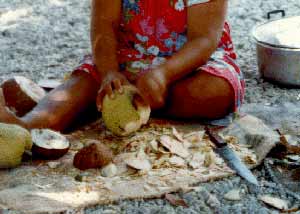
Uses: There are numerous uses for breadfruit in the Marshall Islands. The fruit, of course, is a major traditional staple and ceremonial food. Breadfruit may be prepared in a variety of delicious recipes (the Marshallese-English Dictionary lists 20). The mature fruit can be baked, boiled, roasted, steamed, fried, or made into soup. If baked traditionally, it is put in the underground oven (um) for at least 4-5 hours; if it is steamed, the fruit is cut into many slices and cooked for about 1 to 2 hours. The fruit can also be cut into many small pieces and than fried in a skillet. Breadfruit can be fermented (kabwiro) and stored for later use. To produce bwiro: Remove the skin of the fruit; place it in cloth bags (approximately 200 lbs of fruit per bag); soak it in saltwater for two or three days; take the fruit from the bags and squeeze or knead it to remove the water; then bake it in the um. The bwiro is then stored in Marshallese baskets or more commonly now in large biscuit or cracker cans. Breadfruit preserved in this manner can be stored for 12 or more months before being eaten. Thus it has long served as an important emergency food in times when food is scarce (for example, following disastrous storms or other natural calamities). Another preserved food, jekaka, is prepared by baking and sun-drying. Jekaka lasts for a long time and is also the first process in the preparation of the breadfruit preserve known as jāānkun (in the Rālik Chain this term is also applied to dried pandanus paste). It can be dried in a fashion similar to that used for arrowroot and mixed with water for consumption as needed. Over-ripe fruits can be fed to pigs. The trunk and large branches of mā can be used to make canoe hulls, and other wood products. Fallen branches of the breadfruit tree are used for firewood. The leaves serve as fans, plates, wrappings for baked foods, and have a number of other uses. The white sap that exudes from ripe fruit has long been used for a variety of purposes in the Marshall Islands. Traditionally, the cooked sap served as a glue; for example, it was put on the end of a long pole used to catch birds. Today breadfruit sap glue is sometimes used in schools as classroom paper glue. The roots of breadfruit are also used for Marshallese medicine.
1. Fruits born on branches, moderate in size
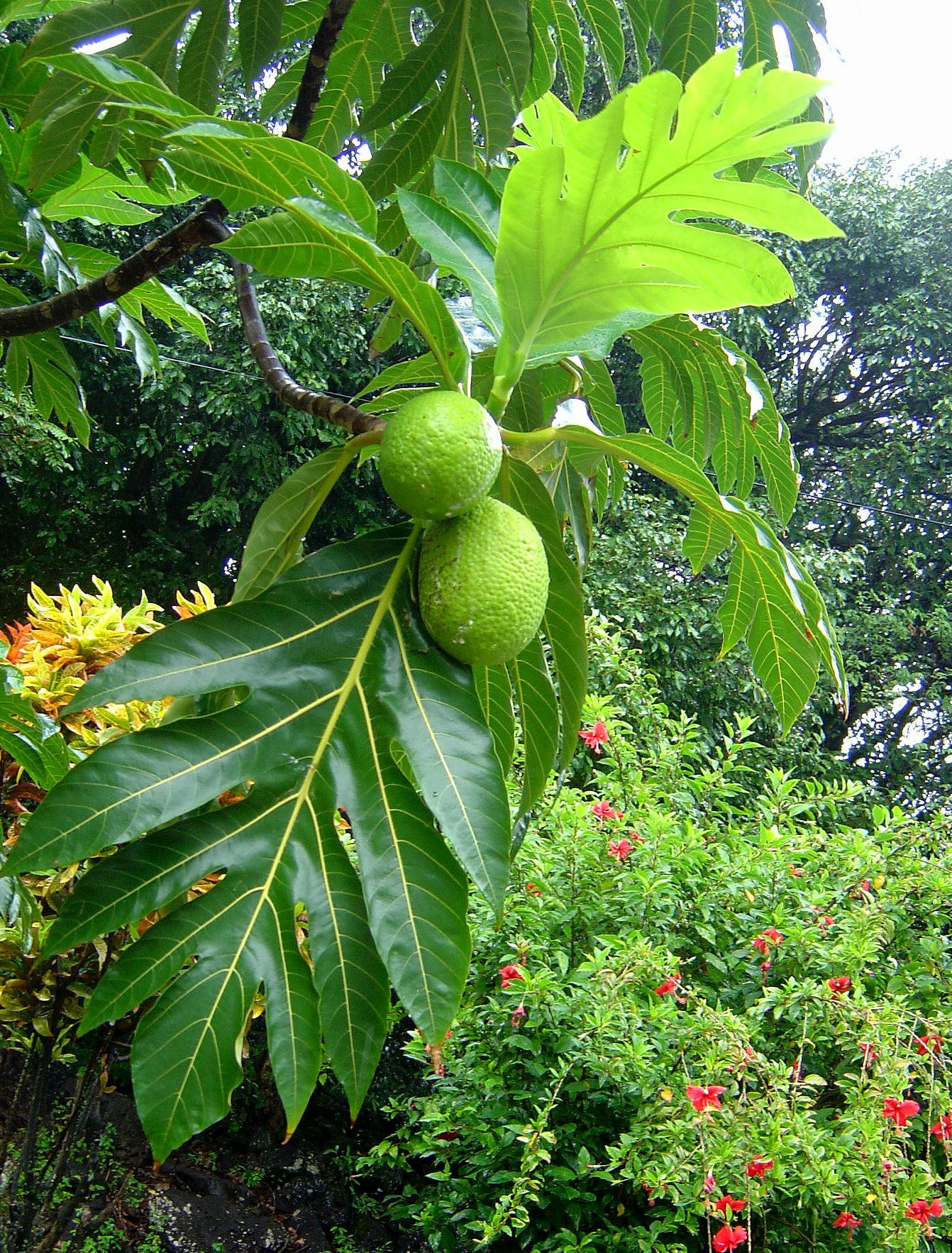
2. Leaves pinnately lobed, lower surface without hairs, fruit often over 20 cm long, usually seedless .......... Artocarpus altilis
2. Leaves simple, generally entire or with few shallow, lobes lower surface hairy, fruit mostly 15 to 20 cm long and with seeds ........................................................................... A. mariannensis
1. Fruits borne on lower part of main trunks, cylindrical, often 30 to 40 cm long, leaves not lobed or only slightly lobed
2. Fruits often over 35 cm long, twigs and stems with stiff hairs (English: jak-fruit; Chamorro: nangka) .............. A. heterophyllus Lam.
2. Fruits up to 30 cm long, twigs and leaves without hairs (Chamorro: lemasa; Malay: chempedak ............... A. integer (Thunb.) Merrill
Distribution: Artocarpus mariannensis: endemic to Micronesia; A. altilis: Malaysian and Pacific area; Marianas and Carolines; A. heterophyllus and A. integer: Indo-Malaysia.
Comments: Artocarpus altilis is a very important food and multipurpose tree cultivated and naturalized, spreading via root sprouts. It hybridizes with the wild A. mariannensis, producing intermediates. Artocarpus heterocarpus and A. integer are not common on Yap.