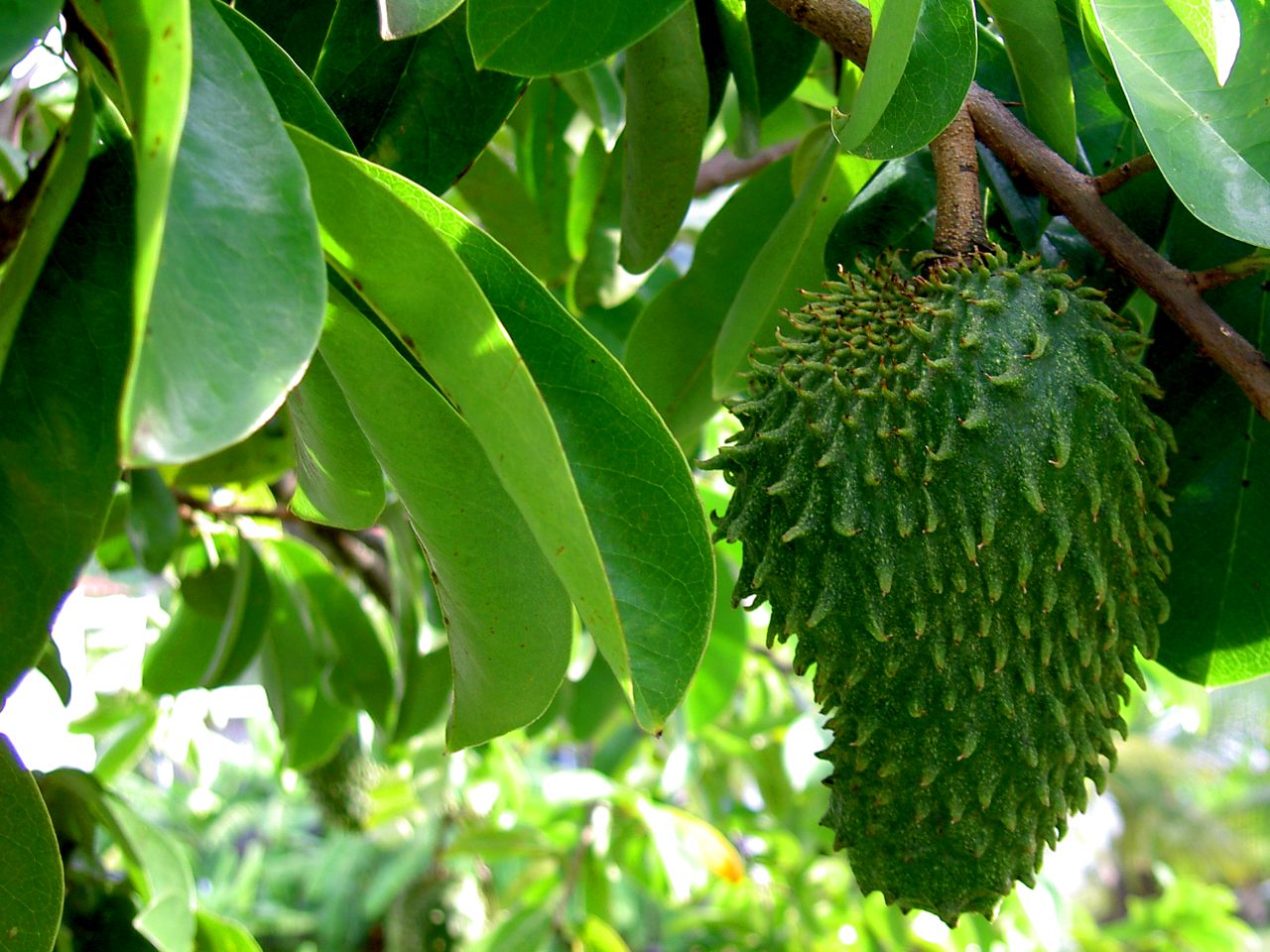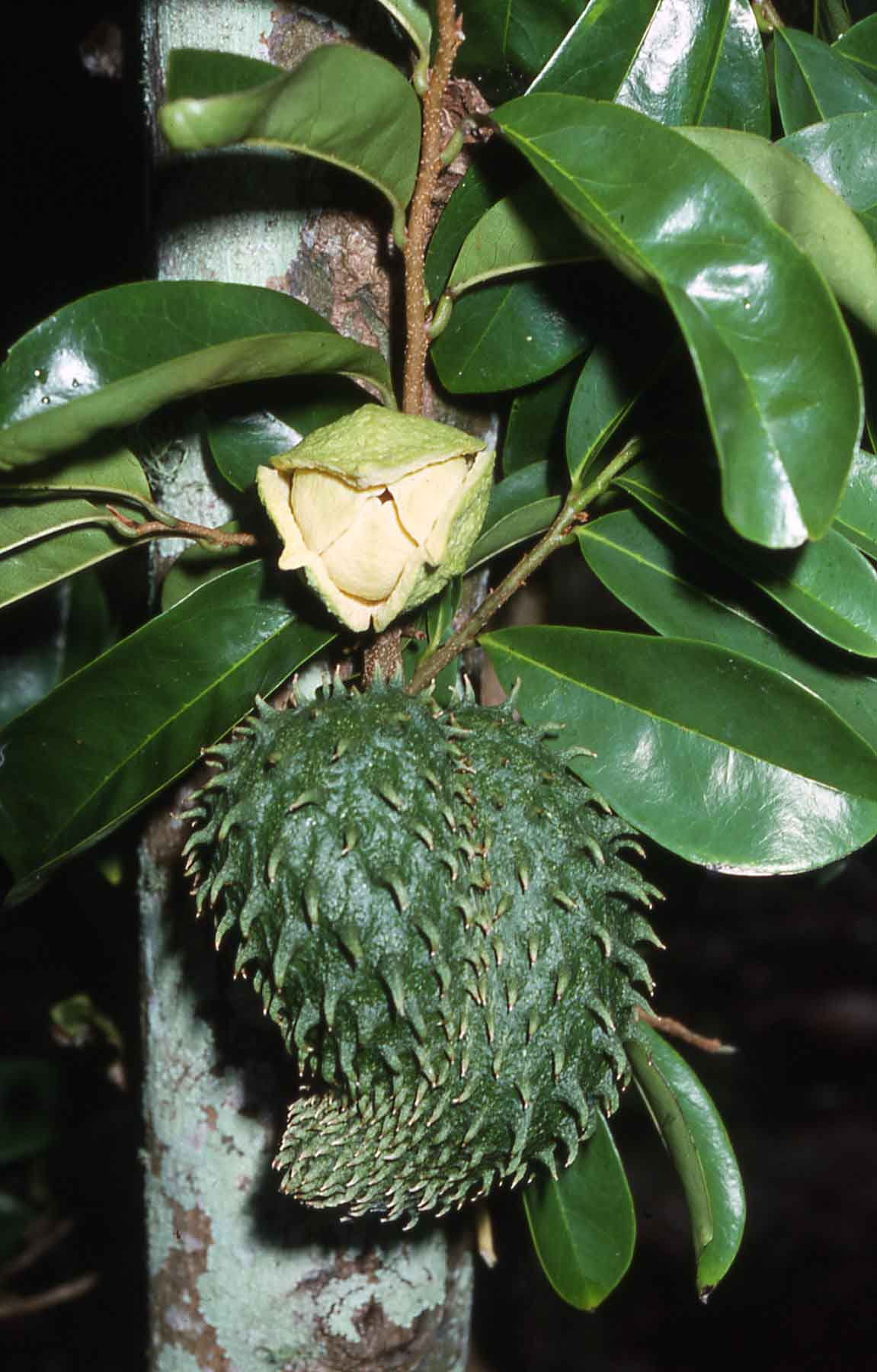
Description: Known in English as the “soursop” tree, Annona muricata is a cultivated woody species which usually does not reach heights of more than 8 m (25 ft). This small, much branched evergreen tree produces shiny, dark green, oblong or oblong-elliptic leaves which are pointed at the apex and rounded at the base. Its large, irregularly heart-shaped, soft-spined, yellowish green fruits are more or less oval or heart shaped; these soursop fruits that can reach about 10-30 cm (4-12 in) in length and are covered by a leathery skin with regularly-spaced, short, slightly curved, fleshy spines. The edible pulp is cream-colored, granular, and separates easily from the mass of white, juicy segments surrounding the central core. The pulp of the soursop fruit has a somewhat pineapple-like aroma, but its musky, sub-acid to acid flavor is distinctive. The seeds are tough and dark brown to black (Stone 1970, Morton 1987, also see Falanruw 2015:34).
Distribution: This fruit tree is native to tropical America, probably originating “in the Antilles in the Caribbean, Central America and South America [and now is] widely distributed in Asia from south India to northern Australia and Polynesia, [as well as] in Africa in the hot lowlands in the west and east” (Lim 2012:191). In addition, the “soursop” tree was probably introduced to some islands of Micronesia such as Yap before World War II for its food value. It is often cultivated in gardens, especially near homes on the high islands, but it can be found elsewhere, typically in lowland areas below 1200 m elevation. It is a hardy fruit tree which thrives in many tropical regions today because it can tolerate relatively poor soils (PIER 2002).
Uses by Island or Island Group: Although Annona muricata (soursop or graviola) of Annonaceae family is best known as a tasty fruit pulp resource, it has also been used widely in medicinal remedies for many years, and it reportedly has a broad range of therapeutic effects, including antibacterial, antiviral, antifungal, antitumor, antihelmin, analgesic, hypotensive, antiinflammatory, and immune enhancing effects” (Dongre 2014).
Uses in Palau: Ripe fruits of the introduced soursop tree (Sausab in Palauan), Annona muricata, are eaten in Pohnpei, and it has been common in recent years for people to mash and mix the soursop fruit and add sugar with some water to make a soursop “smoothy” beverage.
Uses in Yap: The juicy, somewhat acid, aromatic, ripe fruit of A. muricata (known as Sausau in Yapese) is eaten in Yap, where soursop is of “minor importance for food” (Hunter-Anderson 1991:39-40). “The seeds of Annona muricata can be crushed, mixed with shampoo, and used to kill head lice…. [and the leaves and bark] are used medicinally” (Falanruw 2015:34).
Uses in the Mariana Islands: A hundred years ago in Guam, the soursop tree, A. muricata was reportedly not as commonly cultivated as the closely related (Annona squamosa). Soursop has a pleasant acid flavor. The natives reportedly make jelly of it and preserve the fruit. It is of tropical American origin and was introduced into Guam over two hundred years ago. “The vernacular name for Annona muricata, laguaná, is probably derived from the Spanish-American name of the fruit laguanábana” (Safford 1905); the closely related “cherimoya” fruit tree, Annona squamosa, Atis or Ates in the local language of the Mariana Islands, is said to be more commonly planted and its fruit more readily eaten in these islands than the fruits of A. muricata or laguaná. In areas of remaining agroforest in the Mariana Islands, custard apple (Annona reticulata), soursop (A. muricata) and sweetsop (A. squamosa) are among the useful cultivated trees (Falanruw et al. 1989:8).
Uses in Chuuk: The juicy, somewhat acid, aromatic, ripe soursop fruit of A. muricata, known as Saasaf, Saasap or Sasaf in Chuukese, is eaten in Chuuk.
Uses in Namoluk: Marshall (1975) reported that informants had given him local names for ninety-eight plants growing on the atoll in 1971, of which many were introduced (alien), including Saasaf, the soursop (A. muricata).
Uses in Pohnpei: The stems of the introduced soursop tree (A. muricata, known in Pohnpeian as Sei) have been used in Pohnpei to make tool handles. In addition, in recent times, the juice of ripe soursop fruits is sometimes extracted and allowed to ferment for about a week and then consumed as an alcoholic beverage. Medicinally, parts of this tree have been used in Pohnpei to treat seizures (lusulus), asthma, headaches, upset uterus, and to inhibit vomiting. It has also been reported that the bark is scraped, pounded, and wrapped in a piece of cloth to use as a charm to cast away an angry spirit of an ancestor (winahnihn kouseni, see Balick 2009).
Uses in the Marshall Islands: The soursop (Jojaab) is an introduced fruit tree in this island group. However, it is not common in the Marshall Islands because it does not grow well in most places on these coral limestone atolls.
Uses in Nauru: The soursop (known on Nauru as Dawatsip) is a recently introduced fruit tree in this island. It is cultivated in home gardens for its ripe fruit which is eaten raw, often with ice cream; elsewhere the soursop tree is reportedly grows “spontaneous on coastal strip, in some areas of escarpment forest, and in the Buada Lagoon area” (Thaman et al. 1994:88).