


Family: Euphorbiaceae
Copper-leaf
Smithsonian Institution
Common or English Name: Copper-leaf or Joseph's Coat
Micronesian Names by Islands or Island Groups: Cheresachelucheang, Cheremalucheang or Klekel (Palau), Mónnow (Chuuk), Te aronga (Kiribati)
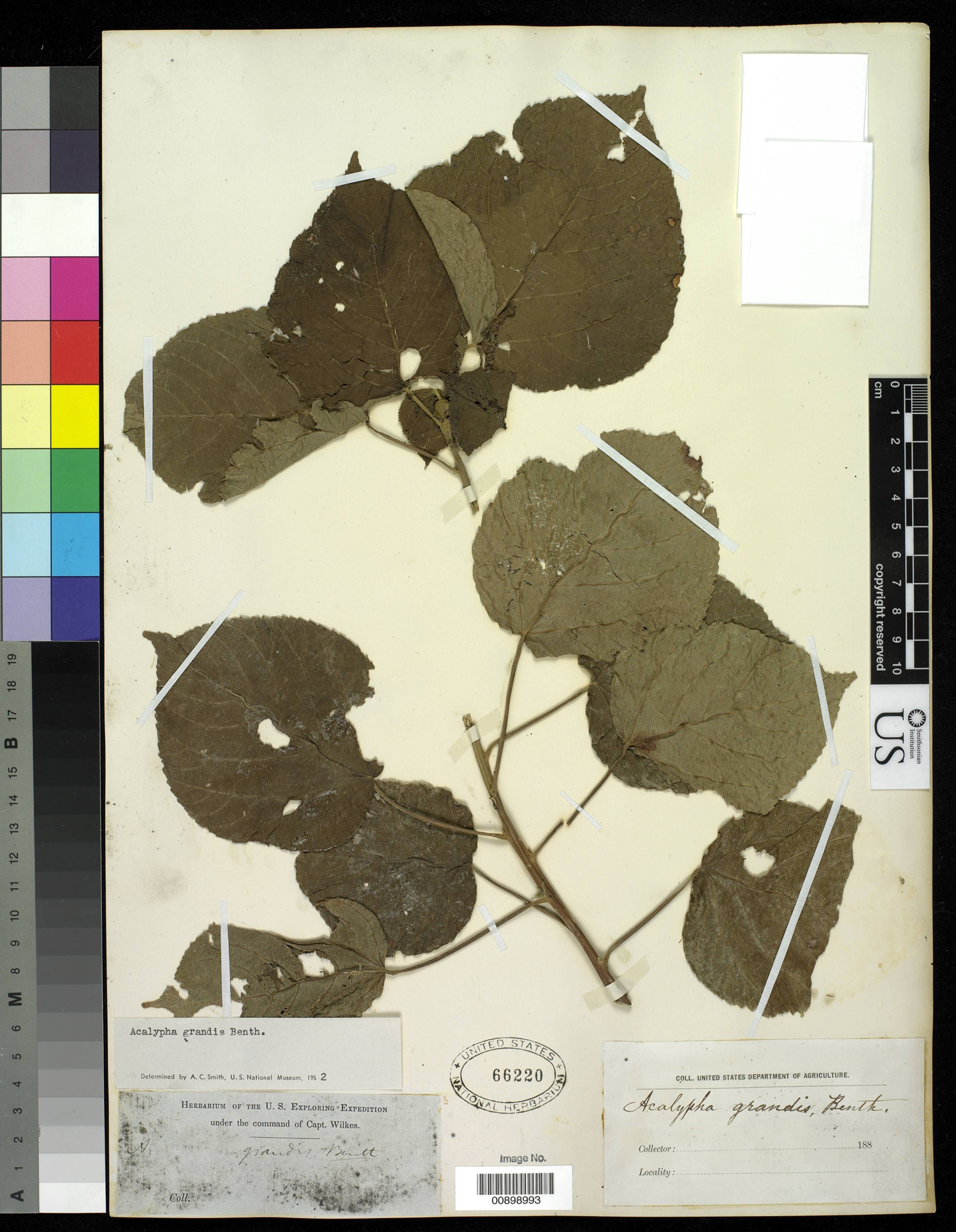
Description: Acalypha grandis, also known as known as Acalypha amentacea, is a medium to large shrub can grow to 2-5 m (6-15 ft) in height. It produces curved, green to reddish leaves, 10-20 cm (4-8 in) long with serrated edges and blotches. The small, male and female flowers have no petals and are borne on narrow spikes. Each female flower grows from the axil of a bright red bract on a nearly erect spike; male flowers are produced in narrower, longer, hanging "strings" among lower leaves on the same shrub. Numerous cultivars are recognized, primarily by leaf coloration and leaf width.
Distribution: Native to Malaysia or western Melanesia, Acalypha grandis was probably introduced to some tropical Pacific islands in the pre-European contact period by early voyagers; however, it may have arrived in some regions of Micronesia in more recent times. This shrub is now common to abundant in home gardens or other cultivated areas, e.g., in Chuuk.
Uses by Island or Island Group: As an ornamental plant, Acalypha grandis is often planted for hedges and used to mark boundaries on many Pacific islands because it grows quickly, is attractive, and usually grows luxuriantly from stem cuttings. It is also able to survive relatively dry periods in poor soil.
Uses in Chuuk: According to Mahony (1973), wood cut from these slender trees are favored for breadfruit picking poles in Chuuk, and the dry timber was preferred for drills (niiok) used to start fires. The leaves are used to cover the earth oven and to wrap fish.
Uses on Pingalap Atoll: According to St. John (1948:111), Acalypha grandis has been cultivated on Pingalap Atoll where it is called “Kurulong.” St. John referred to this alien shrub as an “ornamental, grown in the village beside the houses or as a hedge plant, introduced during the German rule.”
Uses in Kiribati: According to Thaman (1990), Acalypha amentacea [A. grandis] is a commonly cultivated ornamental plant in villages where it is cultivated as a hedge or living fence, and its leaves are integrated into garlands. Catala (1957) referred to it as a food plant in areas other than Kiribati, but it was used in these islands for ornamental purposes, mainly for personal ornamentation. In the 1950s, this plant was very rare in Kiribati, but quite common on Nauru, where it was used to make hedges, and from where it was most likely brought to Kiribati by people from Kiribati who went Nauru to work in the phosphate mines on that raised atoll in Micronesia (see below).
Uses in Nauru: Acalypha amentacea was probably introduced to Nauru and other Micronesian Islands before WW I and since then it has been used as an ornamental and hedge species (Thaman et al. 1994:125) with one of its names on Nauru (“Kayser bush”) honoring a European missionary (Alois Kayser) who spent about 30 years on the island and may have been the person who brought it Nauru, or was noted for cultivating it.
Micronesian Names by Islands or Island Groups: Cheresachelucheang, Cheremalucheang or Klekel (Palau), Mónnow (Chuuk), Te aronga (Kiribati)
Description: Acalypha grandis, also known as known as Acalypha amentacea, is a medium to large shrub can grow to 2-5 m (6-15 ft) in height. It produces curved, green to reddish leaves, 10-20 cm (4-8 in) long with serrated edges and blotches. The small, male and female flowers have no petals and are borne on narrow spikes. Each female flower grows from the axil of a bright red bract on a nearly erect spike; male flowers are produced in narrower, longer, hanging "strings" among lower leaves on the same shrub. Numerous cultivars are recognized, primarily by leaf coloration and leaf width.
Distribution: Native to Malaysia or western Melanesia, Acalypha grandis was probably introduced to some tropical Pacific islands in the pre-European contact period by early voyagers; however, it may have arrived in some regions of Micronesia in more recent times. This shrub is now common to abundant in home gardens or other cultivated areas, e.g., in Chuuk.
Uses by Island or Island Group: As an ornamental plant, Acalypha grandis is often planted for hedges and used to mark boundaries on many Pacific islands because it grows quickly, is attractive, and usually grows luxuriantly from stem cuttings. It is also able to survive relatively dry periods in poor soil.
Uses in Chuuk: According to Mahony (1973), wood cut from these slender trees are favored for breadfruit picking poles in Chuuk, and the dry timber was preferred for drills (niiok) used to start fires. The leaves are used to cover the earth oven and to wrap fish.
Uses on Pingalap Atoll: According to St. John (1948:111), Acalypha grandis has been cultivated on Pingalap Atoll where it is called “Kurulong.” St. John referred to this alien shrub as an “ornamental, grown in the village beside the houses or as a hedge plant, introduced during the German rule.”
Uses in Kiribati: According to Thaman (1990), Acalypha amentacea [A. grandis] is a commonly cultivated ornamental plant in villages where it is cultivated as a hedge or living fence, and its leaves are integrated into garlands. Catala (1957) referred to it as a food plant in areas other than Kiribati, but it was used in these islands for ornamental purposes, mainly for personal ornamentation. In the 1950s, this plant was very rare in Kiribati, but quite common on Nauru, where it was used to make hedges, and from where it was most likely brought to Kiribati by people from Kiribati who went Nauru to work in the phosphate mines on that raised atoll in Micronesia (see below).
Uses in Nauru: Acalypha amentacea was probably introduced to Nauru and other Micronesian Islands before WW I and since then it has been used as an ornamental and hedge species (Thaman et al. 1994:125) with one of its names on Nauru (“Kayser bush”) honoring a European missionary (Alois Kayser) who spent about 30 years on the island and may have been the person who brought it Nauru, or was noted for cultivating it.