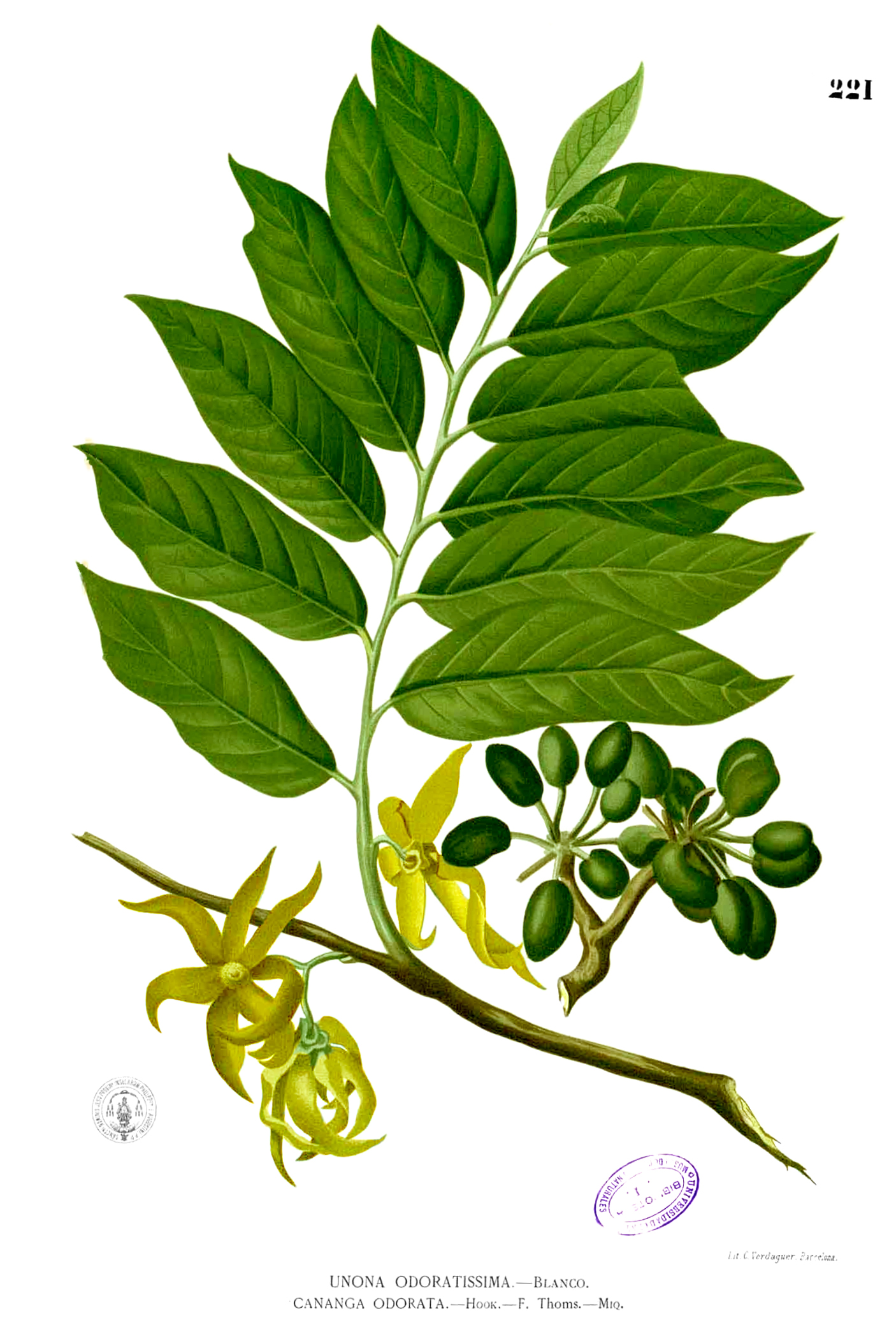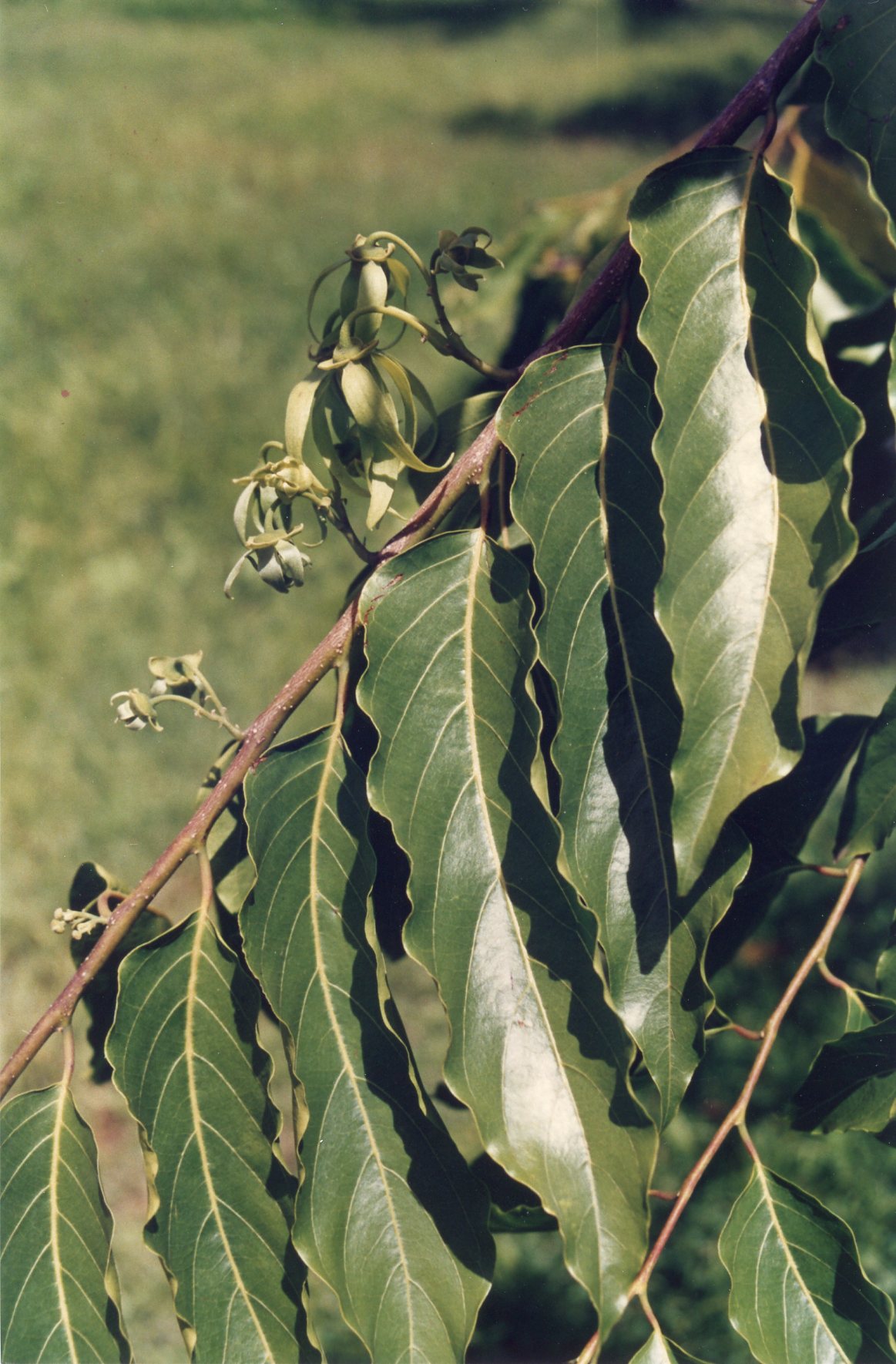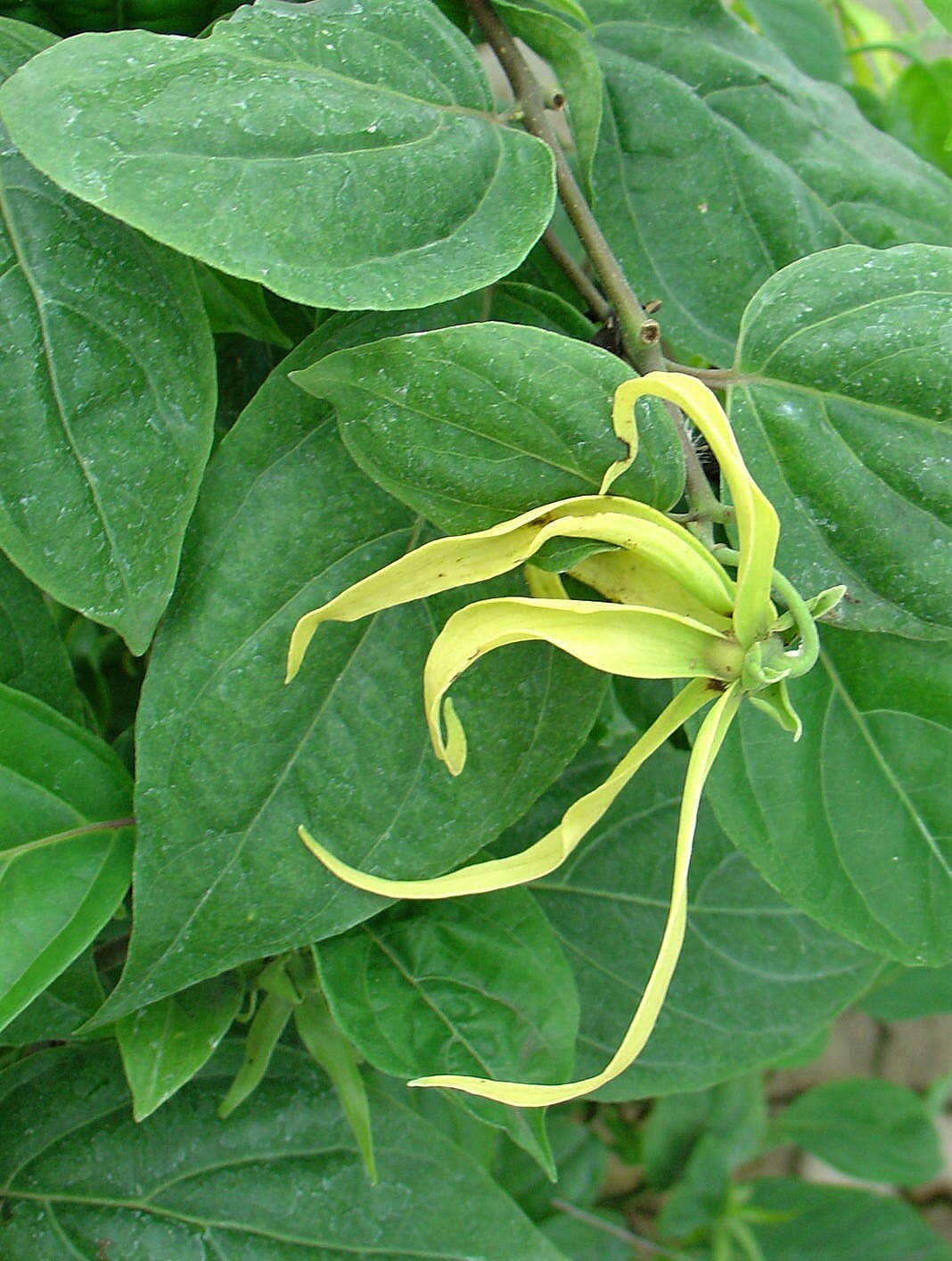
Description: Cananga odorata is a relatively fast growing tree that can reach heights of about 10-20 m (~33-65 ft) or more, preferring moist soil rich in humus. It produces a crooked trunk, smooth, gray bark, and drooping, brittle branches with large glossy dark green leaves, up to about 20 cm (8 in) in length, are arranged along a plane, and are alternate, simple, entire, elliptic-oblong in shape and have a drip tip. C. odorata flowers throughout the year in clusters of 4-12 yellowish green inflorescences which consist of long, twisted, wavy, linear-lanceolate, drooping petals in thick bunches at the leaf axis; these are followed by small greenish fruit which are fleshy, containing many seeds. Sometimes referred to as a “perfume tree” because its flowers are very fragrant, it is commonly refered to widely as Ylang Ylang.
Distribution: Cananga odorata is a useful tree native to Southeast Asia, the Philippines, northern Australia, and may be truly wild as far to the east as the Solomon and some of the Caroline Islands. However, it was probably introduced during prehistoric times into a number of Pacific islands, while it is a more recent introduction in others. This relatively fast-growing tree (increasing more than 2 m in height per year) was probably brought to all or most of the Micronesian Islands after early European contact (e.g., see Manner and Elevitch 2006). In some cultivated or disturbed tropical Pacific island areas where it is native, or more likely alien, C. odorata sprouts from seeds scattered by birds, especially pigeons, and other animals. It is thus common in home gardens and is occasionally planted or protected in other areas.
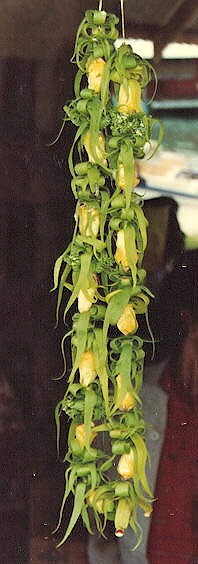
Uses by Island or Island Group: In the Pacific, C. odorata can be used for many purposes. For instance, the wood is used in the construction of small canoes and furniture, as well as for fuelwood. It can serve as a trellis support for vine crops such as yams. The fragrant flowers are also used in making garlands such as lei and mwarmwars; and the essential oil extracted from the flowers of this tree is used in perfumes, soaps, shampoos and other cosmetic products, foods, and aromatherapy (e.g., see Elevitch 2006).
Uses in Palau: The flowers of C. odorata are collected and used in garlands in Palau. The flowers are also put in coconut oil that is used for body perfume; it is also, used as an air freshener (Cynthia Chin, personal communication, 2002).
Uses on Guam: Safford (1905) commented on the shapes and distribution of C. odorata on Guam over a century ago:
“Bark of tree smooth, ashy; trunk straight normally, but in Guam often twisted out of shape by hurricanes. In Guam, straight trunks of sufficient size for canoes are never found. Its introduction into Guam is comparatively recent; but the fruit eating pigeons are spreading it gradually over the island.”
According to Moore and McMakin (1979:133), C. odorata was most likely brought to the Mariana Islands from the Philippines where it is generally known as Ylang-Ylang: “The scented flowers are soaked in coconut oil to make a pleasantly perfumed body lotion that is sometimes thought to ward off malevolent spirits to cure spirit-caused illnesses.” In the Northern Mariana Islands, Nandwani et al. 2008:325) listed medicinal for pneumonia and stomach ache, and referred to the emotional use of C. odorata flower garlands to “a’good feel’ status.”
Uses in Chuuk: The flowers of C. odorata are collected and used in garlands in Chuuk, where it is a source of firewood, and since this tree will grow back (coppice) from a cut stump, the entire tree is sometimes chopped down to harvest the sweet smelling flowers. Flowers are used as fragrance in coconut oil for bathing in Chuuk. Stone (1967a:113) referred to this fragrant treein his study of the plant species on Romonum Island in Chuuk Lagoon as occuring: “in gardens around houses, or on old house sites, and also sometimes at random in various parts of the higher parts of the island, will be found ornamental species [including C. odorata]and hedgerow species.”
Uses on Puluwat (Poluwat) Atoll: C. odorata is occasionally found as an ornamental tree in village areas of Puluwat Atoll where it is cultivated primarily for its fragrant flowers that are used in garlands.
Uses in Pohnpei: This species is used on Pohnpei as an understory trellis tree for yams in agroforest areas, where it is sometimes ring-barked for this purpose (see Manner and Elevitch 2006). Women use the fragrant flowers as ornaments, weaving them into mwaramwar head garlands. The flowers are collected with the use of a hooked pole made of Keleu (Hibiscus tiliaceus) or Ahlek (Saccharum spontaneum). Since this tree will grow back (coppice) from a cut stump, it is chopped down sometimes to harvest the sweet smelling flowers. Medicinally on Pohnpei, C. odorata is used: “To treat fungal infection, as many flowers as needed are boiled in as much water as needed; then, after the water has cooled, it is used to bathe the body…To treat sunburn, red spots, and other skin problems, coconut oil (Cocos nucifera) is heated and the flowers are added and left to stand for a while, after which the flowers are strained off and the purified oil is obtained, then applied to the skin...(see Balick 2009).”
Uses in Kosrae: On this island, yam vines are often trained to grow up over C. odorata plants into the canopy; and to facilitate this farming technique, these “perfume trees” are killed by girdling (ringing the bark). The fragrant flowers of C. odorata are used by women as ornament and woven into neck and head garlands. The flowers are collected with the use of a hooked pole made of Lo (Hibiscus tiliaceus). Since this tree will grow back from a cut stump, sometimes the entire tree is chopped down to harvest the sweet smelling flowers.
Uses in Nauru: Cananga odorata is an uncommon tree on Nauru where it is planted as an ornamental tree in home gardens in the Buada Lagoon area. Its flowers are used in garlands and for scenting coconut oil (Thaman et al. 1994:89).