Micronesian Names by Islands or Island Groups: Pele (Chuuk), Pele (Marshall Islands), Nabare, Te nambere or Te bere (Kiribati).
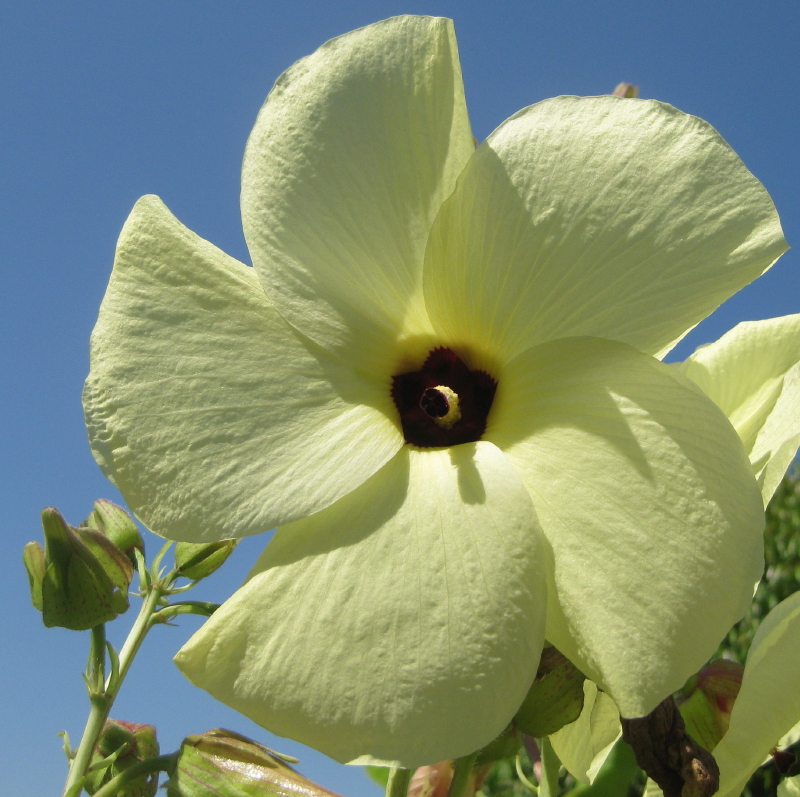
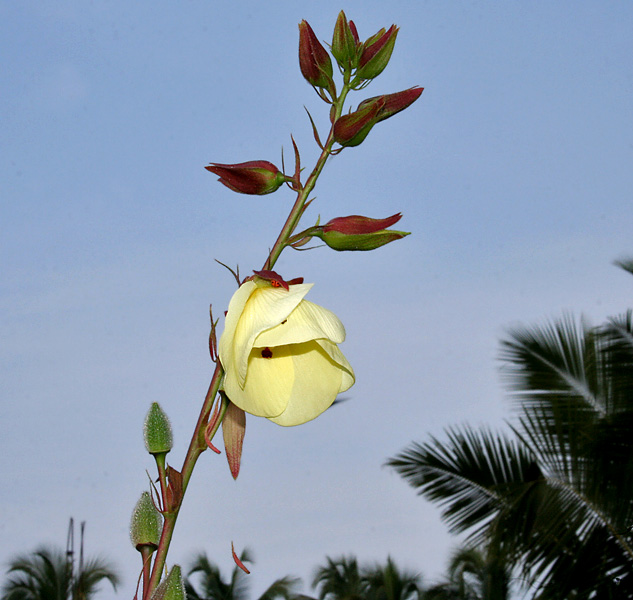
Description: Abelmoschus manihot has many English names including Edible Hibiscus which relates back to the Hibiscus manihot, an earlier scientific name for this species. A. manihot is a perennial shrub which, under good conditions, can grow to over 3 m (~ 9 ft) in height. A. manihot has a single central stem up to 2 m (~6 ft) long and short sparse branches. It grows very quickly and is a hardy plant, which prefers a sunny aspect with rich, moist, well- drained soil; however, the plants may naturalize (set seed and grow on their own). Plants grow well in an ornamental vegetable garden, and this may not only add to the appearance of the garden but may also make it easier to ensure that the plant does not naturalize. The large, up to 15 cm (6 in) hibiscus-like flowers are yellow to white in color, often a brilliant lemon with deep purple centers borne on long pedicels at the apex of the plant. Flowers are produced in the warmer months with pollination occurring via insect activity. Although the flower petals can be added to salads or cooked, and the ornamental attractiveness of the large yellow flowers, the main significance of A. manihot is that it produces very nutritious, large leaves that have relatively high protein content. The edible leaves are ovate to nearly orbicular in shape about 15-30 cm (6-12 in) long or more, and generally tender and sweet; and they can be served raw or steamed. The specific (epithet) name manihot probably suggests the resemblance its leaves to those of the widely cultivated tropical food plant known as cassava or manioc. Indeed, there several varieties of A. manihot among which the lobes of the leaf can vary in depth and leaf color, with the latter ranging from sulfur yellow to very dark green. Propagation occurs through seed sown in the spring or by root division and replanting (i.e., vegetative reproduction).
Distribution: The native range of A. manihot extends from East and Southeastern Asia to Northern Australia, and is an aboriginal introduction to Melanesia and possibly parts of Western Polynesia; but it is most likely a more recent introduction into other areas of Polynesia and Micronesia. Normally it is found in habitat wasteland and humid rocky hillsides. In Guam, it reportedly is found in “marshy locations” (Stone 1970:408); “Very nutritious leafy green vegetable, high in iron, vitamins A and C and fiber, which is one of the most important spinaches in Tonga and Melanesia” (Thaman 2016:98)
General Uses: As a perennial shrub, A. manihot can grow to over three meters in height under good environmental conditions. It is a nutritious vegetable, with leaves that have relatively high concentrations of vitamins A and C, iron and about 12% protein by dry weight. The very nourishing leaves of A. manihot are commonly used in salads, stir-fry, stews and soups. Ethnobotanist Jacques Barrau (1958) described this edible species as “truly the traditional vegetable for all Melanesia” where its nutritious leaves are widely eaten. Moreover, this perennial shrub is easily propagated from cuttings and therefore easy to cultivate; it is also relatively disease-resistant, and “provides a continuous supply of highly nutritious leaves and shoot tips throughout the year” (Preston et al. 1998:8); and it is also considered to be a useful medicinal species. According to Clarke and Thaman (1993, no. 51), the Edible Hibiscus is: “Common to abundant in both rural and urban food gardens; common in home gardens. A wide range of cultivars planted as an intercrop and uncommonly as a monocrop in small plots as a supplementary food crop; nutritious slippery green leaves and young shoots cooked as one of the major leafy green vegetables throughout Melanesia and in Tonga; an important cash crop sold at local produce markets; recently promoted as a nutritious vegetable in Samoa, the Cook Islands, Tuvalu, Kiribati, and the Federated States of Micronesia; leaves also used medicinally to cure coughs, sore throats, dysentery, and stomach aches….” The Edible Hibiscus, A. manihot, is also a useful species in parts of temperate East Asia, including the Japanese Islands where it is known as “Ryûkyû tororo aoi” and is used to make “neri,” a starchy substance used in making washi, an early form of Japanese paper. In Korea, this plant is known as “hwang chok kyu” and is utilized to make “dak pul,” which assists in making hanji, traditional Korean handmade paper. In a number of the Southwestern Pacific Islands, the common name for A. manihot is bele and vauvau, and along with leaves or fronds of true taro (Colocasia esculenta) leaves, spinach, and a wide variety of wild ferns, the leaves of this edible species is a main source of greens for the peoples in many local villages. It is also widely planted either along borders of gardens or as an intercrop throughout many traditional gardens in the tropics (see Thaman 1988:41). Along with taro leaves, A. manihot is considered to be one of the two most important leafy green vegetables in the Pacific Islands (Thaman et al. 1994:163). Although production and consumption are not widespread in Micronesia and Polynesia, use of this nourishing plant is increasing with the growing awareness of the nutritional value of leafy vegetables such as the edible hibiscus, A. manihot (see Preston et al. 1998).
Uses by Island or Island Group: “Along with taro leaves, [the Edible Hibiscus, Abelmoschus manihot] is one of the two most important leafy green vegetables in the Pacific Is” (Thaman et al. 1994:163).
Uses in Yap: Cordage extracted from the stems of Abelmoschus manihot, recently introduced into Yap, is used in construction of dancing skirts (Clarke and Thaman 1993, no. 51); in addition, A. manihot (“bush spinach”) is now cultivated among a variety of other crops in successional, slash and burned forest plots in some areas in the Western Caroline islands (e.g., see Johannes 1989:46-47).
Uses in Marshall Islands: A. manihot is a modern introduction by UNICEF in the Marshall Islands where it has been promoted as a nutritious vegetable crop: “Green leaves cooked as a very nutritious spinach-like vegetable” (Vander Velde 2003:104-105).
Uses in Kiribati: Known as Te nambere or Te bere in Kiribati, the Edible Hibiscus, A. manihot, was possibly brought in from Banaba and now provides a source of Vitamin C and protein for the people in Kiribati who have access to this recently introduced edible plant: “Occasionally cultivated around houses in villages; leaves cooked as a vitamin- and protein-rich spinach; [and it] grows particularly vigorously and disease-free in Betio, where it was supposedly introduced by contract workers returning from Banaba (Ocean Island)” (Thaman 1990:23).
Uses in Nauru: The Edible Hibiscus, A. manihot is a recent introduction into Nauru where it is now a food plant cultivated “in gardens at Location and Topside Workshop and occasionally in other home gardens.” The nutritious slippery green leaves are cooked as a green vegetable (Thaman et al. 1994:163).
Uses Categories: cordage, food.
Uses by Island or Island Group: “Along with taro leaves, [the Edible Hibiscus, Abelmoschus manihot] is one of the two most important leafy green vegetables in the Pacific Is” (Thaman et al. 1994:163).
Uses in Yap: Cordage extracted from the stems of Abelmoschus manihot, recently introduced into Yap, is used in construction of dancing skirts (Clarke and Thaman 1993, no. 51); in addition, A. manihot (“bush spinach”) is now cultivated among a variety of other crops in successional, slash and burned forest plots in some areas in the Western Caroline islands (e.g., see Johannes 1989:46-47).
Uses in Marshall Islands: A. manihot is a modern introduction by UNICEF in the Marshall Islands where it has been promoted as a nutritious vegetable crop: “Green leaves cooked as a very nutritious spinach-like vegetable” (Vander Velde 2003:104-105).
Uses in Kiribati: Known as Te nambere or Te bere in Kiribati, the Edible Hibiscus, A. manihot, was possibly brought in from Banaba and now provides a source of Vitamin C and protein for the people in Kiribati who have access to this recently introduced edible plant: “Occasionally cultivated around houses in villages; leaves cooked as a vitamin- and protein-rich spinach; [and it] grows particularly vigorously and disease-free in Betio, where it was supposedly introduced by contract workers returning from Banana (Ocean Island)” (Thaman 1990:23).
Uses in Nauru: The Edible Hibiscus, A. manihot is a recent introduction into Nauru where it is now a food plant cultivated “in gardens at Location and Topside Workshop and occasionally in other home gardens.” The nutritious slippery green leaves are cooked as a green vegetable (Thaman et al. 1994:163).