


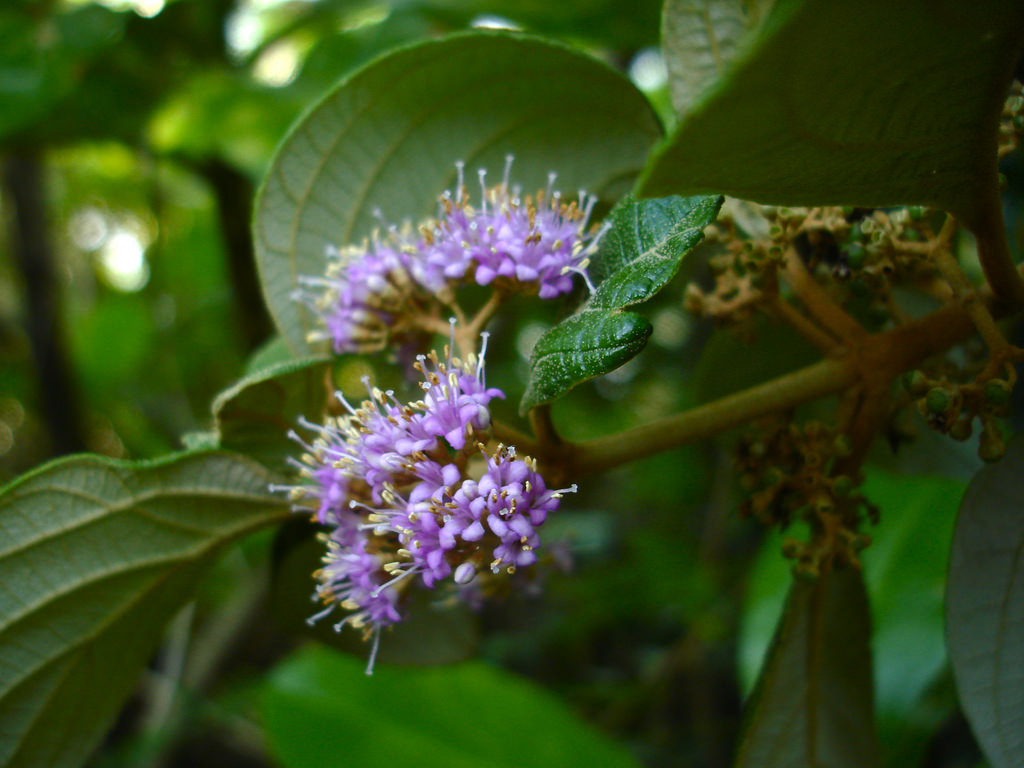
Description: Callicarpa candicans is a relatively small shrub can grow up to 2-4 m (6-12 ft) in height. Its broadly elliptical-shaped leaves are variable in size, about 3.5–18 cm (1.5-7 in) long by 1.5–9 cm (0.5-4 in) wide with about 5-7 lateral veins on either side of the midrib. The small mauve or violet flowers of C. candicans are produced in clusters. Its fruits are small and fleshy drupes with a hard inner layer enclosing a single seed.
Distribution: Callicarpa candicans is found in thickets and secondary forests at low altitudes from southern China westward to eastern India and southward throughout Southeast Asia to tropical parts of Australia and the Pacific, including the Marianas, and the Caroline Islands.
Uses by Island or Island Group: Traditional usage of various parts of plant species in the genus Callicarpa includes preparations used as fish poisons, insect deterrents, and traditional medicine; for example, in Malaysia the tender leaves are boiled and made into a drink for stomachache. The genus Callicarpa is made up of about 40 or more species, with approximately 20 that have been utilized by people “in ways suggesting that the genus is a rich source of biologically active natural products,” indeed studies of phytochemical aspects and biological extracts from Callicarpa support the probable pharmacological efficacy of the traditional ethnomedicinal uses of these species “and suggest that this genus may offer a rich supply of bioactive secondary metabolites” (Jones and Kinghorn 2008a/b). In Micronesia, the leaves of Callicarpa candicans have reportedly been used to stupefy fish, in some cases for many hundreds of years in the Philippines Caroline Islands.
Uses in Palau: Callicarpa candicans leaves have reportedly been used to stupefy fish for centuries in Palau (e.g., see Tuyama 1941). The leaves are pounded with water and then thrown into a pond or a stream to catch fish that were stunned and rose to the surface. In Palau as well as Pohnpei, “the leaf has been called fish-killing dynamite because of its strong toxicity” (Kawazu et al. 1967); this also applies to Kosrae (see below). According to Tuyama (1941), In Palau, C. candicans leaves have “chewed in substitution for leaves of Piper Betle” as part of the betel nut quid.
Uses in Yap: In some areas of Yap where C. candicans is found, the leaves have been pounded and then used as a fish poison. This plant also has many medicinal uses; leaves of this plant are also often used for poultices (medicinal bandages) on wounds and boils. In Yap, the flowers, bark, and leaves of Garwew (or Kuruwau), as C. candicans is known is Yapese, are used for medicine, and the fruits are sometimes eaten raw. For body pains, coconut oil is put on the leaves of this plant and an afflicted person may lie on them for relief. In addition, when the leaf of Gabuuy (Piper betle) is not available, the leaf of Garwew may be used as a substitute to use with Buw (betel nut). On Ulithi, the leaves of C. candicans (known as Hatar on that atoll) have been used medicinally; for example, “in the treatment of mathakhi tagarui, or backache” (Lessa 1977).
Uses in the Mariana Islands: McMakin (1978:55) reported that the leaf and stem of C. candicans are used in an “all-purpose” medicinal preparation called “Amot Tinino”by the local traditional healer who brought together many freshly collected plants of particular species, including C. candicans, and boiled them to produce the desired therapeutic combination.
Uses in Pohnpei: In some areas of Pohnpei where C. candicans var. ponapensis (known as Uhpin Palau or other similar names in Pohnpeian) is found, the leaves are traditionally pounded and then used or mixed with parts of other plant species as a fish poison as in other Caroline Islands of Micronesia (e.g., see Balick 2009:402):
“To use as a fish poison, the leaves are pounded on a punding stone (much like sakau [Piper methysticum] is pounded), mixed with sand, and formed into small balls. These are then used in channels or areas where water is contained or blocked off, such as a mangrove channel; the fish eat the sand particles and get docile and stunned, and then people catch them.”
Since the practice of using parts of C. candicans or any other plant or chemical material to stun or poison fish is now illegal in Pohnpei, the use of such fish “poisons” is no longer practiced and the knowledge about the traditional use of C. candicans is being lost or already forgotten in Pohnpei (Balick 2009:403).
Uses in Kosrae: C. candicans as in Pohnpei and possibly other Micronesian Islands, may or may not be a native species. Today it can be found in the lowlands of Kosrae, and was traditionally used as resource to catch fish. For example, according to Des Roches (1992:7), at low tide during the daytime one or two women would stun and capture fish by placing parts of C. candicans (known in Kosraean at Op sra) in “deep holes” in relatively shallow areas of the coral reefs of Kosrae:
“The use of op bosbos (made from the fruit of Barringtonia sp.) was reported by Sarfert [1919] but was not observed by Wilson in the 1960s nor by the author in 1989. Op sra, a poison not noted by Sarfert, appears to have taken its place. Op sra is made from the leaves of Callicarpa candicans and is considered to be the most potent form of naturally occurring fish poison on Kosrae. Op sra kills both small and large fish as well as other marine organisms and consequently has been banned in Kosrae State. The leaves of C. candicans are crushed and mixed with sand before being thrown into a channel or deep hole in the reef during low tide (the author never observed poison fishing with op sra and many of the women interviewed were hesitant to discuss its use). As with op, once the fish are drugged, they are gathered by hand or with the aid of a net. Consuming fish poisoned by either op or op sra has no ill effects, and one cannot taste the difference. The use of explosives such as dynamite to kill fish has not occurred on Kosrae as it has on several other islands in Micronesia Pesticides and other household chemicals are not commonly used although a few people interviewed mentioned that bleach is occasionally used in certain areas of the island” (Des Roches 1992:11-13).