


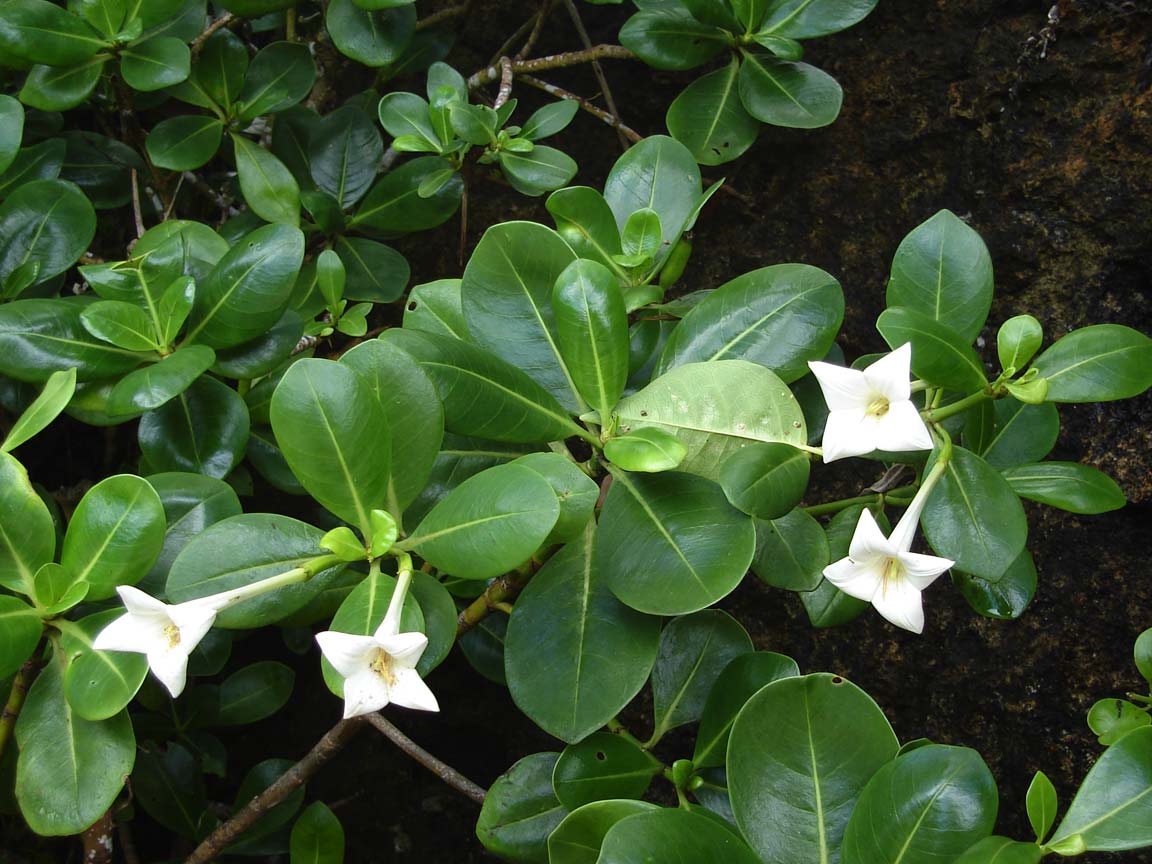
Description: Bikkia is a genus of flowering plants in Rubiaceae, the coffee family. Bikkia tetrandra is a coastal shrub species in this genus which endemic in the Mariana Islands where it grows up to 3 m (~10 ft) tall. Groups of two or three of its fragrant flowers are produced on a short pedicel in the terminal leaf axils. The trumpet-shaped, showy flowers look square when viewed from the front, and flowering occurs year round. Its seed pods contain hundreds of tiny seeds.
Distribution: The genus Bikkia is native to the Philippines the Maluka region of eastern Indonesia, New Guinea and some of the western Pacific islands of Melanesia and Micronesia (Mabberley 2008). Bikkia tetrandra, a shrub endemic to the Marianas Islands (Raulerson & Rhinehart, 1991), is most “commonly found growing on undisturbed limestone cliffs usually close to the ocean.”
Uses in the Mariana Islands: Bikkia tetrandra is known as Gausali in the Mariana Islands where it is held in high esteem, largely due to its attractive white flowers. “Many Guam residents feel it should be the Guam flower” (Frazier and Santos 2006; also see below under Bougainvillea spectabilis). The woody stems of Gausali shrubs are cut into short pieces and then they may be used as candles (Raulerson & Rhinehart 1991), while the wood itself can be used to make larger torches. Gausali also reportedly has “medicinal and cultural utility as well as being an attractive addition to private and public landscapes along the coastal and interior settings,” and Frazier and Santos further pointed out key aspects regarding its propagation:
“Gausali is easily propagated by seeds broadcasted on fine limestone gravel or peat moss. Germination occurs within three to four weeks. Seedlings should be transplanted into individual containers shortly after they become an inch to two inches in height (with 4 to 6 leaves). After 6-8 months of growing in pots, plants can be transplanted into rocky areas rocky (limestone) areas or limestone soil.”