


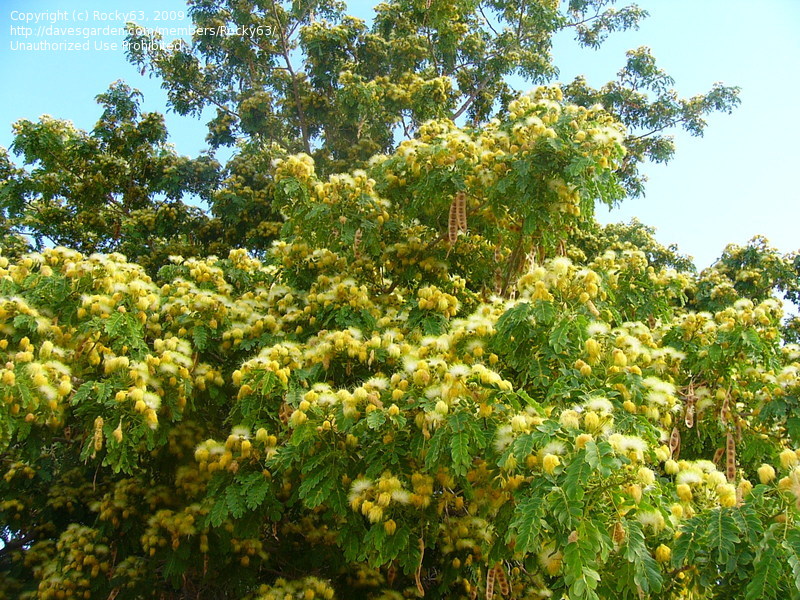
Micronesian Names by Islands or Island Groups: Ukall ra ngebard (Palau), Gumomingabchey or Ngumormingobchey (Yap), Schepil kalaskas (Carolinian), Kalaskas, Mamis, Trongkon kalaskas or Trongkon-mammes (Mariana Islands)
Description: A medium to large deciduous, perennial tree in the bean or pea family, Fabaceae, Albizia lebbeck can reach heights up to 10-20 m (30-65 ft) with leaves that are bipinnate (many paired small leaflets). Its dense shade-producing crown can be as large as 30 m in diameter and it forms globular clusters of 15-40 white, fragrant flowers. The fruits are 10-30 cm (4-12 in) long reddish-brown pods that contain 5-15 flat rounded, free moving seeds. These many pods produce a persistent rattle under windy conditions which some have likened to “women's chatter,” and thus the derogatory English name for the tree as “women's tongue.”
Distribution: Albizia lebbeck is a large introduced woody species reportedly native to areas of tropical Africa, Asia and Northern Australia. It is naturalized widely in sub-humid, semi-arid tropical and subtropical areas, especially where there is in climatic succession a regular arid season followed by a wet season. A. lebbeck occurs naturally from sea level up to an altitude of about 1800 m (~6,000 ft) in tropical and some subtropical regions. Athough it has been planted widely for forestry as a multipurpose tree, A. lebbeck is considered to be potentially a self-sown invasive species in areas where it has been introduced and cultivated. Often planted as an alien, fast-growing shade tree or ornamental in rural areas, plantations, home gardens, and along roadsides, A. lebbeck has become abundantly naturalized along roadsides, stream banks, and in secondary vegetation on many tropical Pacific islands, including some of those in Micronesia.
Uses by Island or Island Group: As noted above,in some tropical and subtropical areas of its native and introduced geographical range of distribution, A. lebbeck serves as a multipurpose tree. For example, its wood is sometimes used in general construction as well as for firewood and wood carving, and its foliage, twigs, flowers and immature pods are readily comsumed by various kinds of livestock; in addition, and A. lebbeck is also used for shelter belts to protect an area, especially a farm field, from strong winds and the erosion, as well as a shade tree in coffee and tea plantations (Clarke and Thaman 1993, Orwa et. al 2009). Furthermore, A. lebbeck has a lengthy history of medicinal use in some Asian countries such as India where “it is used both in Indian traditional system and folk medicine to treat several inflammatory pathologies such as asthma, arthritis and burns,” and recent research has shown that A. lebbeck does possesses remarkable anti-inflammatory activity, supporting the folkloric usage of the plant to treat various inflammatory diseases” (Prakash Babu et al. 2009:356); Indeed, medicinally A. lebbeck is reportedly “antiasthmatic, antianaphylactic, antiinflammatory, nootropic [cognitive enhancer], anticonvulsant, anxiolytic, antispermatogenic, antidiarrheal, antibacterial, anthelminthic and antiulcer activities that are documented in scientific studies” (Sesoltani 2010; also see Mishra et al. 2010).
NOTE: Although Albizia lebbeck has a long history of value of a multipurpose tree in various Asian countries where it is native, it is important to reiterate here that A. lebbeck has serious potential to become invasive in areas where it has been introduced, especially in small tropical islands such as those in Micronesia.
Uses in Palau:Recently introduced to Palau, where it is known as Ukall ra ngebard, Siris-tree, or Rain tree (A. lebbeck) has been planted as a shade tree and is reported from Koror, Malakal, Ngerkebesang and Babeldaob islands.
Uses in Yap: As noted previous, in those tropical areas where it has been introduced, Albizia lebbeck is commonly planted for a variety of uses including shade, ornament, timber, wood carving, and firewood. In Yap, A. lebbeck has also been used for medicinal applications; for example, according to Okabe, for myelitis, the “crushed roots and bark of [Albizia trees] are mixed with bark of Pterocarpus indicus” and the sap is drunk with coconut oil, or the bark of the root [of Albizia] “is crushed together with the leaves and fruit of Capsicum frutescens [chili pepper], and the sap is drunk with coconut milk” (see Defilipps et al. 1988). According to Falanruw (2015:97):
“At least two other species of Albizia are reported from Yap: A. retusa, and A. rotundata Bl. ex. Miq. Albizia are characterized by their bipinnate leaves, petiole and rachis with glands, and heads of globose flowers, which, if you look carefully, are generally 5-merous, usually bisexual, calyx toothed, petals connate to or beyond the middle, stamens 10 (per flower), connate basally, exerted.”
Uses in the Mariana Islands: Among a number of trees have been introduced to the Mariana Islands, some have become naturalized including; for example, on Saipan, the “patches of Albizia lebbeck mixed in with other vegetation, especially Leucaena” have been reported; and A. lebbeck is among the alien trees “common in areas of secondary vegetation” on Rota and Tinian as well as Saipan in the Commonwealth of the Northern Mariana Islands,” (Falanruw et al. 1989:9). More recent reports indicated that A. lebbeck is an “bundant naturalized tree species” in the upland limestone forest on Saipan (e.g., Hess and Pratt 2006).
Uses in Chuuk: Albizia lebbeck was introduced relatively recently to Chuuk where it has been planted as a shade tree but is or could become an invasive tree speciesas cultivated or naturalized along roadsides and in forest patches in others, e.g. on Chuuk (e.g., see Space et al. 2000).
Uses in Pohnpei: Albizia lebbeck was also introduced relatively recently to Pohnpei where it has been planted as a shade tree but is or could be an invasive or potentially invasive tree species.
Medium to large tree with gary-brown bark; leaves bipinnate, the primary leaflets subopposite, 2-4 pairs; ultimate leaflets opposite, 6-8 pairs, oblong, slightly asymmetric, blunt, 2.5-4.5 cm long; flowers fragrant, in loose heads, pedicellate, the head 2-4 cm broad, whitish; stamens long-exserted; pods flat, thin, pale straw-colored when mature, 15-20 (rarely 30) cm long, 2.5-3.5 cm wide, few-seeded, the seeds bulging; pods drying, opening slightly or not. A paleotropical species, Africa to Australia; often planted as a fast-growing shade tree. Not very common in Guam, but very abundant in Saipan. Merizo (4246). The rattling of the dry pods has given the tree the name `woman`s-tongue`. The wood is moderately heavy and rather difficult to work, but is used in India. The shallow root system makes it liable to topple in typhoons.