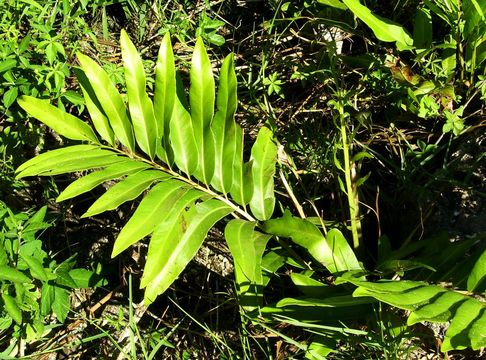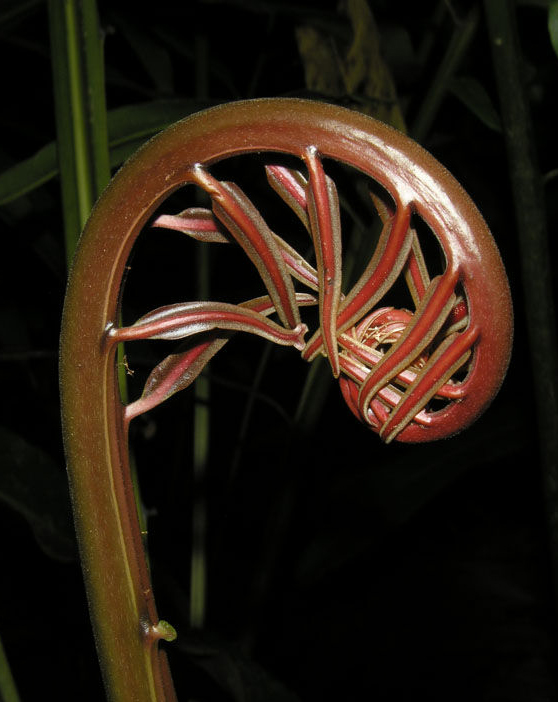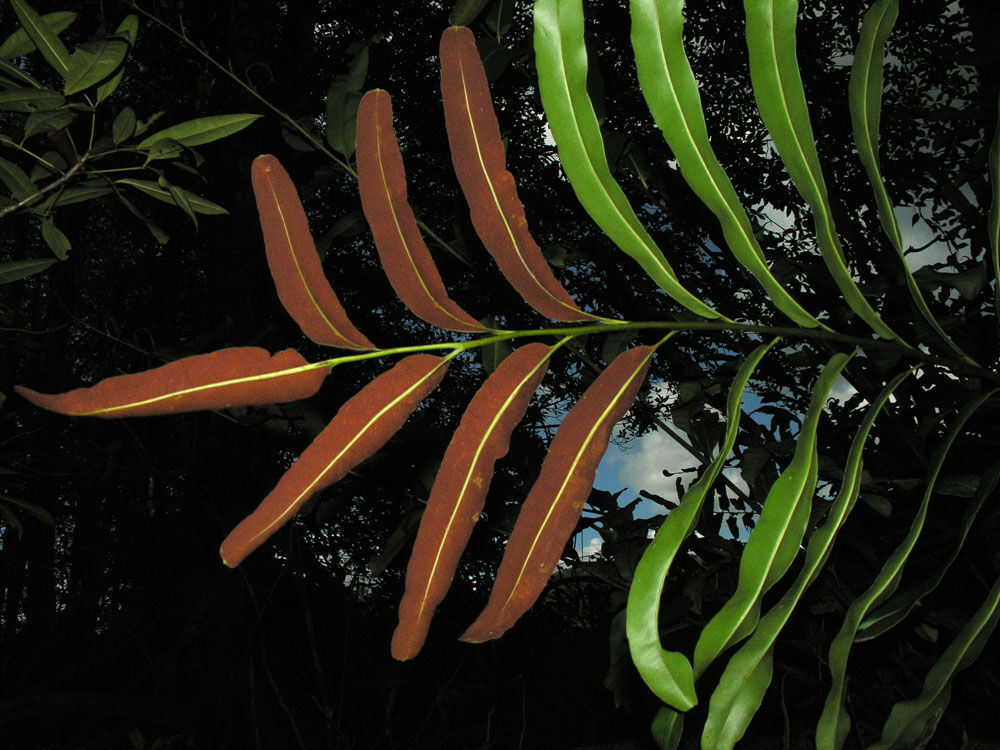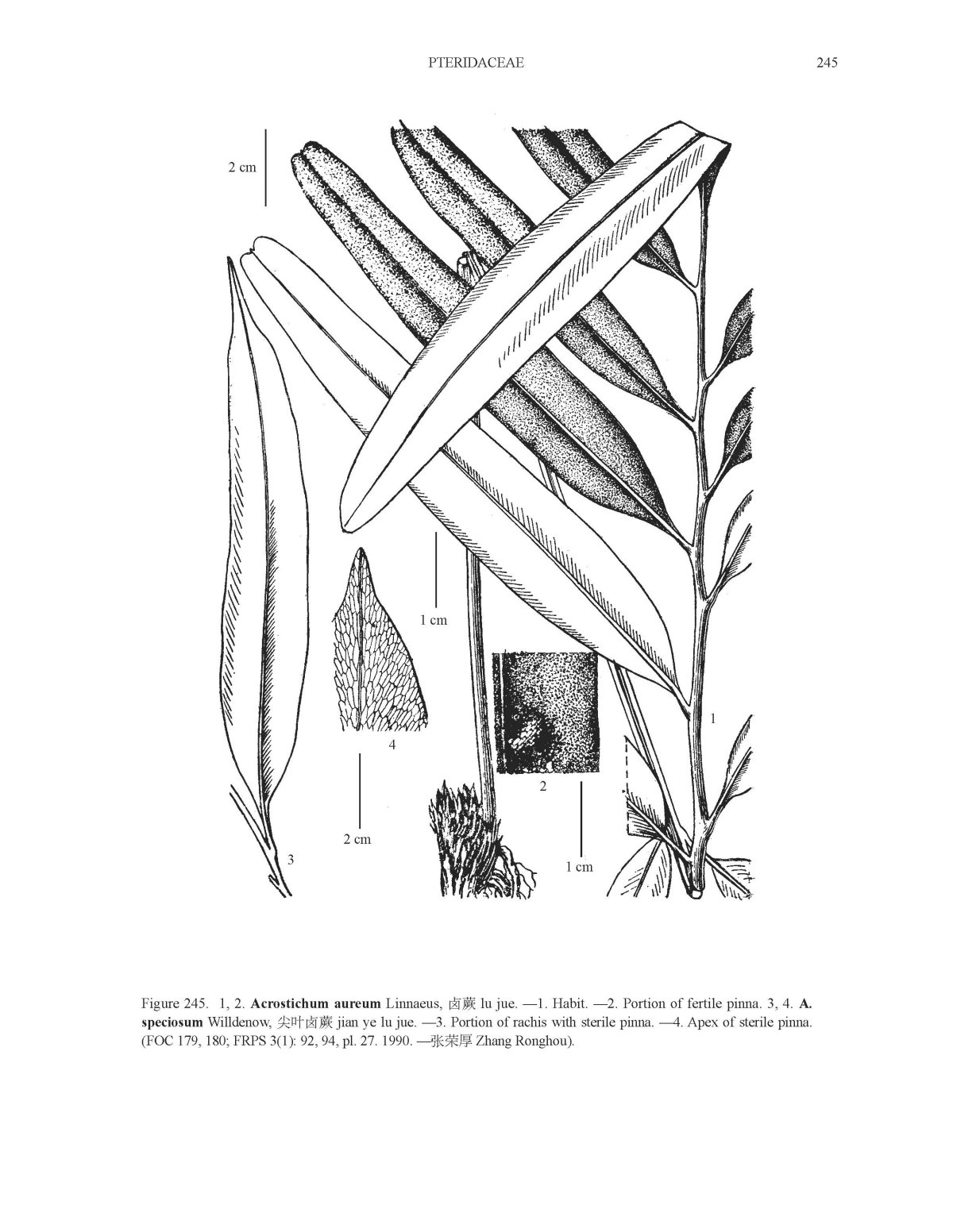
Micronesian Names by Island or Island Groups: Okkuam, Chokuám or Gokuám (Palau), Ungangafe, Ugutobung or Welbrob (Yap), Langayao (Mariana Islands), Appaaw (Pulusuk), Apeu (Namonuito), Epku or Epéu (Satawal), Ááppásew or Apaseu (Chuuk)
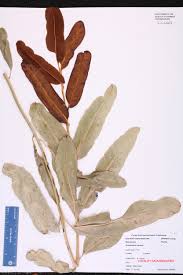
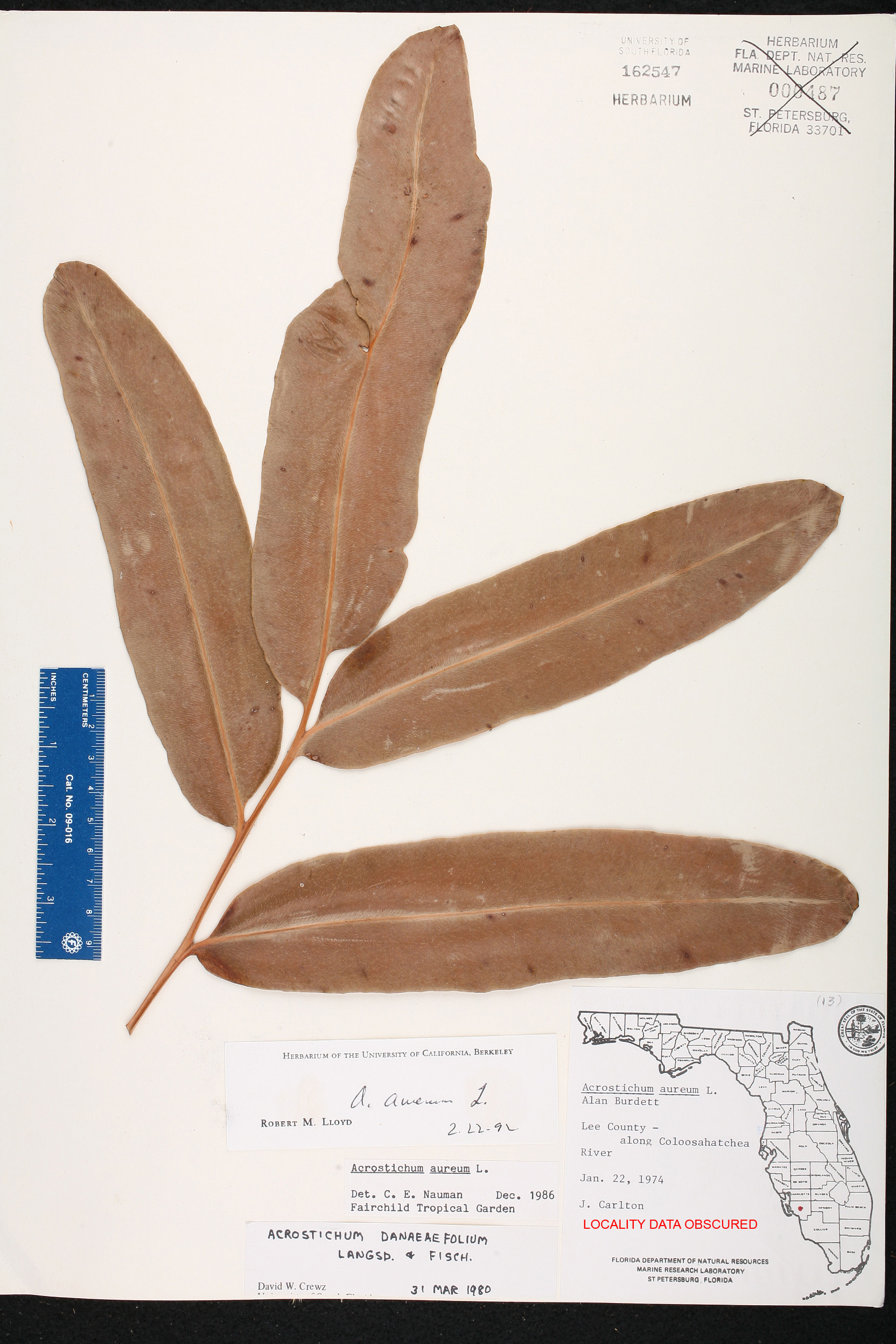
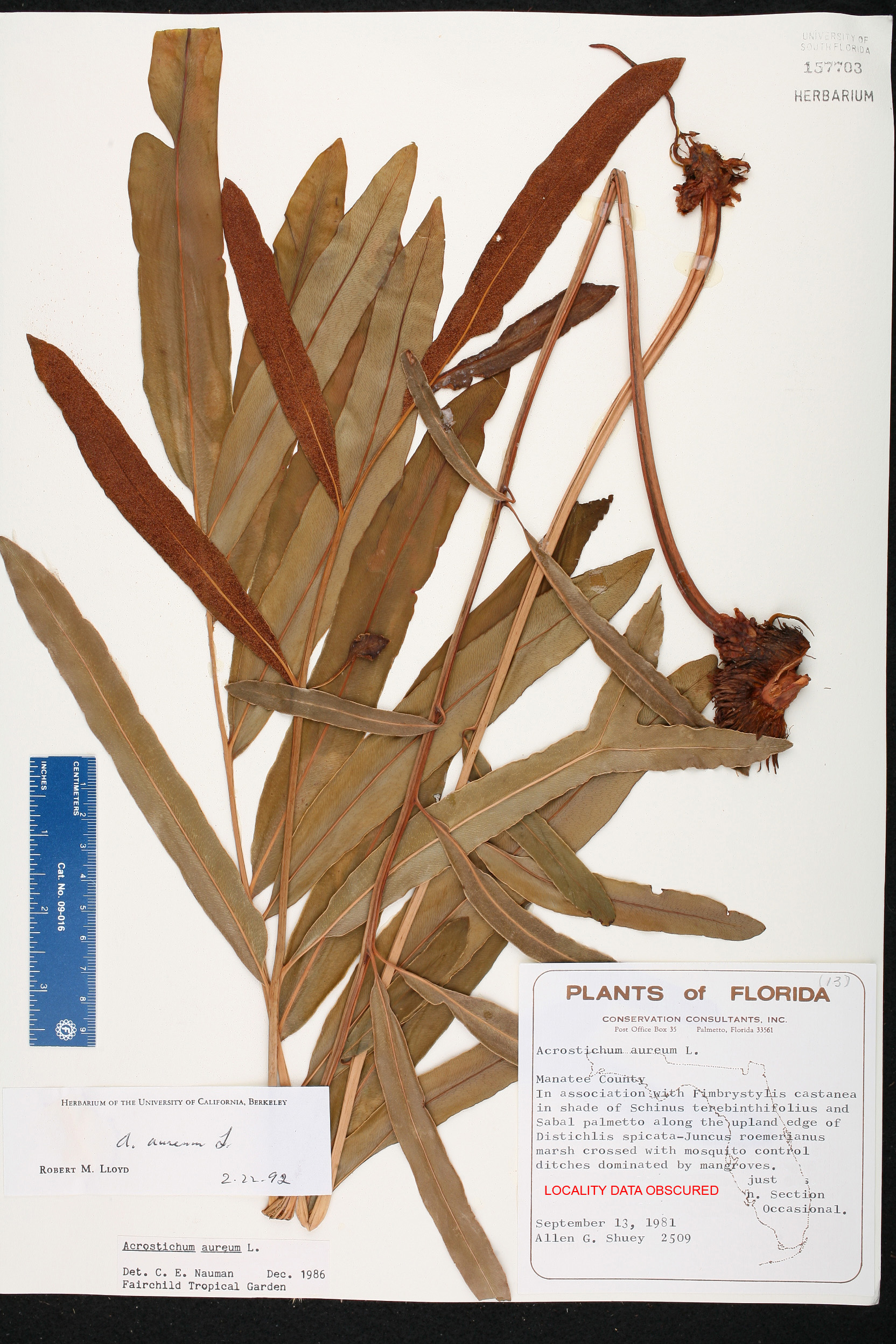
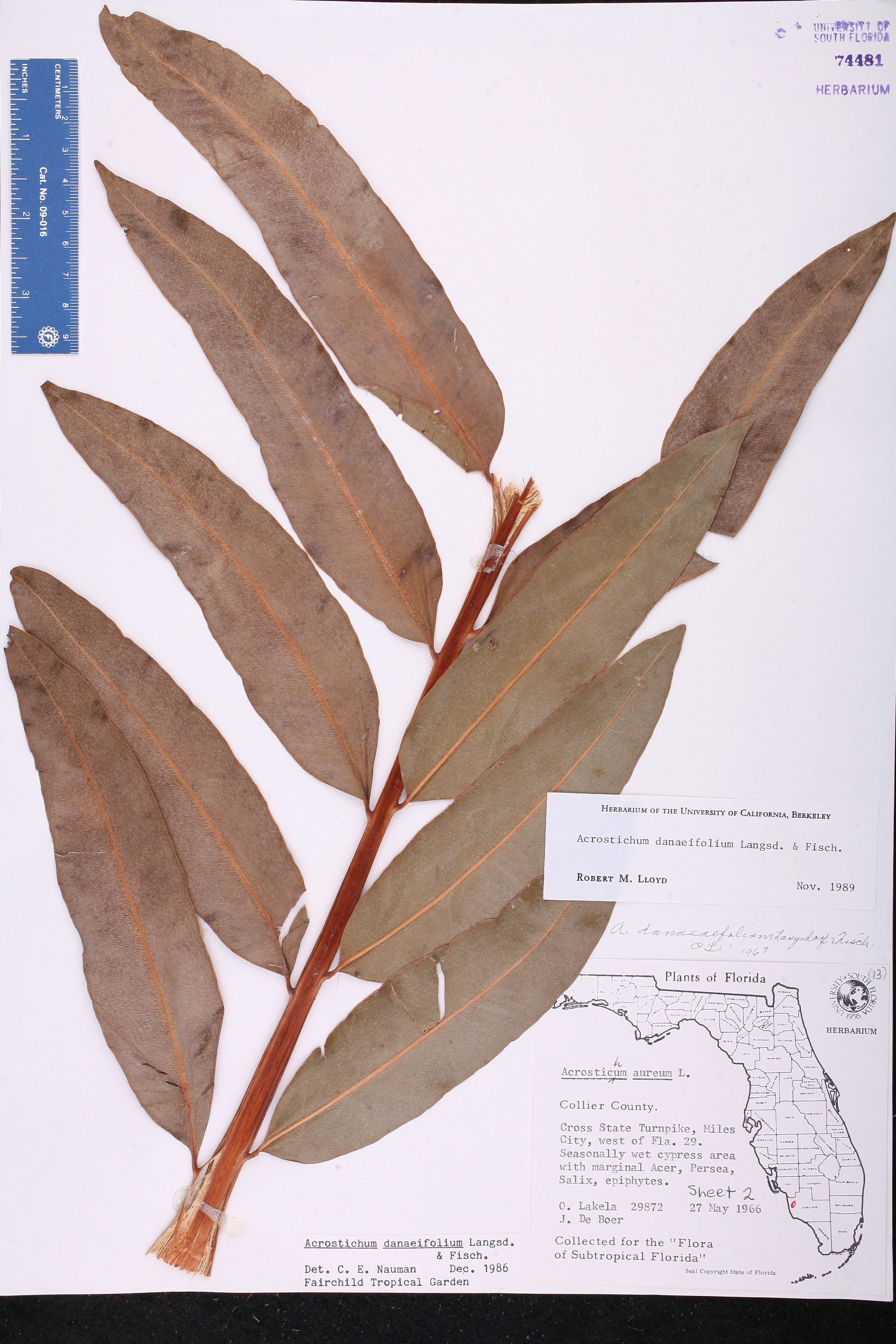
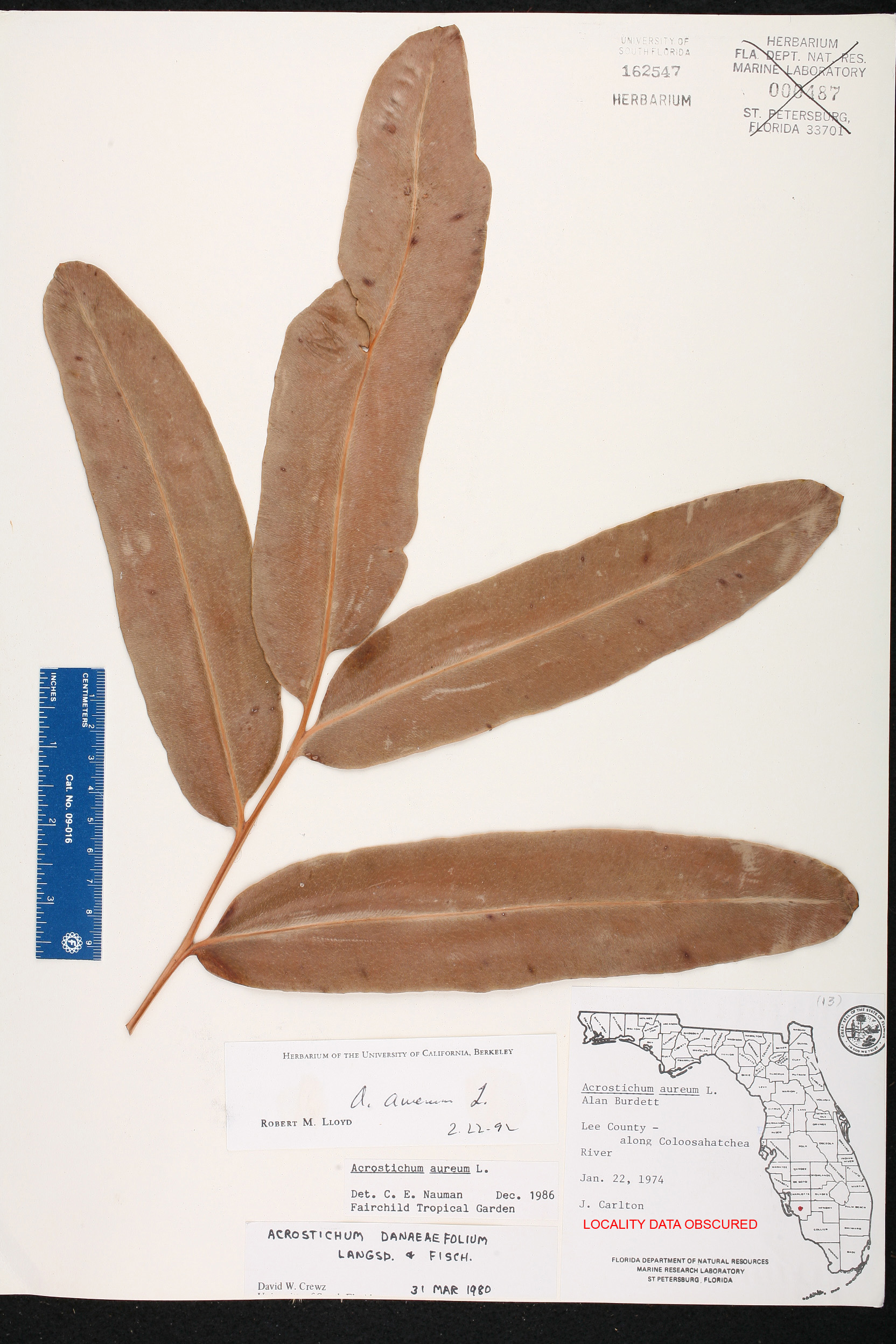
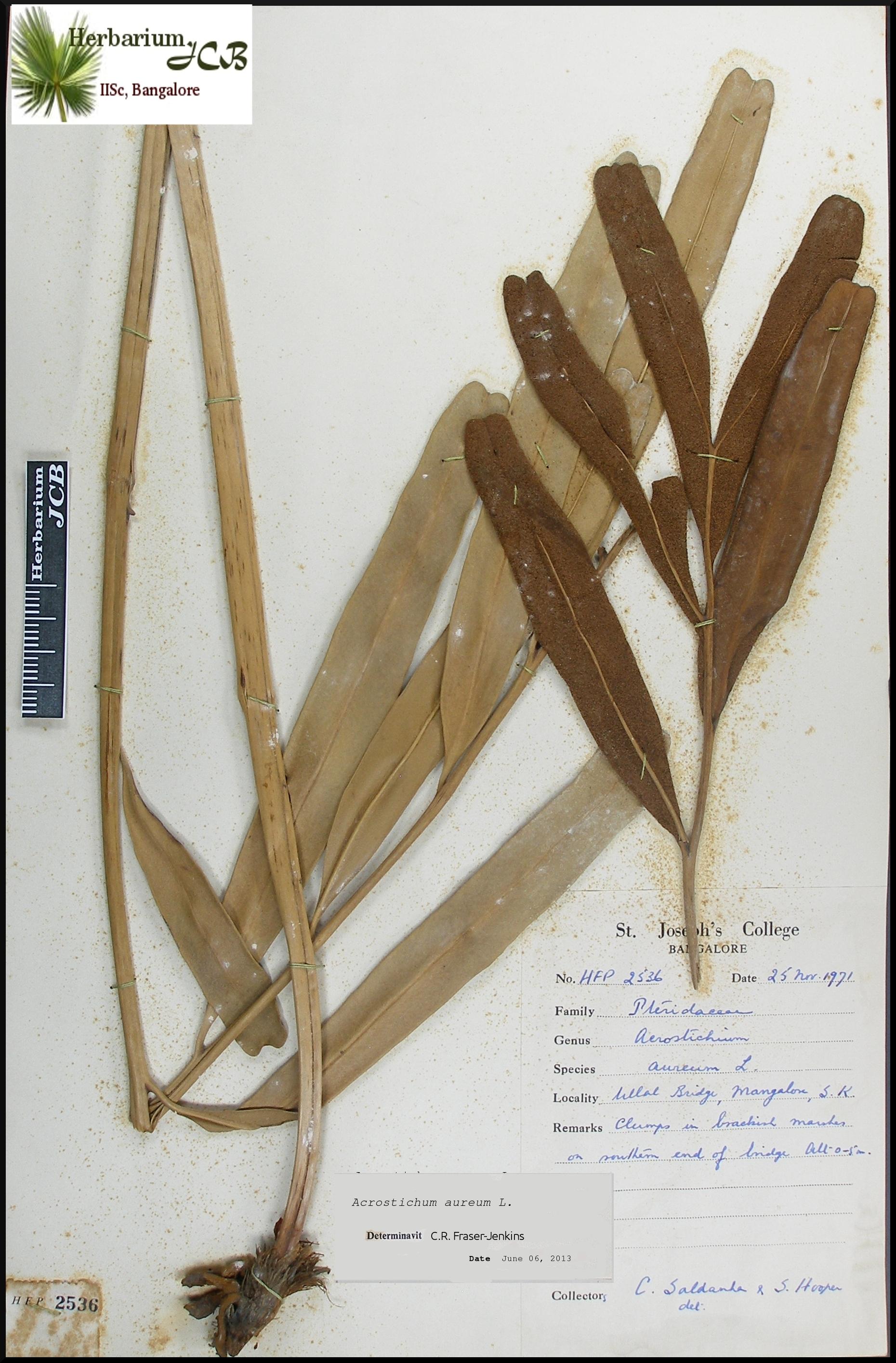
Description: Acrostichum aureum is a large, coarse and robust fern. It has tough, leathery fronds with network venation and opposing leaflets. The once-pinnate fronds are about 1 m (3 ft.) long growing in huge clumps. The lower surface of the upper several leaflets of fertile fronds becomes completely covered with golden brown spores, thus one of its common English names, “Golden Leather Fern.”
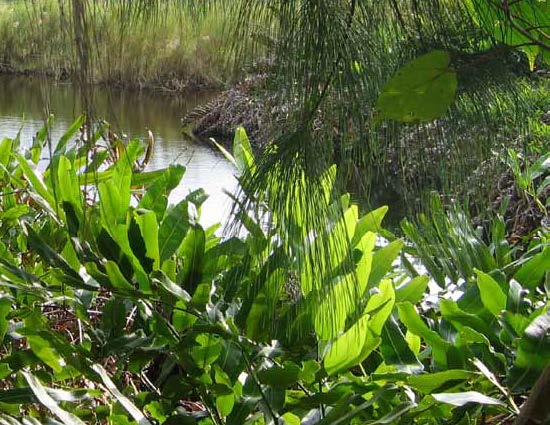
Distribution: Acrostichum aureum is a pantropic species known from most humid tropical areas of the world, especially those with mangrove formations. This large fern is indigenous to some of the high and low islands in Micronesia. It is common in wetland areas with fresh to somewhat brackish water, in coastal marshes such as the large marsh on Guam near the village of Agaña (now known as Hagåtña) called La Ciénaga (Safford 1905:174), at the margins of mangrove swamps, in river mouths, and occasionally in large floating masses in freshwater. This fern is among the first large low-growing plants to grow on the landward side of mangrove areas. It provides shade for other plants and trees to become established. However, when it invades cleared mangrove habitats, it may develop into impenetrable thickets which prevent other plants from taking root. For this reason, A. aureum is sometimes considered to be weedy, but these fern thickets can provide safety and shelter for animals. On Satawal, Fosberg (1969) reported this large fern growing in the mangrove depression near east end of this low raised reef island.
General Uses: Acrostichum aureum is sometimes harvested from the wild for local use as a food, material for thaching, as a source of medicine for a variety of ailments (e.g., as an ornamental sometimes grown in gardens. Some examples of the food, medicinal and other uses of Acrostichum spp (i.e., A. aureum and A. speciosum) include the following:
“The young shoots can be eaten raw as a salad or cooked, [as they are by people in some tropical countries such as Malaysia, India, Sri Lanka]. The leaves are also used as cattle feed. Older leaves when dried are parchment-like and used as fire-resistant roof thatch (Vietnam and the Pacific). The [fibers] of old leaves may also be used to make cord…. [This large fern also has traditional medicinal uses in some tropical areas such as Sri Lanka in Ayurvedic medicine, and in Malaysia where its] rhizomes are pounded into a paste and used to treat wounds and boils… [and its leaves] are used to stop bleeding. (http://www.naturia.per.sg/buloh/plants/acrostichum.htm, also see Mastaller 1997:93, 96-97). A number of traditional medicinal uses of Acrostichum aureum in Fiji are reported by Cambie and Ash (1994).
Uses by Micronesian Island or Island Group:
Uses in Yap: In Yap, Acrostichum aureum fern is said to have medicinal uses including its application alone or with parts of other plants to treat injured skin or cuts (e.g., Okabe, see Defilipps et al. 1988:12-13). Recent research indicates that the rhizome of this fern is indeed useful for wound healing (e.g., see Putra et al. 2013).
Uses in Guam: Traditionally, the dried fern fronds can be dried, attached to rods, and used as thatch for the roofing (Safford 1905).
Uses on Puluwat Atoll: The stalks of this large mangrove or marsh fern have been used to make the bottoms of fishtraps (unik) on Puluwat Atoll (Manner and Mallon 1989:32).
General Uses: Acrostichum aureum is sometimes harvested from the wild for local use as a food, material for thaching, as a source of medicine for a variety of ailments (e.g., as an ornamental sometimes grown in gardens. Some examples of the food, medicinal and other uses of Acrostichum spp (i.e., A. aureum and A. speciosum) include the following:
“The young shoots can be eaten raw as a salad or cooked, [as they are by people in some tropical countries such as Malaysia, India, Sri Lanka]. The leaves are also used as cattle feed. Older leaves when dried are parchment-like and used as fire-resistant roof thatch (Vietnam and the Pacific). The [fibers] of old leaves may also be used to make cord…. [This large fern also has traditional medicinal uses in some tropical areas such as Sri Lanka in Ayurvedic medicine, and in Malaysia where its] rhizomes are pounded into a paste and used to treat wounds and boils… [and its leaves] are used to stop bleeding. (http://www.naturia.per.sg/buloh/plants/acrostichum.htm, also see Mastaller 1997:93, 96-97). A number of traditional medicinal uses of Acrostichum aureum in Fiji are reported by Cambie and Ash (1994).
Uses by Micronesian Island or Island Group:
Uses in Yap: In Yap, Acrostichum aureum fern is said to have medicinal uses including its application alone or with parts of other plants to treat injured skin or cuts (e.g., Okabe, see Defilipps et al. 1988:12-13). Recent research indicates that the rhizome of this fern is indeed useful for wound healing (e.g., see Putra et al. 2013).
Uses in Guam: Traditionally, the dried fern fronds can be dried, attached to rods, and used as thatch for the roofing (Safford 1905).
Uses on Puluwat Atoll: The stalks of this large mangrove or marsh fern have been used to make the bottoms of fishtraps (unik) on Puluwat Atoll (Manner and Mallon 1989:32).
Pantropical. In lowland marshes and at borders of mangrove and Scirpus swamps. Agafia swamp (4234); Apra (4889; 4947). Fronds 1-pinnate, 1-2 m tall; fertile pinnae entirely covered with sporangia on dorsal side. Common in suitable locations.