


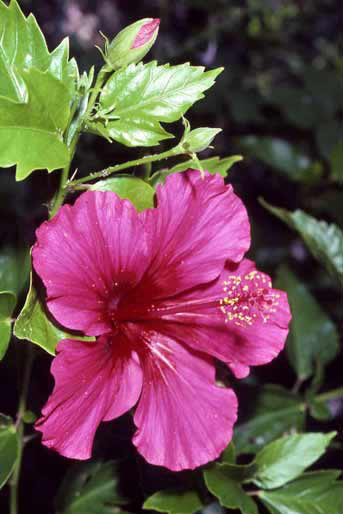
Description: Hibiscus rosa‑sinensis is a very widespread, evergreen, ornamental or garden plant which flowers continuous through the year. Most ornamental varieties of this species are hybrids; H. rosa‑sinensis is, in reality, a highly polymorphic group composed of complex hybrids and their derivatives, often involving hybridization with various other Hibiscus species, frequently crossing with Hibiscus schizopetalus. This popular, commonly cultivated, Red Hibiscus is a woody shrub or small tree, up to about 4 m (~12 ft) high, with glabrous, dark green to variegated, serrate leaves that are alternately arranged; its flowers are large, conspicuous 5-petalled, red, pink, white, or yellow in color. As a cultivated plant, it is usually progated vegetatively (via cuttings or grafting). H. rosa-sinensis rarely produces its fruit capsules which are “ovoid rounded, 5-valved, 15-seeded (or less)” (Stone 1970: 411; also see Whister 2000:253-254). H. rosa-sinensis is hermaphrodite; in other words, an individual plant has both male and female organs; and the species is pollinated by insects. Generally, it grows well in light (sandy), medium (loamy) and heavy (clay) soils and prefers moist, but well-drained soil.In Micronesia, H. rosa‑sinensis is a decorative shrub that is closely related botanically to the very useful and widespread native or introduced Hibiscus tiliaceus (Beach or Sea Hibisicus) species; and somewhat similar to H. tiliaceus, H. rosa‑sinensis is a useful plant in many Pacific island societies. In addition to its ornamental use, the leaves, barks, roots and flowers of H. rosa-sinensis have been used widely in the traditional medicine systems to treat various diseases; and its efficacy has been more or less documented by various research studies indicating that different parts of this species have antioxidant, antimicrobial, antidiabetic, antiulcer, hepatoprotective, antifertility, antigenotoxic and antiinflammatory properties, which may aid in the treatment of numerous diseases or ailments (e.g., see Kristi and Patel 2016).
Distribution: Because of its very widespread use as an ornamental shrub or small tree in a variety of climatic regions, the origin of H. rosa‑sinensis is uncertain; indeed, this attractive plant is not known in a truly wild environmental situation. However, it is probably indigenous to eastern Africa or tropical Asia, and is most likely an aboriginal or very early post-European contact introduction to Melanesia and parts of Polynesia, and is probably a pre-World War II introduction into most of the other islands of Polynesia and Micronesia.
General Uses: As noted above, the common Red Hibiscus, H. rosa-sinensis, is a widespread cultivated, ornamental plant. It is adapted to relatively warm environments and requires very little gardening care. It flowers prolifically, and overall it is a very good plant for landscaping. It can be found occasionally in rural areas and is common to abundant in urban areas where it serves as a decorative plant and often as a hedge or living fence. In the tropical Pacific, its flowers are frequently used in garlands and for decoration, and in some places the leaves are used as goat feed. H. rosa-sinensis has many common English names; one of these is “shoe black” or “shoe flower” because its flowers have been used to polish leather shoes and as a dye. Another important use of H. rosa-sinensis, previously noted involves the widespread therapeutic applications of its leaves, barks, roots and flowers in traditional medicine also noted above. In addition, the bast fibers of this species have sometimes been used to make coarse fabrics, nets and paper.
Uses by Micronesian Island or Island Groups:
Uses on Palau, Yap and Fais: Hibiscus rosa-sinensis has been introduced as an ornamental plant to these western Micronesian Islands (e.g., see Fosberg et al. 1979:162, Raulerson et al. 1996:31, Ragone et al. 2001). The principal reason for its introduction to these and many other tropical islands has been for its decorative appearance and relatively easy cultivation and maintenance.
Uses on Satawal: Fosberg (1969:8) reported that the ornamental H. rosa-sinensis, which he reported to be known by the local islanders as “Pue tal”on Satawal Island, was not common on Satawal, but was “planted in forest near center of island.” Roddy (2007:182) listed the Satawalese name for H. rosa-sinensis as Peoitaen, the “red hibiscus bush.”
Uses in Chuuk: Manner (2013:240) reported that H. rosa-sinensis is known in Chuukese as “rowas,” and that he observed many varieties of this decorative hibiscus specieson Romonum Island in Chuuk Lagoon, where it is a “valued flowering ornamental shrub” commonly found “in village areas.” Fosberg et al. (1979:162) reported H. rosa-sinensis as an introduced plant on Etan, Lukunor and Namonuito Atolls in Chuuk State, as well as on Tol the largest of the volcanic islands in Chuuk Lagoon.
Uses in Pohnpei: This ornamental shrub, known as Keleu en wai in Pohnpei is closely related botanically to the very useful and widespread Keleu (Hibiscus tiliaceus) plant. The varieties of Keleu en wai, which have beautiful reddish, pink, yellow or white flowers, were introduced to Pohnpei beginning in Spanish or German times and are now commonly planted near buildings. The flowers are commonly used in mwaramwar (garland worn on one’s head) and leis.
Uses in Kosrae: According the Lorence and Flynn (2010), H. rosa-sinensis is an introduced and cultivated plant on Kosrae.
Uses in the Marshall Islands: The common hibiscus ornamental plant, H. rosa-sinensis, was probably introduced to the Marshall Islands during the Spanish or German colonial period. Today it is commonly planted near private homes and business buildings for decoration on Majuro, as well as several other atolls in the Marshall Islands, and it is occasionally cultivated in rural garden areas.
Uses in Kiribati: The introduced ornamental H. rosa-sinensis is known as Te roti (“the rose”) in Kiribati because it “is considered by [the people of Kiribati] to have rose-like flowers” (Thaman 1987:13); and it is reportedly a commonly cultivated, decorative plant with many varieties found in home gardens, mission settlements, school grounds, or in major settlements in Kiribati (e.g., see Clarke and Thaman 1993). H. rosa-sinensis is also reportedly an important, common shrub in village gardens on Kiritimati [Christmas Island], where it seems “to do well in the harsh atoll environment” of this remote part of Kiribati; on Kiritimati its flowers are said to “used for decoration and worn in the hair or over the ear” (Thaman and Tye 2015:12,16,54). Note: hybridsof H. rosa-sinensis were reported as present on the raised reef island of Banaba by Fosberg et al. (1979); and subsequently, Thaman and Samuela (2016:73) reported that H. rosa-sinensis is also a common ornamental shrub on Banaba, where its local name is also “te roti (‘rose’),” it is found as “planted ornamental in houseyard gardens, around settlements, along roadsides, and occasionally in graveyards,” and its flowers used in body ornamentation and in flower arrangements.”
Uses in Nauru: The common hibiscus ornamental plant, H. rosa-sinensis, is known as Dorot (“the rose”) in Nauru, where it is a recent introduction and now cultivated as an ornamental and hedge plant. On Nauru, its flowers are reportedly “used in garlands and for decoration.” (Thaman et al. 1994:164; also see Thaman et al. 2009).