


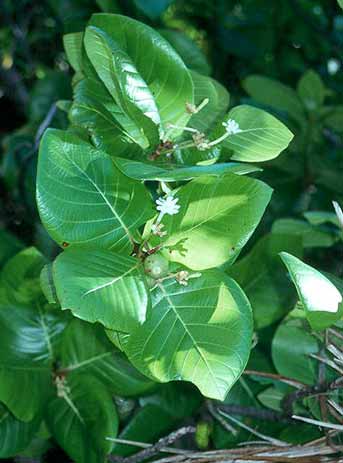
Description: Guettarda speciosa is a shrub or small tree that may reach heights of about 15 m (50 ft) or more and is very bushy with short thick branches, along with multiple twigs about 1 cm (~0.3 in) accross. It has large dark green, glossy, ovate leaves 12-30 cm (5-12 in) long, each with a prominent midrib and 7-10 pairs of lateral veins. The attractively scented, white tubular flowers are up to about 5 cm (2 in) long and grow from the leaf axils. The roundish, faintly ribbed, stalk-less fruits are green turning whitish with age. rounded but somewhat flattened, fibrous at maturity, about 2-3 cm (~1 in) wide, and usually contain 4 to 6 seeds, each in separate cells or cavities. G. speciosa is pollinated at night by moths and the fruits are eaten by hermit crabs, and due to their corky interiors they can float and thus disperse on ocean currents.
Distribution: Guettarda speciosa, with its floating fruits, is a native indigenous coastal tree found throughout Micronesia; and like most of the plants found in the strand vegetation or low coral island forest areas, it is also found on many other tropical Pacific Islands beyond Micronesia. Besides growing naturally in tropical lowland coastal vegetation, G. speciosa can also be found “in places at considerable elevation,” for example, in frequently in upland areas in the Mariana Islands (Fosberg et al. 1993:59). The native geographical range of G. speciosa includes parts of tropical East Africa throughout tropical Asia and the Pacific Islands region from the Marshall Islands to southeastern Polynesia (Elevitch, 2006a/b).
Uses by Island and Island Group: The wood of Guettarda speciosa is especially important on tropical low islands and atolls where it has many uses, including “hard and durable wood used in light construction, for pilings, fish-trap stakes, stakes to hold garden mulch in place, coconut huskers, fishing poles, floats, spears, thatching needles, fishing rods, fishnet and bird-net handles, stilts, eel traps, fruit harvesting sticks, bowls, slit-gongs, for canoe hulls, supports, steering paddles, bailers, poles for poling canoes, and floats” (Clarke and Thaman 1993). It is thus known to be one of the most important tropical Pacific coastal plant species for use by islanders living on the low reef islands with very widespread medicinal use of its bark and leaves (e.g., see Thaman 1992a:6). For example, G. speciosa is reportedly used widely to reduce fever, and as a remedy for diarrhea, muscle aches and wounds.
Uses in Palau: Guettarda speciosa is known in Palau as Blau (e.g., Kitalong 2008:181) or other similar names. According to Tuyama (1941), G. speciosa has wood with “yellowish-white color,” and has been used in Palau “as a building material and in tool making.”
Uses in Yap and its outer low islands: Guettarda speciosa, known as Blaw or Balaaw in Yap, is sometimes planted by seed or cutting for ornament and/or windbreak on Yap. The trunk can be used for house timber and strong paddles, and branches are collected for excellent firewood. On Yap proper, the bark and leaves are reported used for medicine; for example, see Okabe (in Defillips et al. 1988:11), who noted that the leaves of two other trees, “Alpinia carolinensis” and “Eugenia javanica,” are mixed with those of“Warao” (G. speciosa)and used in a remedy for colds in Yap. Okabe, also reportedthat “the fruit, young leaves and bark [of G. speciosa] are crushed together, and the sap is drunk” by women for “monthly troubles.” In addition, on Yap, the persistently sweet-smelling flowers of G. speciosa, even though they bruise rather easily, are used in making garlands which are known locally as nunu or marmar (e.g., see Falanruw 2015:190). The bark, wood, leaves and flowers of G. speciosa are used widely among the Micronesian Islanders living on the remote low lying outer islands of Yap State for a variety of purposes (see below).
Uses on Ulithi Atoll: The relatively small trees or shrubs of Guettarda speciosa are known on Ulithi Atoll as Iuth or Uth. According to Lessa (1977:180) this species has many uses on Ulithi:
“…wood is used for house timber, steering paddles, firewood, and earth ovens. Its flowers are used in leis. The leaves are used as a washcloth for babies. One of its medicinal uses is to give babies suffering from stomachache the juice extracted from its bark. Its parts may be fashioned in any of various ways by women and men to make a ielsol, or love charm, to attract a person of the opposite sex, being worn as a head wreath, neckpiece, or earpiece, or carried in a basket, or even left at home, but its efficacy comes from a magical incantation.”
Uses on Fais: Flowers of Guettarda speciosa (known by the people of Fais as Outh) are reportedly used in the production of leis or garlands on this raised reef island (Lessa 1977:180).
Uses on Eauripik Atoll: Similar to Fais, the wood of Guettarda speciosa is reportedly used to make canoe paddles and as a source medicine on Eauripik, where this species is known as Wut (Lessa 1977:180).
Uses on Woleai Atoll: Known as Ut, Wuut or Ood on Woleai, Guettarda speciosa reportedly has been used for medicinal purposes; for example, its branches are said to have a magical significance in treatment of swelling. The wood of this coastal tree is used in construction and to make canoe paddles, and parts of the plant are also used in the making of garlands on Woleai (see Fosberg et al. 1993:59, citing Alkire; also see Lessa 1977:180).
Uses on Ifaluk Atoll: Known locally as Ot, Wut or Wutu on Ifaluk, the flowers of Guettarda speciosa are prized for their fragrance and used in leis or garlands; in addition, the flowers and green bark of this species are used on Ifaluk for dysentery, while its leaves are used to cover food and its wood is used to make house timbers (Lessa 1977:180).
Uses in the Mariana Islands: Guettarda speciosa, known as Panao in the Mariana Islands, is commonly found on the beach strand on Guam, but can also be found in the back strand of limestone forests. According to Moore and McMakin (1979:40), G. speciosa “is widespread over the entire north end of the island.” G. speciosaproduces fragrant flowers that are used in massage oils, and other plant parts are reortedly used medicinally: “Panao has been known to be used for timber such as construction boards” (Raulerson and Rinehart 1991); Fosberg et al. (1993:59) reported the use of the wood of G. speciosa for “building material” on Rota Island. Reportedly, the seeds of this species can easily propagated, and, as is done in many Micronesian Islands, the flowers of G. speciosa are used for mwarmwar (flower headbands) decoration in the Mariana Islands.
Uses in Chuuk and its outer low islands: Guettarda speciosa, known as Mwoosor or Mwéwúkkay in Chuuk, is a native species, but is also sometimes planted by seed or cuttings by people as an ornament or windbreak. In Chuuk, cuttings are sometimes cultivated “on either side of a house in the osu ceremony,” which involves “rites to send away the spirits that have caused an illness and make them content not to return” (Goodenough and Sugita 1980). The wood of G. speciosa is used in Chuuk to make platters, bowls and paddles. and the flowers of are used in making flower leis or garlands on the high and low islands of Chuuk (e.g., see Lessa 1977:180).
Uses on Puluwat Atoll: the wood is used for addles and house construction; the flowers for leis and love magic Lessa 1977:180.
Uses on Losap Atoll: According to Manner and Sana (1995:74), Guettarda speciosa is a commonly “occurring tree in woodland and strand forest on Lewel Islet” of Losap Atoll, where it is known as Mosor and “its flowers are used to perfume coconut oil.”
Uses on Nomwin Atoll: Known as Mosor on Nomwin Atoll, the flowers of Guettarda speciosa are said to be used for wreaths or garlands, and its wood is useful for making house timbers. (Lessa 1977:180).
Uses on Namoluk Atoll: According to Marshall (1975:46), on the islets of Namoluk Atoll, most of the woody Guettarda speciosa plants on Namoluk (where it is known as Mosor), grow a few meters above the high water mark in rough, rocky terrain; and because the relatively long, white, tubelike flowers have an attractive fragrance, they are sought out for use in making leis or garlands. In addition, on this atoll, the leaves of G. speciosa are occasionally used to wrap food for cooking, as disposable plates, and to cover food in an earth oven. In addition, the wood of G. speciosa has a variety of other uses; for example, logs of this species are used as firewood, and its saplings are used in building construction, as poles for moving canoes, for fences and “as markers to taboo land or reef sections.” Formerly, branches of G. speciosa were used to start a fire by use as friction drills (cf. Girschner 1912:141). In modern times, the wood has also been used to make canoe paddles; and “the bark, flowers and fruit of G. speciosa are used as ingredients of herbal medicines” (Marshall 1975; also see Lessa 1977:180).
Uses on Pohnpei: There are a number of uses for Guettarda speciosa on the atolls associated with Pohnpei Island in the Eastern Caroline (also see above for uses in other atolls in the general Micronesian region). For example, the trunk of G. speciosa has been used for house timber, especially on the low lying islands where the number of different woody species is much more limited than on the high islands, such as Pohnpei, where this woody species is known as Ihd. Lessa (1977:180) referred to the use of parts of G. speciosa on Pohnpei to ease the pain of a bruises; and more recently, Balick and his colleagues (2009:481) provided a number of uses for this lowland coastal tree on Pohnpei:
“The seed kernels are eaten fresh as food by children (because it is a lot of work and adults do not have the time) … To use as a fire starter… The wood makes excellent firewood … It is also used for limber for house posts… and to make ipew (spear handles) … The flowers are picked and tied together for mwaramwar (head garland or lei) … To make perfume coconut oil… To treat bedwetting in babies (male or females) … The leaves are used for problems with pregnancy in women in an unspecified way….”
Uses on Pingelap Atoll: According to St. John (1948), the logs of Guettarda speciosa, known as Eles on Pingelap Atoll, are used to make canoe hulls, and the white, fragrant flowers are utilized as ornaments in the hair and used.to perfume coconut oil.
Uses in Marshall Islands: Both the tree and flower of Guettarda speciosa are known as Utilomar in the Marshall Islands; indeed, the blossom of Utilomar is unofficially regarded as the national flower of the Marshall Islands. The name Utilomar means “flower in the midst of foliage,” probably because the woody plant grows among other shrubs and trees and is not sufficiently resistant to salt spray to serve as a windbreak. The soils under Guettarda speciosa trees are considered to be the most fertile ground on many atolls. Indeed, this native coastal forest woody species has many traditional uses in the Marshall Islands (for references to the many uses of G. speciosa in these atolls, see St. John and Mason 1953; Kiste 1968, Lamberson 1982:58, Fosberg et al. 1993:59, Clarke and Thaman 1993, Taafaki et al, 2006). As an example of the broad utility of this species to atoll dwellers, the people from Bikini Atoll in the Marshall Islands who were interviewed on Kili Island in the 1950s and 1960s, reportedly have long had a number of uses for G. speciosa such as using the wood to make house frames, house posts, construction of outrigger canoe booms and braces, and if the trunk is large enough it could be used to form into a canoe hull (also see Okabe 1941d:13); in addition, the Bikini people as well as people living on other Marshall Island Atolls and low reef islands have had medicinal uses for the leaves of G. speciosa, whichis sometimes planted by seed or cutting as an ornament, and the flowers are also popular in garland or lei making in these islands. As noted above, the wood (usually the truck) of Utilomar is used for house timber and branches are collected for excellent firewood. The wood of this tree is also considered to be among the best to use, through rubbing, to traditionally start fires; Kaar (Premna serratifolia)and Kiden (Tournefortia argentea) are also reportedly good for this fire starting use. Utilomar fruit mixed with coconut is a fast-acting antidote for fish poisoning. Flowers of Utilomar actually have a number of other than for making flower garlands (ut and maramar); for example, the flowers are used in female medicine, treating hemorrhoids, and scenting coconut oil. The flowers also said to be used as a purgative and for treating headaches. For example, the leaves are also used to make a baby bath and a remedy for pains in a person’s head, in this case, the leaves are placed in hot water; then a towel which is soaked in this water, is put on the head (see Taafaki et al, 2006 for more details on the medicinal uses of Utilomar in the Marshalls). In addition, the large leaves of Utilomar are used to cover the um (earth) oven. Furthermore, in a well-known story, the leaves of this plant are used for toilet tissue; i.e., in an old story, a father looking for a lost boy used the leaves of this plant for this purpose. Utilomar has also been celebrated in a popular Marshallese song for its fragrance known as “The Coolness of the Evening” which contains the lines (translated below):
“This garland I give you/ Is to remind you of me/ This wreath simply woven/this wreath of Utilomar/ Now the scent wafts toward me.”
The anthropologist Davenport (l954:235) was told by a Marshallese person that a beautiful woman named Labo, granddaughter of an Ebon chief, composed the song referred to above, the most popular in the Marshall Islands from 1938 to 1945. The lyrics have some Japanese words, and, according to Davenport, the melody has a somewhat Japanese sound. Labo contracted leprosy and starved when the Japanese, in control of Ebon Atoll, cut off the leper's food.
Uses in Kiribati: Guettarda speciosa is a very common tree on Kiribati where it is important in local legends and mythology; names of the leaf and the plant associated with phases of the moon and stations of the sun in Kiribati (Clarke and Thaman 1993, see also Catala 1957 below). According to Thaman (1990:19), this tree is “one of the main components of the atoll vegetation and particularly common in the center of islets, where it is important in the formation of black topsoil (te iarauri or te ianuri); this is where trees are mulched with the leaf-compost and used in planting babai [a key food plant, Cyrtosperma merkosii, giant swamp taro], pandanus trees and other crops.” According to Clarke and Thaman (1993), the fallen leaves of G. speciosa are believe to be “the most important component and source of black topsoil, which is mixed with compost for the cultivation of giant swamp taro, pandanus, and other crops in Kiribati [and these] leaves, either alone or with other leaves, provide one of the most important composts in Kiribati… [and moreover these] leaves provide a jet-black hair dye in Kiribati.” According to Catala (1957:96):
“The wood is used in houses for rafters and wall frames, in canoes for hull and ribs. Formerly used in fire making by friction. Flowers are commonly used in making garlands. Leaves are used as fertilizers for babai and other plants, alone or mixed with other materials. All pastes and preserves are spread on them for sun-drying. They have other domestic uses, as dishes and on various occasions when we would use paper. The soil (te iarauri, te ianuri) scraped under Guettarda trees is added to composts for babai and other cultivated plants.”
On the atoll islets of Kiribati, Babai has been traditionally planted in a “bottomless basket” made from pandanus or coconut leaves, and covered with layers (compost) of chopped leaves and soil (Lambert 1982). The Babai giant swamp taro is composted with leaves at least four times a year until it is harvested two to three years after planting, and the preferred compost leaves for Babai cultivation are Guettarda speciosa, Tournefortia argentea, Artocarpus altilis, Boerhaevia sp., Wedelia biflora, Triumfetta procumbens, Cordia subcordata, Hibiscus tiliaceus, and Sida fallax (see Manner 1993:32). According to Moul (1957), “The fragrant flowers of [G. speciosa] were used by the natives [of Kiribati to make garlands] and the “skin” of “the fruit of this plant, with a part of the root of Scaevola [a common coastal shrub], were said to be used effectively to cure venereal disease in a mixed beverage also involving “a drinking coconut.” According to Clarke and Thaman (1993), “flowers and young leaves [of G. speciosa are] soaked in water to provide deodorant or aphrodisiac in Kiribati.” In addition to his reference to G. speciosa as a key source of building material for houses, canoes fishing rods, etc., flowers for ornamental purposes, and leaves for composting Babai cultivation, Catala (1957:76-77) also noted that G. speciosa is significant in the legends and mythology of the people of Kiribati, and the names of the leaf and the plant are associated with phases of the moon and “stations of the sun.”
Uses in Nauru: According to Thaman et al. (1994:155), G. speciosa, known on Nauru as Iut or Yut, enters the natural ecological succession of vegetation on this raised reef island early and remains as one of the dominant woody species in the 40- to 80-year-old sites (following the forest and soil removal for guano extraction); other woody dominants in this forest succession include Calophyllum inophyllum, Dodonea viscosa and Ficus prolixa; and, interesting from a cultural point of view, it is Scaevola taccada and Guettarda speciosa that are the first flowers smelled by sailors returning to Nauru. Thaman et al. (1994:187) added more information on the distribution and uses of Guettarda speciosa on Nauru:
“Occasional in woods and thickets on coastal strip, but less common in forest on plateau near escarpment; common in regrowth in older strip-mined areas; planted in home gardens. Straight pieces of timber make excellent house rafters and used for canoe parts and handicrafts; bark scraped and mixed with other plant extracts, eg., Scaevola taccada (emet) and Cordia subcordata (eongo) to produce a medicine for beriberi; leaves used to parcel food and as plates; flowers used in garlands and decorations, often after soaking in coconut oil; flowers considered the best for scenting coconut oil; juice from flowers used as a deodorant; flowers and young leaves soaked in water to make a love potion, which is drunk by women and which when sweating, makes men go crazy (reportedly learned from I-Kiribati [people of Kiribati]); juice of flowers mixed with coconut juice is used to keep hair healthy.”
Uses in Kapingamarangi Atoll: On the Polynesian outlier atoll of Kapingamarangi in Micronesia, Guettarda speciosa is known as Pua (which generally means “flower” in the Polynesian languages). Here its dried branches reportedly provide the best fuelwood when they are not needed for other uses: “The Branches are broken into short lengths of a couple of feet or so and tied in a bundle for transport to the home,” and Pua wood is also used as the common source to make the many types of bowls that “are in everyday use in all families” (Te Rangi Hiroa 1950:9, 14). The wood of G. speciosa is also reportedly used for construction and to make implements while the root is used to make shark hooks, and the flowers are used in garlands on Kapingamarangi (Fosberg et al. 1993:59, citing Niering 1956).