


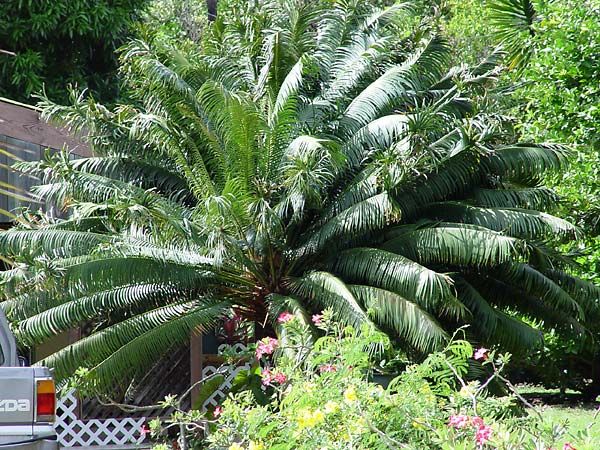
General comments regarding Cycad species: “Cycads are the world’s oldest seed-bearing plants, originating more than 200 million years ago in the age of dinosaurs” (Falanruw 2015:2). Cycads are indeed an ancient type of gymnosperm or “naked seed” plant. The many species of Cycas (cycad species collectively) have a very wide distribution and have long been utilized by some peoples as a source of food and medicine. In some places, the poisonous, nutlike seeds of cycads are carefully processed and eaten, especially in times of famine. Please note that eating the seeds of cycads can be very dangerous, and should not be consumed unless the special preparation necessary has been thoroughly completed. “Words of Wisdom” from Rivadeneyra-Domínguez, E. and J.F. Rodríguez-Landa (2014:517) summarize the pros and cons of using Cycad seeds for food:
“Cycads contain neurotoxic compounds that may contribute to the development of neurological diseases when ingested improperly. We must be mindful of the fact that while some plants have a high nutritional value and may fill the food gap for vulnerable populations, they can also be toxic and have a negative impact on health.”
Description:Cycads in general are palm-like shrubs or small trees with thick trunks containing starchy pith. The trunks are columnar or sparsely branched with crowns of large pinnate leathery leaves. C. circinalis may grow up to about 6-7 m (~20 ft) high with featherlike leaves up to about 3 m (9 ft) long by about 65 cm (~2 ft) wide; in addition, the many pointed, glossy, dark green leaflets spread widely and are about 1.5 cm (~0.5 in) wide and have a prominent midrib. C. circinalis has a long taproot and many branched tuberous side roots. Cycads are dieocious with male and female reproductive parts on separate plants. The male and female “cones” arise from the central part of the plants. The male cones of cycads produce some of the largest sperm known. Female plants of C. circinalis produce large orange seeds in a cone-like structure located in the center of the rosette of leaves.
Distribution: Cycas circinalis is an ornamental cycad. Itwas thought to be indigenous to parts of tropical Asia, Australia, and as far east as Fiji and Tonga, but is presently considered as possibly an aboriginal introduction into most of these areas. This cycad is now known to be endemic to a restricted part of southern India including the Western Ghats in the states of Kerala, Karnataka, Tamil Nadu, and the south of Maharashtra. C. circinalis is a relatively recent introduction to eastern Polynesia and Micronesia, including some atolls such as those in the Marshall Islands and Kiribati. It is a component in savanna grasslands in New Guinea and occasionally found in fallow areas, open forests, and savanna or grassland areas in other areas of Melanesia; it is also infrequently found in coastal areas or in home gardens and urban areas on both high islands and atolls.
Uses by Island Group: C. circinalis has a number of traditional uses among Pacific Islander. It is used as an ornamental species or as ceremonial plant, e.g., in Vanuatu where it is cultivated in sacred meeting grounds (nakamal), and in areas where pigs are killed. In the Solomon Islands, the bark sap of C. circinalis is used as glue, and the fruit and bark are reportedly used medicinally. Significantly, the seed kernels of C. circinalis are processed into flour as a famine or ceremonial food in some areas of Melanesia, Polynesia and Micronesia. However, as noted above, a detoxification process is involved in the traditional seed kernel processing, which must be thorough and effective in eliminating naturally forming poisons because the seed contains highly toxic hydrocyanic acid. Evidence shows deleterious effects in populations eating the seeds without proper processing; one the other hand, staminate (male) cones are also reportedly edible and the cycad fruits are sometimes strung together to make children's toys or rattles.
Uses in the Mariana Islands: Moore and Krizman (1981:14) reported the presence of “Cycas revoluta” in Guam, suggesting that this cycad species was introduced as an ornamental plant, perhaps from somewhere in its native region in “Japan and China.” C. revoluta is sometimes referred to in English as “King Sago,” and according to Moore and Krizman, it “is smaller than the native C. circinalis” (which they seem to have confused with C. micronesica, the true native cycad, see below under Cycas micronesica). In any case, C. circinalis, a recently introduced alienornamental plant in some areas of Micronesia, is sometimes known in English as Queen Sago, as a common ornamental association with another relatively similar common ornamental cycad, King Sago, C. revoluta. According to Fosberg et al. (1982:80), “Cycas revoluta Thunb.” had been reported from Palau (Koror Island), Tinian, Rota, and Guam in the Mariana Islands, Chuuk (Moen Island) and Jaluit Atoll in the Marshall Islands.
Uses in Pohnpei: A Cycad species(probably Cycas circinalis)was introduced into Pohnpei “as an ornamental prior to the Japanese period” (Ragone et al. 2001:222). Note: Fosberg et al. (1982:80) that Cycas circinalis (sensu lato) had also been reported from the atolls of Nukuoro and Mokil as well as the on Kosrae Island, probably for use as an ornamental plant.
Uses in the Marshall Islands: C. circinalis was brought to the Marshall Islands in recent times, probably for ornamental purposes. In English, the name of this plant in Marshallese (Ni-baam) means “coconut bomb” or “bomb palm.” However, this alien ornamental plant is not a palm at all, but a cycad, an ancient type of gymnosperm (or “naked seed” plant). It is now sometimes cultivated for aesthetic purposes near homes or in gardens in some of the Marshall Islands (e.g., on Kwajalein, Likip, Majuro, Arno and Jaluit Atoll, see Fosberg et al.1982:80; also see Vande Velde 2003:18).
Uses in Kiribati: This plant was also brought to the islands of Kiribati in recent times, also probably for ornamental purposes. The name of this plant (Te bam) in the local language means “palm plant” (e.g., Thaman 1987:11). It is rarely cultivated on some of the reef islands of Kiribati (e.g., on Tarawa, see Fosberg et al. 1982:80).
Uses in Nauru: C. circinalis is planted as an ornamental with no other reported human use in Nauru (Thaman et al. 1994:34).