
Caricaceae
Michael B. Thomas

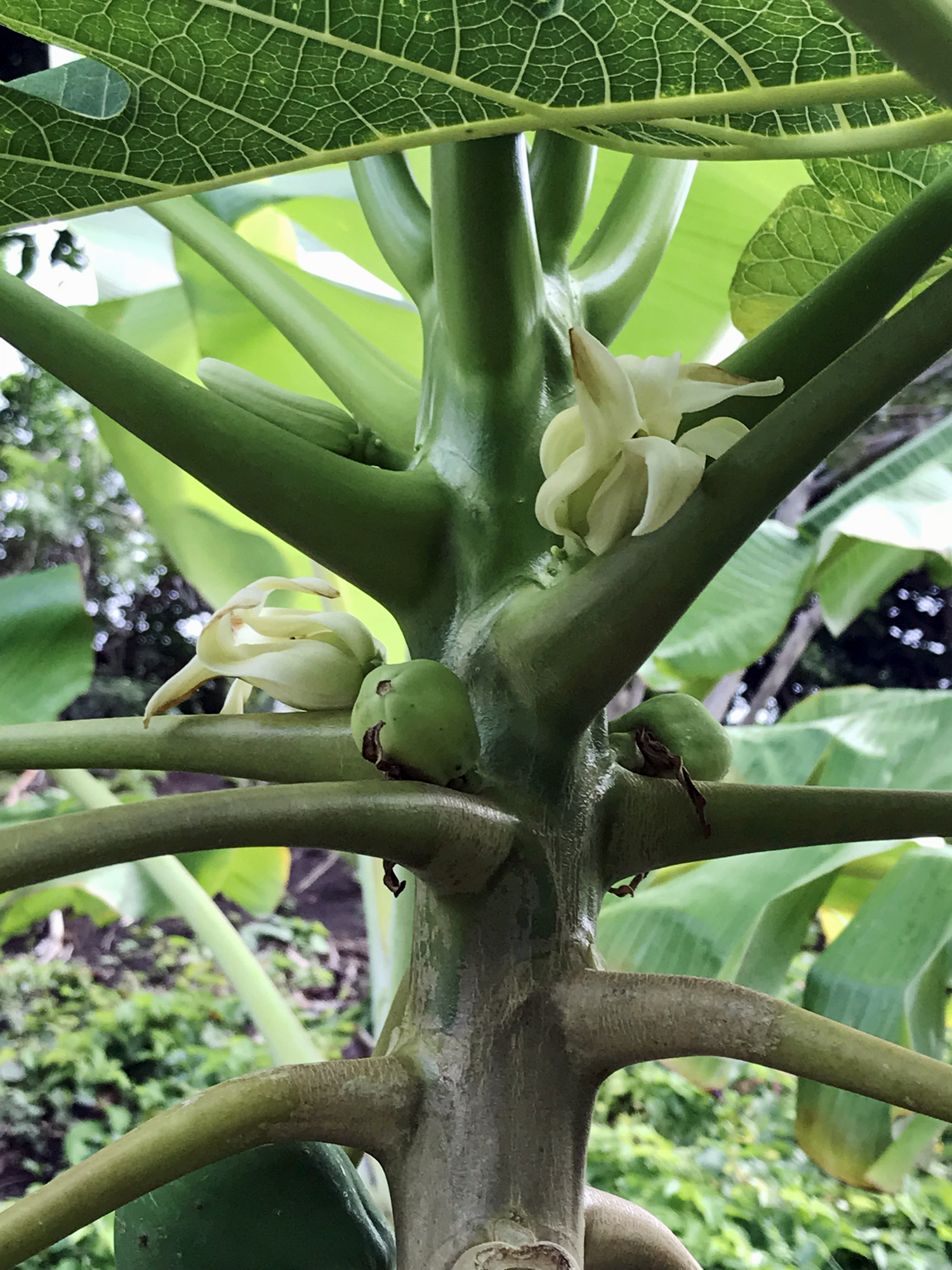
Pachycaul, few-branched, soft-wooded, lactiferous trees; leaves palmate, large, spiralled; stipules none; petioles very long and stout; flowers monoecious or dioecious; calyx 5-parted, corolla of 5 free or (in male flowers) connate petals; stamens 5-10; ovary superior, 1-celled, ovules many, on parietal placentae (usually 5); styles 5; fruit a berry, sometimes very large and like a pepo (melon). 4 genera and perhaps 50 species, all of Tropical America and Africa. The papaya and its relatives (Carica and Jacaratia).
Trees [rarely herbs], wood soft, sap milky. Stems erect; usually unbranched. Leaves alternate (borne at branch tips), palmately lobed [simple]; stipules absent; petiole present; blade margins entire or lobed. Inflorescences usually axillary, paniculate [cymose-paniculate, cymose, or racemose]; bracts present. Pedicels present or absent. Flowers usually unisexual, rarely bisexual, staminate and pistillate usually on different plants, 5-merous; calyces rotate, campanulate, or tubular, 5-toothed. Staminate flowers: corolla funnelform [tubular, salverform], tube elongate, 5-lobed, lobes oblong to linear [ovate]; stamens 10, in 2 series, borne at orifice of corolla tube, alternating longer and shorter; anthers dehiscing by longitudinal slits, introrse, distinct or connate basally, connective often projecting beyond anther sacs; ovary vestigial or absent. Pistillate flowers: petals distinct or connate basally, oblong to linear; ovary (1-)5-carpellate, 1-locular; placentation parietal; ovules 100+, anatropous, bitegmic; styles 0 or 1; stigmas 5, divided into 2 or more lobes. Fruits: berries. Seeds brown to black, ovoid to compressed, smooth or warty; aril gelatinous; embryo linear, cotyledons flat, broad.
Genera 6, species ca. 30 (1 in the flora): introduced; Central America, South America, w Africa; tropical regions; introduced pantropically.