


Micronesian Names by Islands or Island Groups: Cheritem or Agritim (Palau), Adith or Adid (Yap), Ayis, Ais, Gritin or Ómón (Chuuk), Ais (Pohnpei), Ahset (Kosrae)
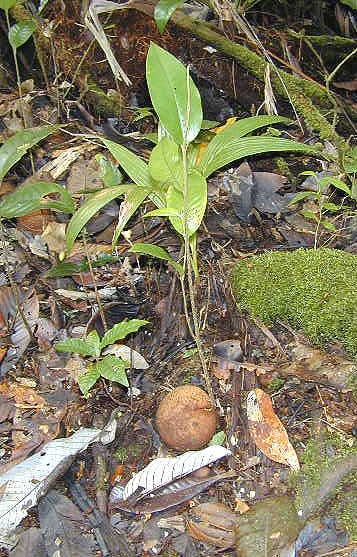
Description: Atuna racemosa is a large canopy tree that grows straight and tall to heights of as much as 25-30 m (80-100 ft, although often less). It produces large, round, reddish-brown fruits, 6-8 cm (2-3 in) in length. The leathery leaves of this tree are simple, oblong, smooth on both surfaces and along the margins, and they are pointed more or less at the tips. The showy, fragrant flowers, up to 2.5 cm (1 in) across, are produced in short axillary racemes. The brown fruits (nuts), which are spherical in shape and more or less flattened on two sides, are produced on the tips of branches. The fruits, which contain useful oil, drop to the ground upon ripening. The kernel within the fruit is hard and surrounded by a thick wall. The wood of this tree is firm.
Distribution: A. racemosa is an indigenous species from Insular Southeast Asia, including Indonesia and the Philippines, all the way to Fiji, and the Caroline Islands in Micronesia (Clarke and Thaman 1993; also see Prance 2004). Although this tree species is found in some cultivated areas in various high islands of Micronesia [such as Yap proper,] it may occur in almost pure stands is some forested places, apparently in those areas where recent disturbance has occurred. In these seemingly wild, forested areas this tree may have been consciously introduced for its valuable products. Although this tree is commonly found on the high Caroline Islands of Belau, Yap, Chuuk, Pohnpei, and Kosrae, it may not be native since its large fruit probably would not have been brought to the islands by birds, wind, or ocean currents, although it has undoubtedly been moved around or within islands by severe hurricanes/typhoons. In Chuuk, this useful tree is found on Fefan, Tol, and Weno in upland areas. In some high island forests in the Carolines it may occur in almost pure stands, apparently, again, in places recently disturbed by natural or human-induced causes.
Uses by Island or Island Group: NOTE - some of the uses described for Atuna racemosa on one island or group of islands may also apply to others although not listed here.
Uses in Palau: A useful oil is extracted from the seed (endocarp) of the Cheritem [A. racemosa] fruit and used as a coating that is applied on canoes and the local bai (men’s meeting houses); this oil helps emphasize the red pigments extracted from clay soils that are used to stain the wood. “The oil also acts as a sealant to minimize water absorption into the wood. The oil is also used in combination with lime powder (aus) to strengthen handles for spears (biskang) and adzes (ebakl)” (Kitalong et al. 2008). Regarding the use of A. racemosa oil in men’s buildings in Palau, the Belau National Museum indicates that:
“The bai (bai er a cheldebechel (men’s club center) was finely carved and incised and then carefully painted with earth pigments and ashes. The extracts from cheritem [A. racemosa] nuts were used as [dark red] varnish [loak] on the exterior painted surface. The extracts are known traditionally for their resistance to rain, humidity and sunlight.”
In addition, the stems of seedling of A. racemosa or its twigs, are traditionally are used in Palauan fishing as Otobed (1968) reported:
“They are woven together to form a cylinder known as umad, which is a structural component of the Palauan fish trap known as bub. Fish entering the trap follow the cylinder until they touch the ends, when they hit the end the trap will open and force the fish inside, locking the fish inside as the twigs return to their original position.”
Uses in Yap: Useful oil is also traditionally squeezed out of the fruit of Atuna racemosa in Yap where the tree is known as Adith (or Adid) in Yapese. Mixtures of the oil of Adith and Niiw (coconut) oil are used in perfumes in Yap, where Adith oil is also mixed with Guchol ni reang (turmeric root material) to make a fragrance with an attractive scent. As an aid in cooking, the oil of Adith is mixed with wood to make it burn easier in Yap, and coconut oil is blended with ground shavings of Adith nut, and rubbed on the skin as an insect repellent. Parts of the plant are also used medicinally in Yap, and the sap is used as glue in canoe construction, while the hard, rot-resistant wood is used traditionally in house construction. It should also be noted here that other valuable uses for Atuna racemosa are only now becoming evident through modern science: “The Mayo Clinic has recently tested an alcohol extract from this species and found that it has antibacterial properties against gram-positive bacteria including methicillin-resistant Staphylococcus aureus” (Falanruw 2015:64).
Uses in Chuuk: The seed, which is highly fragrant, is grated for use as a condiment for food in Chuuk. The oil, extracted with special technique, was mixed with coconut oil to make an attractive perfume (néén ómón) applied to the body for special occasions. The valuable oil squeezed out of the fruit of Ayis (A. racemosa) is very long-lasting and has also been used in Chuuk, as in other high Caroline Islands, to varnish canoes. This oil was also a traditional trade item desired by the inhabitants of the Western group of atolls who visited Tol Island in Chuuk Lagoon to obtain highly esteemed products. However, not all fruits of this tree yield the useful oil, and this has inspired the following Chuukese saying: "paa paan ayis" ("counting of Ayis" or "don't count your chickens before they hatch"). The bark and leaves of this tree are active ingredients of some local medicines, and the hard wood is resistant to rot, and therefore, was very important in house construction, especially when the wood of mangrove trees was not available. The fruits, after they fall and dry out, were used as "magic" to keep mosquitoes away.
Uses in Pohnpei: The hard wood of Ais (A. racemosa) is resistant to rot and is therefore very important in house construction, especially where the wood of several important mangrove trees is not available. The fruits are used for medicine and as an insect repellent. In addition, avaluable oil can be squeezed out of the fruit of Ais. This oil is very long lasting and was used to paint canoes. First, a reddish brown soil cover is applied to the surface of the canoe, and then oil from the fruit of Ais is applied to seal in the earth color and protect the canoe.
Uses in Kosrae: The hard wood of Ahset (A. racemosa) is resistant to rot and is therefore was very important in house construction, especially in areas where the wood of several important mangrove trees is not available. The fruits are also used in Kosrae for medicine and as an insect repellent. In addition, useful oil can be squeezed out of the fruit of Ahset. This oil is very long lasting and was used in the traditional painting of canoes, as done in Pohnpei, and other high Caroline Islands. First, a reddish brown soil cover is applied to surface of the canoe, then oil from fruit of Ahset is applied to seal in the earth color and protect the canoe.