


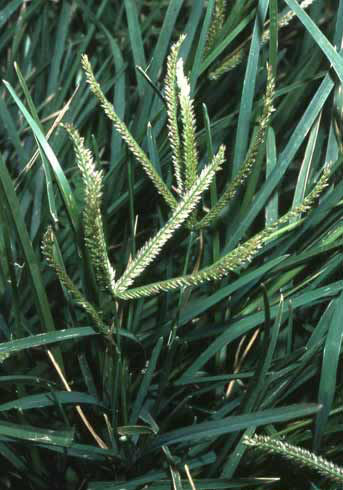
Description: Eleusine indica is an annual or short-lived perennial grass that forms clumps branching from the base, erect or prostrate. It is distinguished by its flattened culms (the above-ground or aerial stems of grasses and sedges). E. indica can grow up to 1 m (3 ft) or more with leaf blades that are flat or sometimes folded and 15-30 cm (6-12 in) long. Stone (1970:191-192) described the plant as a: “Branching erect or prostrate annual [grass], culms flattened, up to 90 cm long; blades up to 30 cm long, 4-6 mm wide. Spikes 2-6 (usually 5) from apex of culm, one slightly below apex, up to 10 cm long. Spikelets few-flowered, up to 6 mm long, awnless, dark green. Seed ridged [~1.5 mm long] and striated.” E. indica grass is very hard to pull out of the soil it occupies as it develops a strong grip on the ground. For example, its common Micronesian name on Namoluk atoll (Fätilimwech) refers to the difficulty of pulling this grass out of the soil in which it grows. A single plant is said to be capable of producing up to 150,000 small seeds!
Distribution: Reportedly native to India or Africa, weedy Eleusine indica now has an immense geographical range, from the tropics to temperate environments. E. indica is quite common on roadsides and on wasteland (disturbed or open areas near settlements or buildings) especially in sandy soil. E. indica is considered to be a major weed in all relatively open areas where it has become established, including cultivated cropland, gardens and roadsides up to about 900 m (3000 ft) elevation. It also occurs in plantations and nurseries, growing best in wet, fertile, cultivated soil in full sunlight, and once it becomes established is hard to eliminate (Swarbrick, 1997a:16; also see Swarbrick, 1997b). Although this species is native to somewhere in the Old World tropics, it is now naturalized in many tropical and temperate areas including many, if not all islands of Micronesia. Although some have considered it to be a native grass in some areas of Micronesia, others, such as some scientists, believe that it is an alien plant introduced by humans to some of these high volcanic islands (e.g., Kosrae) and low coralline inlands (e.g., the Marshalls). Some have suggested that E. indica was an ancient introduction to the Pacific Islands as Far East as Polynesia, but was a European introduction to Hawai’i where it was first recorded in the middle of the 19th century. In any case, this weedy grass is now common in various areas of Micronesia.
General Uses: Eleusine indica is a notorious weedy grass species in many tropical areas of the world today, apparently being poisonous for some mammals, and its seed is reportedly a potential contaminant of cultivated grains. Nevertheless, this plant “is also used locally as a medicine, food and source of materials for weaving, making paper etc.” (e.g., see the Useful Tropical Plants Database 2014). In addition, all parts of E. indica, especially the root, have been reportedly used in traditional medicine in various places within its vast present day range of human-mediated distribution (e.g., see Lim 2012:230-234). Reputed uses of E. indica, such as decoctions of the boiled plant or otherwise, include its utilization as a diuretic, to expel parasitic worms and other internal parasites from the body, to induce sweating and reduce fever, as well as for treating cough and other ailments (e.g., see Kulip 1997); furthermore, the seeds of E. indica are sometimes said to be consumed “as famine food and also used in the treatment of liver complaints” (see Lim 2012:230; Iqbal and Gnanaraj 2012).
Uses in the Mariana Islands: More of a problem species than a plant with benefits to people, Umog (Eleusine indica)was common in Guam at least by the turn of the 20th Century, growing well in sandy places (Safford 1905:269). Today E. indica is “one of the most serious weed problems on Guam, especially portions of [golf] fairways receiving heavy compaction from vehicular and foot traffic” (Wiecko 2002). In farming areas on Rota Island in the Commonwealth of the Northern Mariana Islands (CNMI), E. indica has been reported as one of the major weedy species that has been “predominant and aggressively competing with taro for space, light, water, and nutrients” (Ragus et al. 1993:15). Fosberg et al. 1975:12) reported E. indica to be weedy in villages and other open areas of the CNMI (also see Pratt 2011, Mueller-Dombois and Fosberg 1998:219).
Uses on Namoluk Atoll: Marshall (1975) described some aspects of the distribution and contemporary uses of the alien Eleusine indica grass on Namoluk Atoll where it is known in the local Micronesian language as Fatilimwech:
“Sunny, sandy cleared areas around homes provide the major habitat for ‘fatilimwech’ whose name means literally ‘hard to uproot grass.’ Clumps of ‘fatilimwech’ formerly were placed under newly built canoes just prior to launching in order to prevent drifting (the ‘uprooting’ of the anchored canoe). This grass often is cooked along with taro or breadfruit to prevent scorching of the food although it is not eaten itself. When dried, ‘fatilimwech’ finds use as mulch for taro. The entire plant is pounded, mixed with the water of a green coconut, and drunk as an antidote for bloody stools on assumption that its clinging properties will prevent further loss of blood.”
Manner and Sana (1995:57) reported that on Losap Atoll E. indica was a common grass species on Losap Islet and frequently occurring on Lewel Islet in trailside locations, but had no local name; this is just one example of the continuing widespread dispersal of Eleusine indica, a very weedy grass now common in various areas of Micronesia, even on remote atolls; for example, Fosberg (1969:3) observed E. indica on Satawal where it is known as Puker and very common in the atoll village as well as along pathways on that small coral island.
Uses in Pohnpei: E. indica is known as Reh takai in Pohnpei. In Pohnpeian language “takai” means “stone” and the meaning of Reh takai in the Pohnpeian language indicates that this alien grass species is hard to pull out of the ground. In Pohnpei E. indica has been used for a variety of purposes; for example, Balick and his colleagues (2009:298) referred to a variety of these uses:
“To treat unspecified baby’s sickness…To use as a charm to protect a person…For use as a stimulant or perhaps as a charm to never become tired when running during a track and field competition, four of the soft parts of the leaves are chewed and swallowed…. To use as a stamina boost, the stems are chewed before races…. To treat continuous menstrual bleeding…To maintain healthy hair…Alternatively, as a hair conditioner, one plant is collected, cleaned, mixed with scraped coconut (Cocos nucifera), put into a cloth and squeezed on the hair….”
Uses in the Marshalls Islands: The lower part of the stem of the alien E. indica grass is now sometimes used as a baby medicine in the Marshall Islands where it is pounded in water for use in a bath. Its Marshallese name, Katejukjuk, means “try to stay put” or “make a community,” probably in association with difficulty one has when pulling E. indica of the ground where it has taken hold. Okabe (1941d:14) listed the “culm & leaves” of E. indica as sources of food on Jaluit Atoll in the Marshall Islands.
Uses in Kiribati: Catala (1957:78) referred to E. indica as plants used to feed pigs and chickens. The Kiribati name “te uteute na banaba” indicates that it is a “hollow grass” (Thaman 1987).
Uses on Banaba Island: E. indica is also known as te uteute (which is a general word for “grass”) on Banaba Island where it is reportedly found in abundant numbers “in gardens, near pig pens, waste places, roadsides and other ruderal habitats,” and immature E. indica grass “is eaten by pigs” (Thaman and Samuelu 2016:49).
Uses in Nauru: Known as Ibugibugi on Nauru Island where it is very common, E. indica occurs “in rather dense concentrations or colonies in gardens and waste places”(Thaman et al. 1994:71).