


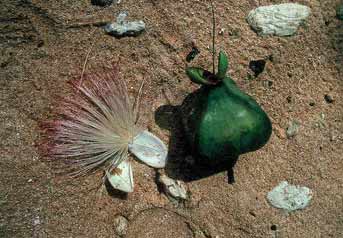
Description: The large “Fish Poison Tree” (Barringtonia asiatica) is a thick-trunked, native coastal tree with prominent, attractive white flowers. It can grow to heights of 20 m (65 ft) often as a mangrove associate that occurs on sandy and rocky shores. Its bark is greyish and smooth, and its large, glossy, mature leaves are simple, narrow obovate (more or less egg-shaped), about 20–40 cm (8-24 in) long and 10–20 cm (4-8 in) wide. The leaves are produced in rosettes at the ends of branches. The young leaves are a bronze colored with pinkish veins, while the older leaves turn yellowish. Flowers appear on a long spike from the center of a leaf group. The flowers are “pompoms” of long white stamens tipped with pink and have four small white petals. The flowers open at night and attract large moths and nectar-feeding bats with their heavy scent. The following morning, the flower stamens are usually found strewn beneath the tree. The fruits are relatively large, somewhat squared, about 10-12 cm (4-5 in) across and lantern-shaped. They are green at first, turning brown when ripe, are one-seeded, and can float in water
Distribution: Barringtonia asiaticais a large, tropical woody species found growing on rocky shores along thecoasts of East Africa to the Western Pacific including all of Micronesia. [Note: the reported local names in the Philippines for this tropical coastal tree include Bitong, Bitung or Bitoon and are thus closely related to the local vernacular names in Palau, Yap, the Mariana Islands and Chuuk]After maturing on the tree, the fibrous fruit are dropped off and carried out to sea by the tides. These buoyant fruits then drift along with the currents on the surface of the ocean, eventually washing up on the shores of many tropical Pacific islands; they may then sprout and grow to be large shade providing trees. The fruit can survive drifting on the sea for long distances and remain viable for periods of up to 2 years. Since this coastal tree is a useful species, it may have been introduced into some islands in the eastern part of its present tropical Pacific range? It is quite possible that they were subsequently introduced by humans to some more remote tropical Pacific islands where they become naturalized (i.e., grow, reproduce and establish new plants on their own). If so, this probably happened before European contact; this may also apply in some areas of the Pacific to the coconut palm (see section on Cocos nucifera).
Uses by Island or Island Group: B. asiaticais one of the most common traditional sources of fish poison among Pacific Islanders who have inhabited islands where this tree grows naturally or was introduced by people in time before European contact; this includes islands in Micronesia. All parts of the large B. Asiatica treecontain saponin, a potential poisonous substance. The seeds and other parts of the plant are pounded, pulped or grated to release the poison and used to stun fish in stagnated seawater in the intertidal zone as well as in some lower areas of freshwater streams. The floating seeds are sometimes used as fishing floats. A colorful shady tree, it is commonly planted as a roadside tree in some tropical areas of Southeast Asia. In some tropical regions the wood of this tree is used in construction (e.g., for houses and canoes); and the species also has traditional medicinal uses, for example, in the Philippines, the heated leaves are used to treat stomachache and rheumatism and its seeds are used to eliminate intestinal worms (e.g., see Tan 2001; also see Ravikumar et al. 2015 for traditional fishpoison use by tribal groups of the Nicobar Islanders in the Indian Ocean, and see Barrau 1955 for notes on fishpoison use in the tropical South Pacific region).
Uses in Palau: The fruits of B. asiaticaknown in Palau as Bduul have been used traditionally for net floats in fishing, and the crushed and grated seeds are used in shallow water fishing as a stupefying “poison” which causes the fish to be “narcotized” and float to the surface where they can be collected easily (e.g., see Tuyama 1941).
Uses in Yap and its outer islands: The seeds of Biuwol (B. asiatica) have been used to stupefy fish and octopus in many Pacific islands including Yap, although it occurs more commonly “in outer islands than on mainland Yap” (Falanruw 2015:46). To stun fish in tidal pools of the reef, the firm white seed can be crushed, mixed with water, and thrown into pools where fish are found. This method of stupefying fish does not appear to harm the flesh of the fish as food. The bark is used by some on Yap for medicine. On Ulithi, the leaves serve as dishes, covers for food containers, and are made into a bandage to treat khilsobou (ringworm), which is said to be contracted by those who break certain taboos. On Ifaluk, the bark and fruit are used to treat yaws sores and a concoction from the fruit serves as a treatment for bad dreams. On Fais, it has medicinal applications and the wood is for canoe-making (Fosberg and Evans 1969).
Uses in Mariana Islands: According to Amesbury et al. (1986, also see Cunningham 1992:35), the Puteng or Putting tree, as B. asiatica is known in the Chamarro language of the Mariana Islands, has been a traditional source fishpoison:
“Guasa was a traditional method of poisoning or stupefying fish to make them easier to catch in the Mariana Islands such as Guam. The poison was extracted from puteng [or puting see Safford 1905, Thompson 1945, McMakin 1978] seeds from the fruit of the Barringtonia asiatica plant, which grows in mangroves. Thefruit is fibrous and has a single seed. The mature fruits would fall off the tree but because of their buoyancy, they float. The seeds (puteng) would be removed from the fruit and ground with a mortar and pestle. The extracted poison was then mixed with sand and placed in tidal pools to stun the fish which float to the surface in a stunned state within about five to ten minutes. Apparently, the poison does not affect the flesh of the stupefied fish which would be scooped up by hand or with nets.” Interestingly, according to McMakin (1978:45), the material from the outer part of the trunk of this “Fish-kill tree,” B. asiatica, served as a remedy for consumption of toxic fish: “The bark of this indigenous tree is boiled into a tea that is taken as an antidote for eating poison fish.”
Uses in Chuuk and its outer islands: Kuun, as B. asiatica is known in the Chuukese, is sometimes planted as a windbreak and wave barrier. The seeds of Kuun have been used to stupefy fish and octopus in many places. To stun fish in tidal pools of the reef, the firm white seed is crushed, mixed with water, and thrown into pools where fish are found. This method of stupefying fish does not appear to harm the flesh of the fish as food. The fruits of Kuun are used to treat wounds. They are also used as poisonous cockroach bait. It is generally not used as firewood in some areas of Chuuk because it gives off a foul odor when burned. On Namoluk Atoll, where it is used for firewood, the leaves are used for wrapping food, the seeds are grated and placed into tide pools to stupefy fish, and leaves, flowers, and seeds are also used in traditional medicine; on Puluwat Atoll, the seeds of the fruits of this common large tree are also used in traditional medicine; and on Namonuito, sun dried leaves are used to cover preserved breadfruit pits and the seeds of the fruits are also used to stun and collect fish (Stone 1959).
Uses in Pohnpei: The large, buoyant fruit of Wihnsed, as B. asiatica known in Pohnpeian, is said to provide magical protective medicine. The fruit drift along with the currents, wash up on many tropical Pacific island shores, sprout near the shore and grow up to be large shade-providing trees. The seeds of Wihnsed have been used to stupefy fish in many places. To stun fish in tidal pools and quiet streams, the firm white seed can be crushed, mixed with water, and thrown into pools where fish are found. This method of stupefying fish does not appear to harm the flesh of the fish as food. The leaves of the Wihnsed tree are used to cover an earth oven (uhmw) when it is used to cook food. The leaves are also used to cleanse and smooth the skin and treating diarrhea in children, as well as for treatment of food and drink poisoning when someone has poisoned another person. “To treat skin diseases, a fruit that is floating in the water is cut in half to get to the nut, which is then scraped and wrapped in a piece of cloth and rubber onto the skin” (Balick 2009). The following traditional Pohnpeian story involves the buoyant fruits of Wihnsed:
“There was a man on Pohnpei who while working on his land cut his finger. Blood poured out from his cut. He took a leaf of Sawa (taro ‑ Colocasia esculenta) and put his blood in this leaf. He then left the leaf with his blood on the ground and went back to work. When he looked back at the leaf on the ground, he saw it shaking and a pretty girl (his daughter) emerge out of the leaf. The man and his new daughter walked along the shore, where she saw a Wihnsed fruit floating nearby. She told her father that she wanted to get on the fruit and drift away because there were no people there. When she stepped onto the fruit the seedling emerged. She held on and floated away. The fruit and the girl eventually arrived in Madolenihmw where they named the fruit Likin ("outside"). After the girl and the fruit become established there, she sent a messenger to her father who told him that she wanted to eat a breadfruit. Her father collected a special breadfruit variety and then paddled to Likin with this breadfruit. There this breadfruit is called Temwen Mei and it eventually evolved into Mein Pwuht, a type of breadfruit now only found in this area of Madolenihmw, a place where many Wihnsed trees are also found today. When the huge, thick‑trunked, native fish poison coastal tree drops its leaves, certain fish such as the Unicorn fish (Pwilak), are found in abundance on the reef” (Merlin et al. 1992).
Uses in Pingelap: According to St. John (1948), B. asiatica (known as Wi on Pingalap Atoll) was most likely “introduced by the natives because of its value as a fish poison.”
Uses on Nukuoro Atolls: The seeds of the fruits of the fish poison tree (B. asiatica) are also used on this atoll traditionally to extract “a stupefying drug affecting fish” (Stone, 1966).
Uses in Marshall Islands: Wōp or Wōb (B. asiatica) is sometimes planted as a wind break and a wave barrier. It is also used for firewood. The seeds of Wōp have been used to catch fish in many places, including the Marshall Islands. The firm white seed can be crushed, mixed with water, and thrown into pools where fish are found. The stunned fish can then easily be caught by hand. This method of stupefying fish does not appear to harm the flesh of the fish. Women use the fruits and leaves of Wōp to stop post-partum bleeding. The leaves are pounded with water and applied to boils and other skin irritations (Merlin et al. 1997). Vander Velde (2003:102) reported that Wōp was found occasionally, sometimes planted in household gardens on Majuro Atoll and had been reported previously by Fosberg et al. (1979) “on six other atolls and by Vander Velde on other atolls, in one case as a monospecific forest on Namu,” and that the Majuro Biodiversity Workshop [2000?] participants “had identified [B. asiatica] as one of the more useful plants of the Marshall Islands.”
Uses in Kiribati: Te baireati or Te bairiati (B. asiatica), the fish poison tree, is relatively rare in or near villages and is “possibly planted from adrift seeds,” but is seems to have been more common in the past when its seed was more commonly used as a fish poison (Thaman, 1990). In his report on the plant species found on Onotoa Atoll in Kiribati, Moul (1957) commented on the availability and use of this tree:
“One afternoon in the Maneaba (Community house) at Aiaki, as I was passing around plant specimens in order to secure the native names, one of the group of natives told the interpreter that this tree was the only one on the atoll and was on his land. He added that the young fruit was used to poison fish and, in the old days, to poison people.”
According to Grimble (1952, 1957) and Luomala (1953) Te baireati (B. asiatica) is not common among the atolls of Kiribati but a supply of its seeds can be collected intermittently “from western beach of any island, where it is sometimes washed ashore in considerable numbers during the season of westerly gales,” with its thick husk rendering “it capable of traveling great distances overseas,” and subsequently the collected seeds are used for poisoning fish in pools on the reef. “A very small quantity suffices to poison a large sheet of water; on a calm day, fragments allowed to sink into five fathom water off the edge of a reef will stupefy fish in the near neighborhood,” and fish thus stupefied “are eaten with no further precaution than gutting before being cooked.” Catala (1957) referred to “the similar disappearance or decline in numbers of important coastal species, such as Barringtonia asiastica, Calophyllum inophyllum, and Cordia subcordata in Kiribati due to European coconut plantations and their use for timber and firewood” (Thaman 1994). According to Catala (1957), by the mid-19th century, “few natives knew of its [B. asiatica] use as fish poison to catch fish on reefs.”
Uses in Nauru: B. asiatica, the “fish-poison tree,” is known in Nauru as Kwenbabai, Kwenababai, or Eijinut. Its wood is a desirable source of timber and fuelwood, as well as for cooking toddy syrup, and it may have been used to poison fish in the past, similar to how it has been “used as a fish poison or stupefacient elsewhere in the Pacific” (Thaman et al. 1994:160).