


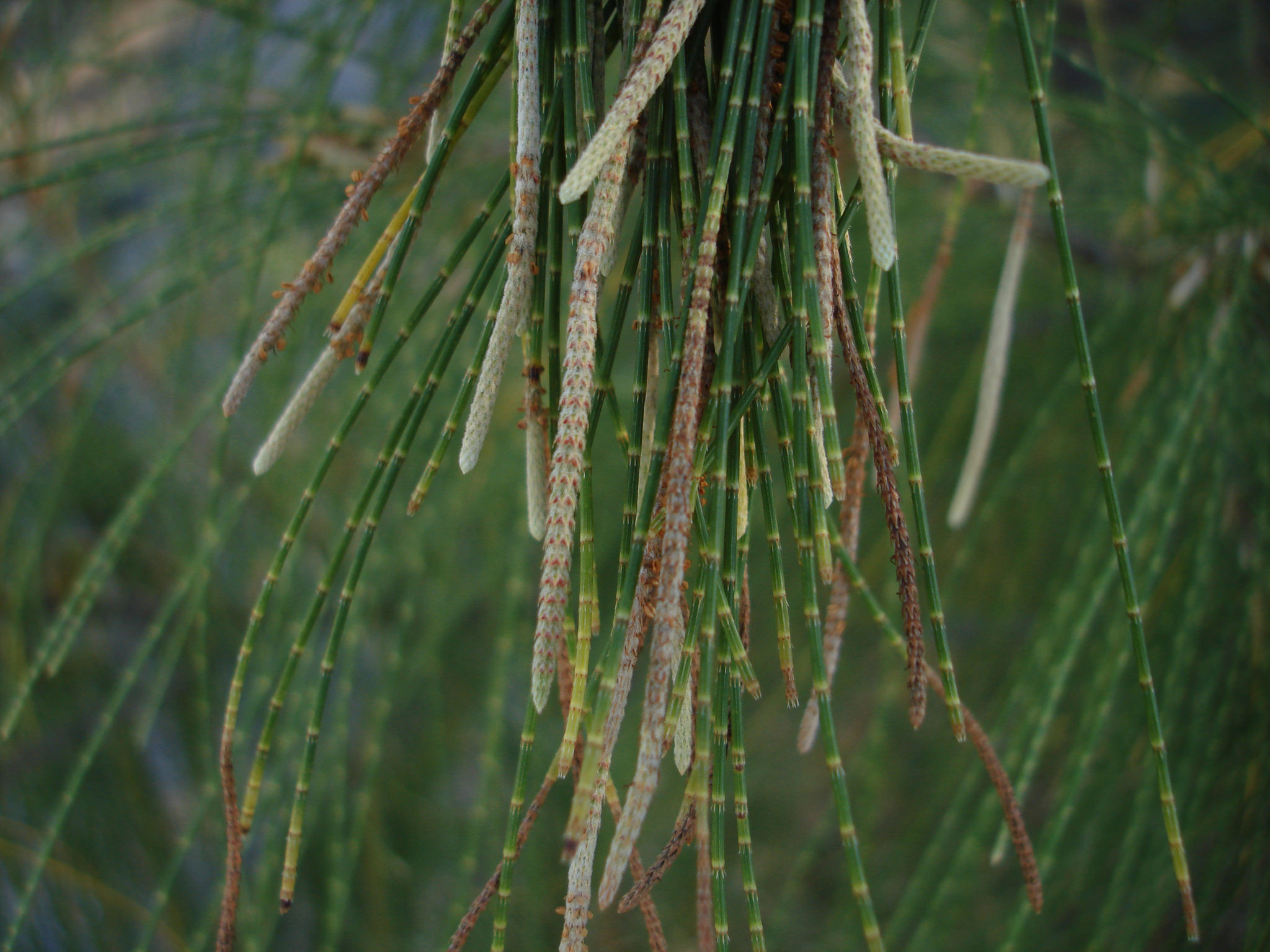
Description: Casuarina equisetifolia is a tall pine-like tree with a soft, wispy appearance that grows up to as much as 20-30m (65-100 ft) in height. It is a deciduous dicot angiosperm tree that superficially resembles a conifer (a true cone bearing gymnosperm tree). C. equisetifolia typically produces a single straight, rough-barked trunk and generally has an open, irregular crown of branches. The leaves are reduced to rings of scales around long, slender, grooved, branches that look somewhat like pine needles with the tips drooping and pubescent. The tiny leaf sheaths of C. equisetifolia are located at the nodes along the leaf-like stems (branches) and have 6-9 “teeth.” The unisexual flowers are tiny, brown and wind-pollinated. Male and female flowers are found on the same or separate trees. Staminate or male spikes are densely flowered, 1-6 cm (0.5-2 in) long with densely pubescent bracts. The small, brown, and cone-like fruit is a referred to as a nutlet, which are subglobose to elongate and oblong-globose, 1.2-2.2 cm (0.5-1 in) long with small winged seeds.
Distribution: Casuarina equisetifolia is reportedly “one of the most common trees occurring on frost-free beaches anywhere in the world and constitutes some 3% of all trees planted in tropical areas.” (e.g., see Schlub 2010). Although C. equisetifolia is probably native to littoral areas in Australia, this dense, hardwood tree may be native on some western Pacific islands such as those in the Mariana Islands (e.g., see Athens and Ward 2004). However, it is an introduced or alien species in many of remote Pacific Islands where it occurs today in open, coastal strand habitat, characterized by sand and shell beaches, as well as along rocky coasts, sand dunes, and sand bars. Indeed, C. equisetifolia is widely cultivated and naturalized in many tropical and subtropical regions of the world. It fruits capable of dispersal by ocean currents, and has seeds with a membranous wing that can be dispersed naturally by wind. However, this tree was probably an ancient human introduction to many of the more remote tropical Pacific islands, and most likely is a relatively recent introduction to a number of these islands in Micronesia, at least those in the eastern parts of this region (for a discussion of its long time, perhaps, pre-contact cultivation and use in Polynesia, see Whistler 2009). C. equisetifolia can be propagated by planting cuttings. This pioneer, fast growing, salt-resistant tree is very well adapted to both limestone and volcanic soils. It is a nitrogen fixing tree and used for erosion control on coastal areas. Even though this hardwood tree has some ecological benefits and has many traditional uses listed below, it has some significant negative impacts, especially when introduced by people to new environments where it is not native. For example, Ironwood has also been introduced to the Hawaiian Islands and to the Florida coast. In Florida, the ironwood tree poses a threat to native vegetation as it competes for sunlight and nutrients. According to Swearingen (1997:1), C. equisetifolia:
“…is a fast-growing tree (1.5 to 3 m per year) that produces dense shade and a thick blanket of leaves and hard, pointed fruits that completely cover the ground beneath it. Dense thickets displace native dune and beach vegetation, including mangroves and many other resident, beach-adapted species. Once established, it radically alters the light, temperature, and soil chemistry regimes of beach habitats as it outcompetes and displaces native plant species and destroys habitat for native insects and other wildlife. Chemicals in its leaves [decomposing into an amorphous gel with phenolic compounds that] may inhibit the growth of other plants underneath it. The ground below the tree becomes ecologically sterile, reducing the food value for native wildlife. Unlike native shrubbery, the thick, shallow roots make it much more susceptible to blow-over during high wind events, leading to increased beach and dune erosion and interference with the nesting activities of sea turtles and American crocodiles.”
In addition, Elfers (1988) pointed out that C. equisetifolia can also harm some people because its pollen can cause respiratory irritation: “Its pollen can cause allergic reactions symptomized by eye irritation, runny-nose, and hoarseness or sore throat.” On the other hand, as noted above, this hardwood tree has some ecological benefits and has many traditional uses which are described below.
Uses by Island or Island Group:The red-brown wood of Casuarina equisetifolia is very dense and therefore one of its common names, “Ironwood.” Although this tree species can have negative impact ecologically and health wise in islands where it has been introduced (as noted above), the wood of C. equisetifolia has been used traditionally in various areas where it is found “for making house parts, posts, fish hooks, and various other tools and artifacts” (Whistler and Elevitch 2006). It is very strong and needs little processing, and thus it is ideal for posts and rough house construction. It is also useful for fencing, piling, and roofing shingles. The rapid growth of the tree and the fine quality fuelwood it produces makes it one of the best trees for firewood; indeed, it still an important as a fuelwood plantation crop, its main commercial importance today, especially in Asia and Africa. It is also widely used as a windbreak, to stabilize soils, for coastal protections, and as a screen or hedge. In addition, “the tree is important culturally since its bark is widely used in traditional medicines for treating digestive tract problems and other ailments” (Whistler and Elevitch 2006).
Uses in Palau: The very dense hardwood of C. equisetifolia (known as Ngas in Palauan) is used in these islandsto make building poles, and it serves as firewood. Overall, this hardwood is relatively hard to work with, and thus it is not very useful for carving or timber, although it is used to make some handicrafts. “Medicinal uses [in Palau] include the following: the bark for toothaches and digestive track problems, the inner bark for teeth and terminating pregnancy, and the roots for treating asthma” (Kitalong et al. 2008, also see Salsedo and Davis 1987). As noted in the general distribution section above, C. equisetifolia can be quite invasive, particularly in poor soils and marginal habitats. On one hand, the tree becomes established and grows rapidly, especially in degraded and infertile areas; thus it can be used for soil erosion control as it devolopes into windbreaks and helps to stabilize coastal sands. However, in several areas where C. equisetifolia s has been introduced, it can become a problem where native vegetation persists, especially because the leaf litter of its leaf-like long, thin photosynthetic stems “needles” which produces an amorphous, allelopathic gel that appears to “inhibit the growth of other plants” (see Kitalong et al. 2008:55).
Uses in Yap: The very dense wood C. equisetifolia is used for fuel on Yap where this species is known in Yapese as Nach and referred to by “children as ‘the singing tree’ because of the sound produced as the wind blows through its leaves” (Falanruw 2015:62). On Ulithi Atoll, where this tree is known as Lach, the inner bark of C. equisetifolia is said to be used to treat diarrhea and other digestive tract ailments (see Whistler and Elevitch 2006:235).
Uses on Guam and other Mariana Islands: Over a hundred years ago, Safford (1905) noted that in Guam C. equisetifolia, known as Gago or Gagu in Chamorro language, “is scarcely at all utilized, as it is hard to work.” Safford also described the Guam “ironwood” trees as having “twisted and gnarled trunks from the effects of hurricanes.” Although it may or may not be a native species in the other Mariana Islands (see Athens and Ward 2004 for archaeobotanical evidence of its prehuman arrival), in modern times, this hardy tree species has been reported as common along some beach areas on Guam, particularly on the eastern limestone shores of the island, but also inland in the higher savannah or open grass or fern lands. Even though C. equisetifolia is rarely if ever seen growing within established forests comprised of other woody species, it still is common in the open anthropogenic (man-made or human disturbed) savannah environments where C. equisetifolia is normally the only tree species. Stone (1970:241-242) described the fire adapted nature and ultimate decline of C. equisetifolia under the pressure of repeated burning such as has long taken place in various areas of Guam and some other islands in Micronesia:
“This tree, together with Pandanus [sp.], is often able to withstand the frequent (and unfortunately often deliberately lit) fires which devastate large areas of savanna each year; and though stunted and deformed, can grow in the waste lands, dominated by swordgrass (Miscanthus) and a few neotropical weeds, which have displaced much of the native forest in the hills of southern Guam. Even so, the swordgrass appears finally to overcome even these trees, resulting in highly inflammable, fast eroding, essentially worthless disclimax grass vegetation, unpalatable to stock, extremely difficult to restore to forest, and grossly wasteful of land.”
Mueller-Dombois and Fosberg (1998:230) indicated that fires set on Saipan after the end of WWII killed off most of the young ironwood trees, and on Guam, the “Causarina forests” in savanna vegetation were almost completely destroyed by human-set fires.” By the end of the 20th century, only “small trees of ironwood, C. equisetifolia” remained in these open “grassland” areas of the Mariana Islands. On the other hand, on the very sparsely occupied Pagan Island in the Northern Mariana Islands, Pratt (2011:1) observed the widespread presence of this tree, especially in some regions: “Ironwood (Casuarina equisetifolia) forests on the northern half of the island were nearly monocultures with almost no trees other than ironwood in vegetation plots, few woody plants in the understory, and low ground cover dominated by native ferns.”
Contrary to Safford’s early 20th century of little human use of this hardwood tree, today C. equisetifolia is progated and used for farm windbreaks, urban landscapes, some construction, firewood, erosion control in grasslands, soil restoration projects and some farmers still reportedly use its foliage as mulch. However, Stone (1970:36) referred to the allelopathic characteristics of the fallen leaves of this ironwood tree in his cautionary recommendation of it as use as a garden plant:
“The value of the gago (Casuarina) is well known; but keep in mind that the litter or leaf-fall which it produces is inimical to many other plants, which can grow in the shade but which cannot tolerate the chemicals released by the slow degradation of Casuarina litter.”
In addition, C. equisetifolia has had traditional medicinal uses in Guam, reputedly for abortions (e.g., see Thompson 1947:200); Whiting (in a 1965 MS, cited by Fosberg and Sachet 1975b:4) refered to the roots being “used in a medicinal tea,” and noted that the roots and possibly the trunk of C. equisetifolia “without bark” [wood under the bark?] “are used in a douche, reputedly as an abortifacient,” and woody parts of this tree species are “burned as a mosquito repellent.” Okabe (1940:2, cited by Fosberg and Sachet 1975b:4) reported that an “astringent principle is obtained from the bark [of C. equisetifolia] and is used for chronic diarrhea.”
It should also be noted here that the relative wellbeing and persistence of C. equisetifolia on Guam, has been called into question over the past couple of decades; where as C. equisetifolia has usually been seen as “a healthy and a highly environmental tolerant tree, a reduction in the health of some tree stands was noticed in 2002,” and by 2008, this increasingly widespread unhealthy condition was referred to as the “ironwood tree decline” (IWTD), with reports indicating decline in various areas of Guam in what appeared to be a spatially random phenomenon. However, closer scrutiny revealed differences in the distribution of the disease severity, with specific anthropogenic associations; for example, IWTD was less severe “in natural undisturbed areas and more severe in disturbed plantations such as golf courses, housing subdivisions, schools and commercial.” Schlub (2010; also see Schlub et al. 2012), based on field observations and modeling techniques suggested that the IWTD was caused by a combination of “basidiocarps, termites, and level of human management.” Then after further investigation, it was concluded that the bacterial wilt pathogen Ralstonia solanacearum (wetwood bacteria) was also strongly associated with IWTD (e.g., see Ayin et al. 2015) .
Uses in Chuuk: Although use of C. equisetifolia (known as Weeku or other names in Chuukese) has had limited in Chuuk, this woody plant was traditionally used as a source of very strong wood for uses such as war clubs (as it was on some other areas of Remote Oceania). On Puluwat Atoll, axe handles and some canoe parts are reportedly made from the wood of this tree.
Uses in Pohnpei:The trunk of C. equisetifolia (Wehku or Weeku) is said to be used for timber on Pohnpei Island (see Balick et al. 2009).
Uses in Kiribati: Thaman and Tye (2015:43) pointed out that C. equisetifolia is known in Kiribati as Te katurina or Te burukam, with the latter local name referring to “blue gum” by confusion with Eucalyptus. Catala (1957), more than fifty years ago, referred to the hardwood trees of C. equisetifolia as being used as building material for making houses, canoes, fishing rods and other things; but Catala also indicated that he only observed three Casuarina trees in the whole area of the islands he visited while doing his research in Kiribati. Catala felt it was “surprising that this tree is not more abundant on these islands, as on so many others in the Pacific.” More recently, however, Thaman (1990:13, 24) noted that C. equisetifolia had become more common in Kiribati around villages and “reclaimed areas” since it was “introduced as a potential source of timber and fuelwood,” and it had become recognized as a useful windbreak tree on the ocean sides of islets “to protect newly planted coconuts.” (also see Overy et al. 1982:14). Timothy Gallaher (personal communication), former Peace Corps Volunteer on Kiribati, was “told that people in Kiribati would tie the tip of a branch of the ironwood to itself and allow it to grow into the shape of a fishhook [and] when it reached appropriate size a fishhook would be carved out of it.” On remote Kiritimati (Christmas) Atoll in the Northern Line Islands, C. equisetifolia (Te katurina) was introduced in the middle of the 20th century and reportedly is now “common in settlements” (Thaman and Tye 2015:16). Indeed, it appears to be spreading in some areas of this large dry atoll where it has been planted “in villages, houseyard gardens and open lots, often as a windbreak or border planting in all the main settlements and around tourist resorts and other developments,” and by 2011 it was becoming self-sown in sandy areas as “a more aggressive invader…with seedlings and suckers growing prolifically in waste places, even in pavement cracks (Thaman and Tye 2015:16).
Use in Nauru: Reportedly a pre-World War I introduction in Nauru, where it is known as “tanenbaum (German for Christmas tree),” C. equisetifolia is planted occasionally as a street tree or windbreak and appears self-sown “on the coastal strip, and as a naturalized pioneer on some mined areas to where [these trees] have spread from trees planted near the Topside workshops (Thaman et al. 1994:114).