


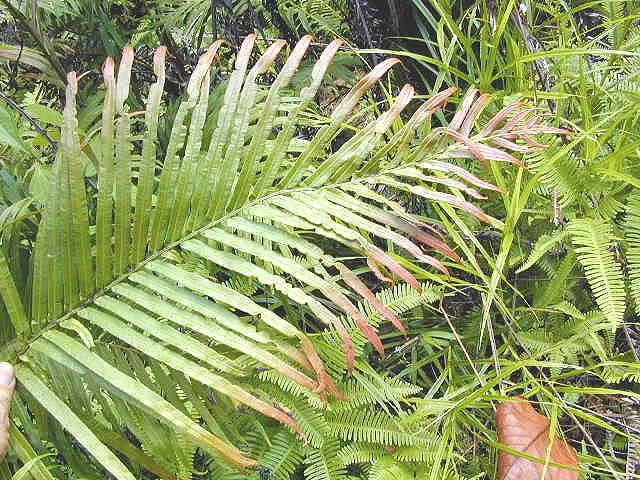
Description: Blechnum orientale is a large tropical fern with attractive, arching fronds that needs plenty of sunlight. It is often confused with B. cartilagineum. The rhizome of B. orientale forms into an erect trunk. Sterile and fertile fronds are similar, ranging in length from about 22 to 130 cm (8-46 in) and about 8 to 54 cm (3-22 in) wide.
Distribution: B. orientale found from India, Nepal, South China, throughout Southeast Asia to southern Japan, Australia and many tropical Pacific islands. This species is a fern adapted to open areas and is thus common along road cuttings in rainforest and extending into drier regions. In fact, B. orientale is a primary colonizer of forest areas opened or cleared naturally or by human impact, and it may remain as a dominant plant species in such areas if repeated fires occur.
Uses by Island or Island Group: In at least some areas of its tropical Asian and Pacific distribution, the tender young unfurled fronds (“fiddleheads”) of Blechnum orientale are eaten as a vegetable. For example, among the “Shompens, a dwindling and critically endangered Mongoloid aboriginal tribe inhabiting the Great Nicobar Island” in the Indian Ocean, the fronds of this fern are “boiled and eaten as vegetable” (Sharief and Rao 2007; also see Piggot 1996: 400-401 for reference to human consumption of the fronds of B. orientale by some people in Malaysia). In some cases, consuming this part of the fern is even considered to be a delicacy, somewhat similar in taste and flavor to that of asparagus (note: “fiddleheads,” or “fiddlehead greens,” are sometimes referred to as a “crozier” because of its association with “the curved staff used by bishops, which has its origins in the shepherd’s crook”). In addition, in some tropical places, preparation of the rhizome of B. orientale for human consumption may involve the rhizome of the fern being “washed, roasted and ground into a flour to make a kind of unleavened bread” (e.g., see de Winter and Amoroso). B. orientale is used in traditional medicine for “the treatment of various skin diseases, stomach pain, urinary bladder complaints and sterilization of women” (Lai et al. 2010); and is also said to be customarily used by the indigenous peoples in it range of distribution “as a poultice to treat wounds, boils, ulcers, blisters, abscesses, and sores on the skin” (Lai et al. 2016).
Uses in Yap: According to Okabe (see Defilipps et al. 1988) in the Map District of Yap, “young leaves [of the B. orientale fern] are put into water until it smells badly, and a small quantity is taken daily for invigoration, chiefly for children between ages two and six.”
Uses in Pohnpei: According to Balick et al. (2009:226-227), B. orientale fern is used as an energizer for pregnant women who are said to “drink this tonic to make the baby’s head smaller so childbirth will be easier.” It is thus used to treat soumwahu en lih (women’s sickness) or an upset uterus, helping induce or facilitate childbirth. Parts of this fern are also consumed with sakau (kava, Piper methysticum) to treat depression, and the fern is used to treat boils (see Balick et al. 2009 for various traditional medicinal treatments involving this fern species).