


Family: Bromeliaceae
Pineapple
Mark Merlin
Micronesian Names by Islands or Island Groups: Ongolngebard (Palau), Giyoer, Nygoongoor (Yap), Pinan (Mariana Islands), Pweyinaper (Chuuk), Pweinaper (Pohnpei), Pweiniper (Pingelap), Te Bainaboro (Kiribati)
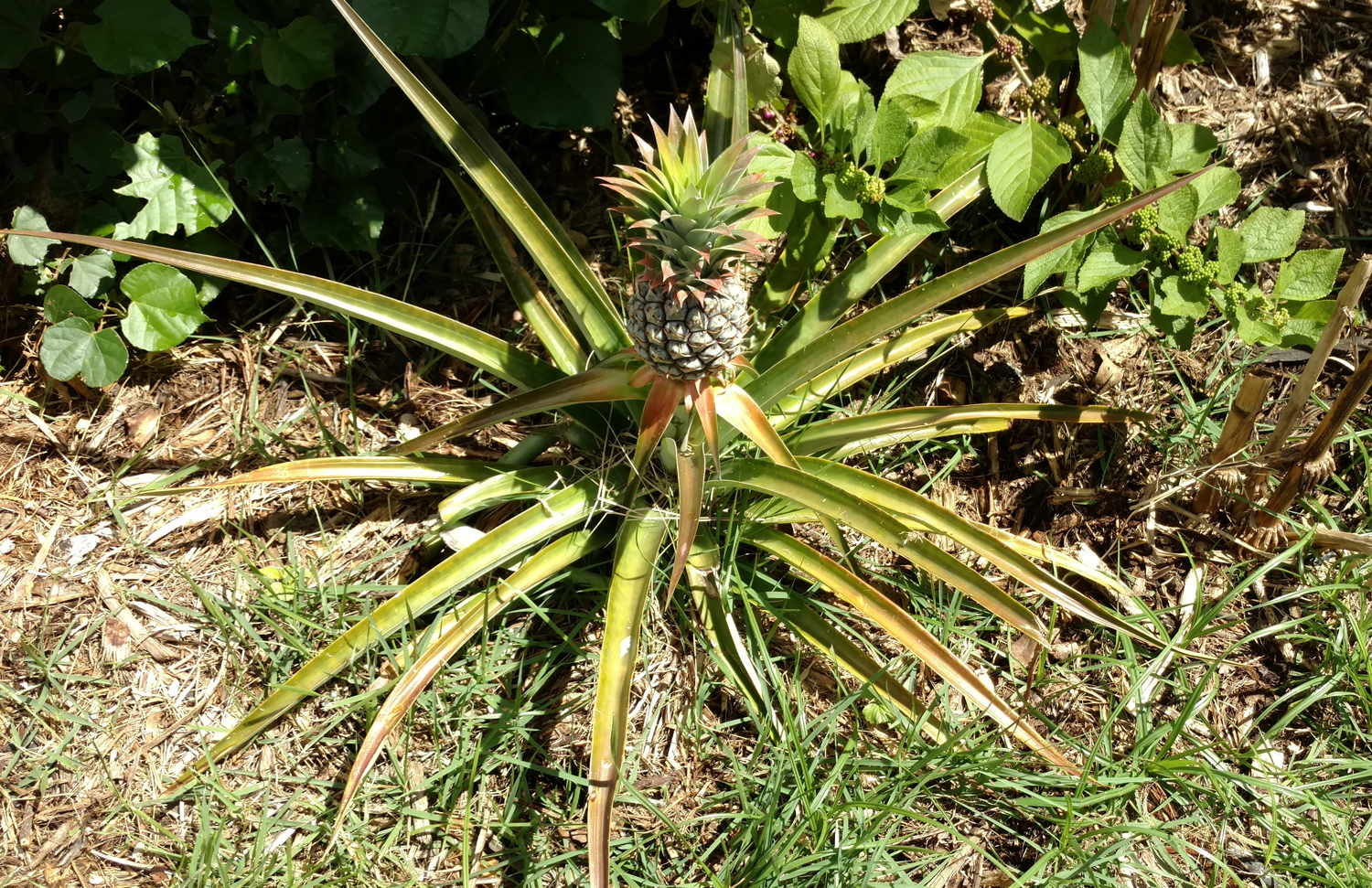
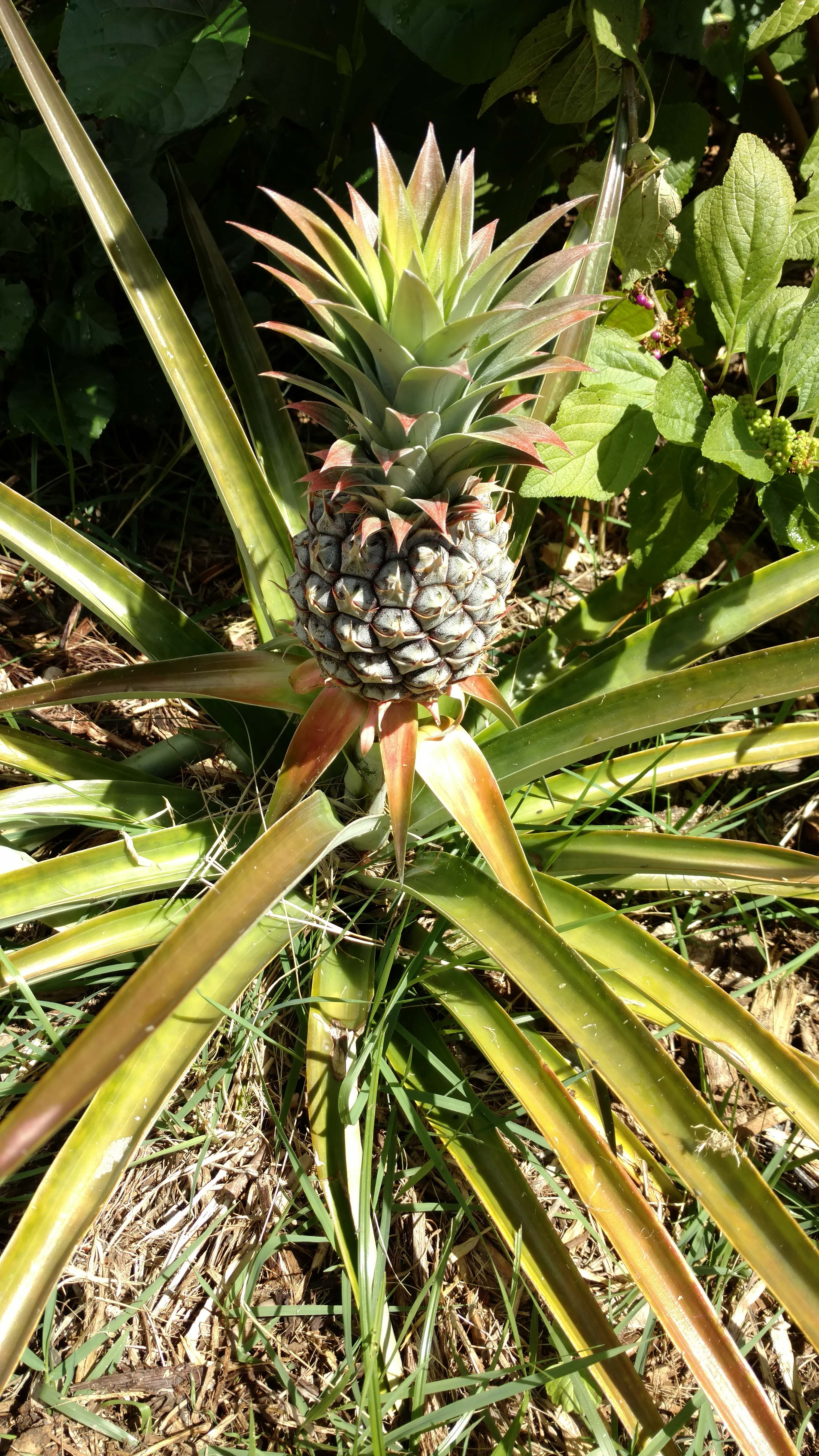
Description: Ananas comosus is the common pineapple grown commercially for its fruit. It is a seedless, herbaceous cultigen (a plant that has been altered by humans through a process of selective breeding). Ananas, the genus name for this cultivated plant comes from anana, the word in the language of the Amazonian Tupi people for the pineapple fruit; the word literally means “excellent fruit,” and the specific name comosus means “tufted” referring to the stem of the fruit. The pineapple plant is a terrestrial herb that grows to a height of about 0.75-1.5 m (2.5-5 ft) with a width of about 1-1.2 m (3-4 ft). It develops a very short, stout stem and a rosette of waxy, strap-like leaves that are long-pointed, usually needle tipped and generally bearing sharp, up curved spines on the margins. The leaves may be all green or variously striped with red, yellow or ivory down the middle or near the margins. When flowering, the stem elongates and enlarges near the apex and puts forth a head of small purple or red flowers, each accompanied by a single red, yellowish or green bract. The stem continues to grow and acquires at its apex a compact tuft of stiff, short leaves called the “crown” or “top.” Occasionally a plant may bear 2 or 3 heads, or as many as 12 fused together, instead of the normal one. As individual pineapple fruits develop from the flowers, they join together forming a cone shaped, compound, juicy, fleshy fruit to 30 cm (12 in) or more in height, with the stem serving as the fibrous but fairly succulent core.
Distribution: The pineapple is a tropical or near tropical plant limited (except in greenhouses) to low elevations between 30°N and 25°S; and because it has been in cultivation for thousands of years, its exact origins are unknown. However, it is sometimes assumed to be native to southern Brazil and Paraguay, especially in the Parana-Paraguay River boundary area, where wild relatives occur, the pineapple was apparently domesticated by the native Amerindians, and then carried by them up through South and Central America to Mexico and the West Indies long before the arrival of Europeans. Under normal conditions only traces of undeveloped Pineapple seeds are produced. Spaniards introduced the cultivated pineapple into the Philippines and may have taken it to some Pacific Islands early in the 16th Century. The best soil for pineapple culture is a well-drained, friable, sandy loam with a high content of organic (e.g., see Morton 1987; also see Beauman 2011).
Uses by Island or Island Group:
Uses in Palau: The unripe fruit of pineapple in Palau is said to serve as a medicine that destroys or expels parasitic worms (i.e., a vermifuge); and the leaves of this plant are also said to be good for that purpose, as well as serving as a purgative and anti-inflammatory; in addition, the bruised plant is applied to burns, itches and boils to encourage healing (Del Rosario 2003, also see Okabe in Defilipps et al. 1988).
Uses in the Mariana Islands: Introduced to these islands after Spanish contact, pineapple has been cultivated for its fruit crop and other uses. Some people on Guam have hand-twisted the fibers of the pineapple for making fine casting nets; and also have used the fiber for wrapping or sewing cigars (Morton 1987). In the Commonwealth of the Northern Mariana Islands (CNMI), pineapple has reportedly been a high value crop with its favorable attributes for the local cultivation including its “low maintenance, typhoon tolerance, source of income and high vitamin C content.” In addition, the three main local cultivars, the ‘Smooth Cayenne’ (Pinan Hawaii), ‘Red Spanish’ (Pinan Chamorro), and ‘Queen’ (Pinan Aleman), now seriously “affected in recent years by the introduction of diseases and pests, a dwindling economy, high costs of labor, fertilizer, pesticides and irrigation.,” along with other constraints such as natural disasters and a lack of appropriate “planting material” (Nandwani et al. 2011).
Uses in Pohnpei: Known as Pweinaper on Pohnpei, pineapple is a cultivated, but not exceedingly common fruit crop on this high volcanic island in the eastern Carolines (e.g., see Raynor 1989:38; Mueller-Dombois and Fosberg 1998:290; Balick et al. 2009: 270).
Uses in Nauru: A relatively recent introduced fruit crop in Nauru, pineapple is a “food plant in home gardens at Location and Topside Workshops and occasionally in expatriate home gardens” (Thaman et al. 1994: 47).
Introduced, Herb.
Rosette herbs with stiff sword-shaped gray-green leaves, their margins coarsely spiny-serrate. Scape thick, short; the bracts serrate; inflorescence a compact many flowered head; floral bracts short deltoid, subentire; syncarp 15-30 cm long, fleshy yellow when ripe; usually seedless. Cultivated in Guam; fruits moderate to good in flavor. A native of Brazil. Smaller, scarcely edible forms may occasionally escape from cultivation.
Mark Merlin