


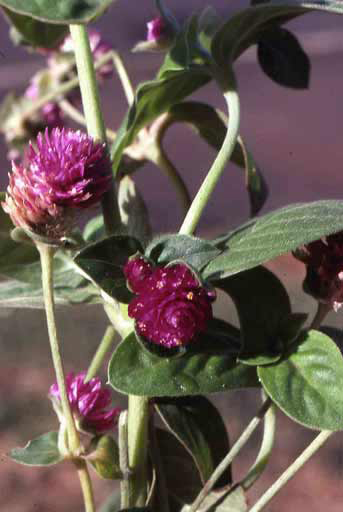
Description: Gomphrena globosa is widespread, stiff, hairy, annual ornamental herb. It grows to be about 0.5 m (1.5 ft) tall or higher at maturity with opposite leaves (two leaves on opposing sides of a stem); these leaves are approximately 10 cm (4 in) long with a maximum width of 4 cm (1.5 in). The sphere or globe-shaped (globose) heads of flowers have colorful and attractive bracts that vary in color from white to yellow, pink, red, purple, violet or multicolored. It tiny fruits are dry and one-seeded.
Distribution: Gomphrena is a widespread tropical genus comprised of about 100 annual and perennial herb species.The native range of G. globosa is obscure, with its probable origin in the neotropics (new world tropical areas); it is now widely cultivated and naturalized in many areas beyond its native range as a garden herb or ornamental, as well as becoming weedy under some conditions.General Uses: Gomphrena globosa is widely cultivated as an ornamental because of its long lasting cut flowers with their colorful and attractive bracts; and in some areas, the globe amaranth is also used medicinally. For example, the flowers are boiled to make a tea in Trinidad which is used for baby distress, low urination, coughing and diabetes. The long-lasting colorful flower heads are used in lei and garlands in such places as Hawai’i, Nepal and in parts of Micronesia.
Uses by Island or Islands Group:
Uses in Palau: The Globe Amaranth, Gomphrena globosa, is an introduced, ornamental plant that has been cited as a potential invasive species in the islands of Palau (e.g., see Space et al. 2003).
Uses in Chuuk: According to Manner (2013:226), Gomphrena globosa is occasionally cultivated “in village sites…for its flowers” on Romonum Island in Chuuk Lagoon where it is referred to as “tonenchuko.”Uses on Pohnpei: The Globe Amaranth, G. globosa, was probably introduced into Pohnpei an ornamental before World War II (see Ragone et al. 2001:304, Glassman 1952:57). Supposedly, a Pohnpei superstition indicates “that if you plant this shrub in your yard and it died, someday and somehow, you will be moved from your land” (see: http://www.comfsm.fm/~dleeling/botany/1999/vhp/gomphrena_globosa.html).
Uses in the Marshall Islands: The common Globe Amaranth (G. globosa) is not native to the Marshall Islands; apparently, it was introduced into these low coral reef islands as an annual potted plant that is sometimes cultivated as an ornamental in gardens; and because some parts of the plant, such as the flowers, retain color and shape long after drying, it is used in leis and wreaths. Reportedly, “the purple-flowered cultivar is most common” in the Marshall Islands, where this alien ornamental is also known become weedy (e.g., see Vander Velde 2003:62).
Uses on Nauru: Planted as an ornamental, its flowers are “used by Nauruans in head garlands and other ornamentation” (Thaman et al. 1994:86).