


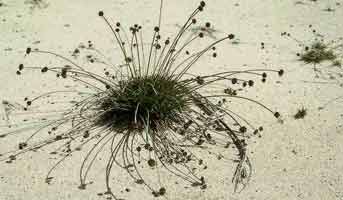
Description: There are a very large number of species in the genus Fimbristylis, which belongs to the sedge family (Cyperaceae). Fimbristylis includes several weedy species, such as the problematic F. litoralis (e.g., see Holm et al. 1997). The genus Fimbristylis is characterized by the spiral arrangement of the glumes of its spikelets. Our focus here is onFimbristylis cymosa, a common sedge in many coastal environments in the tropical Pacific; this species is normally a small, rhizotomous, perennial, grass-like sedge that produces thin, stiff leaves with linear blades, 2-30 cm (1-12 in) long, in dense tufts clumped at the base. Typically, F. cymosa grows to a height of 0.25 to 0.8 m (1 to 3 ft). The small brown flowers are about 4 mm (0.15 in) long, produced in a spherical or branched cluster 8-30 mm (0.3-1.2 in) wide, at the top of a thick stalk 3-30 cm (1-12 in) in length which is longer the plants leaves. Koyama (1964:82-84) pointed out that there “have been many opinions as to the taxonomy of the Fimbristylis cymosa complex, which is one of the most variable groups of the genus in tropical Asia.” Koyama recognized five varieties of F. cymosa, overall chacterizing the species as “Tufted in clumps from very short rhizome.”
Distribution: This low-lying plant is a common coastal sedge found in the tropics from Southeast Asia to tropical America, including most of the tropical Pacific Islands, for example, on Puluwat Atoll, the small sedge, F. cymosa is abundant on trailsides and lawns, and on Satawal this plant is common on the back of the beach (Fosberg 1969). It usually occurs on rocky and sandy coasts, where it is sometimes the only plant. On larger islands it is only rarely found far inland.
Uses by Island or Island Group: The small native sedge, Fimbristylis cymosa, has traditional medicinal and other uses on some Micronesian Islands, including the atolls. In his survery of the uses of Pacific island coastal plants, Thaman (1992:11) commented on the significance of scented coconut oil, referring to the key plant species involved: “Of the species used to scent coconut oil, a product which remains of considerable importance for ceremonial exchange, commercial sale, and ritual, cosmetic, medicinal and other domestic purposes, the most widely used are he fragrant leaves of Polypodium scolopendria, the root nodules of Fimbristylis cymosa, the flowers of Guettarda speciosa, and Phaleria disperma, and the male flower of Pandanus tectorius” (underlining added for emphasis).
Uses in Ulithi Atoll: According to Lessa (1977:137), on Ulithi Atoll, F. cymosa is sometimes employed as medicine: “the leaves being used to treat thepetamae, or nausea and lack of appetite.”
Uses in Ifaluk Atoll: According to Lessa (1977:137), On lfaluk Atoll, “juice from the roots [of F. cymosa] is used medicinally.”
Uses in Chuuk: According Marshall 1975 (also see Lessa 1977:137), F. cymosa is traditionally used for stomach disorders on the islands in the almost atoll of Chuuk.
Uses in Losap Atoll: According to Manner and Sana (1988:59). F. cymosa is also used in traditional medicine on Losap Atoll, and in past times, it was reportedly used to make fish lures.
Uses in Namoluk Atoll: According to Marshall (1975:28; Lessa 1977:137), the native sedge F. cymosa is known in the local language of Namoluk Atoll as “puker uon fanu,” and on Namoluk Islet of this Atoll,F. cymosa reportedly has a preference for “damp locations and sandy soil in areas that are not heavily overgrown with underbrush,” and is used medicinally, while previously, it had been “used to make fishing lures” (see Girschner 1912:153)
Use in Pingelap: According to St. John (1948:101,107), on Pingelag Atoll, F. cymosa is known as Rosakai, and could be found in woods by the lagoon.” According to Damas (1994:232), on Pingelag Atoll, F. cymosa is known as Rosaki (which Damas pointed out is also a common name for grasses on Pingelap); Damas also commented briefly on the distribution and uses of this native sedge on this atoll stating that F. cymosa is found in:
“Woods by lagoon beach. Not clear as to which of the rosaki this is. Possibly a softer variety. Harder varieties (above) used to clean ears and to pick specks from eyes.”
Uses in Marshall Islands: Acording to Vander Velde (2003:39), on Majuro Atoll, F. cymosa occurs “in clusters or tufts in open and semi-open places along ocean and lagoon coasts and in disturbed and open inland sites dominated by limestone rock and debris,” and its Marshallese name is reportedly either Pãdãdijmaan or Pãdãlimaan, “names also applied to Eleocharis geniculata, Fimbristylis dichotoma and sometimes to similar sedges.” According to Taafaki et al. (2006:203), F. cymosa is known in Marshallese as Perelijman (or Bedelijman) and is “abundant on Majuro and throughout the Marshall Islands where it is found growing in clusters or tufts in open and semi-open places along ocean and lagoon coasts, and in disturbed and open inland sites dominated by limestone rock and debris.” On these atolls, the stalks of F. cymosa are occasionally picked and the soft inner part (a little like a tooth brush) is twirled in the ear because it feels good or is relaxing; however, if this done too harshly, or the stalk is pushed too far into the ear canal, damage to the ear can occur (e.g., see Merlin et al. 1997). This plant is used as a medicine and reportedly sometimes in divination (bubu). One twirls the stem, and the dropping parts may reveal the identity of thief or other needed information. In addition, someone wishing to influence the weather may twirl this plant while reciting a chant containing archaic (old) words. Furthermore, this plant is also said to have been used in love magic. According to one informant, persons wishing to protect themselves from illness caused by sorcery may apply coconut oil containing F. cymosa to their skin.
According to Catala (1957:95):
“The juice [of F. cymosa] squeezed by twisting the stems is used as eye drops in cases when a foreign body under the eyelids causes pain. The roots are used to perfume hair oil, and formerly, riri. The chickens are very fond of the seeds.”
Medicinally, F. cymosa is also reportedly used to treat wounds in diabetic patients (uno in kine), asthma conditions (ikkijelok in the Ralik chain; kajink in the Ratak chain), and liver problems (uno in as) in the Marshall Islands (Taafaki et al. 2006:204).