


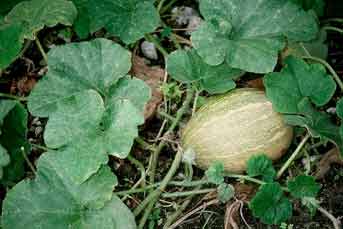
Here it is assumed tentatively that all of the English and Micronesian names and uses listed or described below for squashes and pumpkins refer to Cucurbita pepo L., or, in some cases, more generally to Cucurbita spp.
Micronesian Names by Island or Island Groups: Kalabasáng or Tongáng(Palau), Galabas, Galbass or P’aaw (Yap), Kolobwas (Ulithi), Kalebwas (Ifaluk), Calamasa (Satawal), Kalamasa or Kondót (Mariana Islands), pangkiin (Chuuk), Pwengkin or Pwiinkin(Pohnpei), Baañke (Marshall Islands), Te kateketeke (Kiribati), Dabamakin (Nauru).
Description: Cucurbita pepo is a remarkably variable species due to its diverse genetic background, with a wide variety of names related primarily to the wide variety of fruits produced by these plants. C. pepo, the common pumpkin, squash or marrow plant, is a hearty, hairy, annual climber or vine with stems up to 5 m (15 ft) or more in length. Although the stems often sprawl over the ground, or grow up into the surrounding vegetation supported by the development of branched tendrils,some cultivars of C. pepo have a much more compressed growth habit, establishing a mound of growth up typically 1.0-2.5 feet high, 2–3 feet wide. Its leaves are triangular or heart-shaped, up to 30 cm (12 in) long, with pointed, toothed lobes. The flowers are relatively large and yellow, and the fruit is more or less orange when ripe and regularly furrowed. Although C. pepo (sensu lato) generally refers to the “pumpkin” producing plant, other varieties of this species produce different vegetables such as summer squash, scallop squash, and yellow-flowered gourds (small, hard-shelled, variously shaped, ornamental fruits).
Interestingly, competition to produce the largest pumpkins has progressed exponentially in recent times with the record for a single pumpkin fruit weight was set in Belgium in 2016 “when a
a horticulturist there raised a 2,624.6-pound pumpkin, squashing the world record for the heaviest fruit” (e.g., see https://www.smithsonianmag.com/arts-culture/america-losing-ground-contest-grow-worlds-biggest-pumpkin-180964769/#Q428H2ZqmqUL0ZUt.99).
Distribution: Among the 12-14 species of squashes, pumpkins, and gourds classified in the genus Cucurbita, is C. pepo, one of the most important and earliest of domesticated species of plants in the Americas, along with maize (corn) and common bean. The wide variety of Cucurbita pepo plants is a result of many thousands of years of domestication (artificial selection) in the New World, perhaps in more than one area of this vast region. The great varietal diversity of pumpkin, squash and marrow plant types is correlated to a wide diversity of human uses spread over a very wide range of anthropogenic associations, especially as valuable containers, sources of food and for medicinal applications (see Kistler et al. 2015 for a challenging hypothesis regarding the ancient and early artificial selection of pumpkins, squashes and gourds as an adaptation to megafaunal extinction and ecological survival through domestication).
“The genus Cucurbita (squashes, pumpkins, gourds) contains numerous domesticated lineages with ancient New World origins. It was broadly distributed in the past but has declined to the point that several of the crops’ progenitor species are scarce or unknown in the wild. We hypothesize that Holocene ecological shifts and megafaunal extinctions severely impacted wild Cucurbita, whereas their domestic counterparts adapted to changing conditions via symbiosis with human cultivators.”
Climatically, various types C. pepo plants have a wide range of adaptation from areas in the temperate zone to the tropics as long there is a warm growing season of about 120 days or more; and edaphically, these plants also require rich, well-drained moisture retentive soils with a relatively warm, sunny and sheltered locations. Although C. pepo and other species of cultivated Cucurbita favor growth in open, sunny locations, “intercropping with erect companion crops such as papaya, banana, corn, trellised yam, and cassava is common in much of the tropics, which better exploits all three dimensions of cropping space” (Radovich 2010).
Note: According to Lessa (1977:183), the “Carolinian terms” used in Micronesia for squash and/or pumpkin, such as Galabas for Yap, Kolobwas for Ulithi, Kalebwas for Ifaluk, and Calamasa for Satawal that Lessa recognized taxonomically as “Cucurbita maxima Duch.” (which here is accepted as a synonym for Cucurbita pepo L.) “are corruptions of ‘calabash,’ itself a corruption of Spanish calabaza, a word of possibly Arabic origin.” This Spanish-Arabic language connection may indicate that one or more Cucurbita species were introduced originally into the Mariana Islands (e.g., Guam),by Spanish colonizers beginning in the 16th century and from the Marianas were spread to other Micronesian Islands.
Uses by Island or Island Group: Cucurbita pepo, the common pumpkin or squash plant, is widely cultivated in tropical and temperate zones, mostly for its edible fruit but also variously for its leaves, seed, oil and medicinal uses. In the tropics, C. pepo tends to grow better at elevations of 500 m (~1,500 ft) or more (e.g., see Tindall 1983). C. pepo was introduced in various islands in Micronesia following European contact. However, as a subsistence or marketable crop, C. pepo has some potential disadvantages, e.g., cultivars may require relatively large amounts of water and be vulnerable to a number of pest species. In addition to these environmental drawbacks, there are commercial issues of seasonal over production and cultural preferences regarding the shapes, size and color of the fruits; nevertheless, Radovich (2010) has described some Cucurbita crops as having notable household use in the Pacific region:
“Winter squash is a relatively minor but important subsistence crop throughout the Pacific. Summer squash is generally less important.”
Although squashes and pumpkins are cultivated on some Micronesia islands in the 21st century, during at least part of the last century, introduced squash and pumpkin crops were grown widely for local and foreign consumption. For example, Hezel (2013:197) described the cultivation of cucurbits such as squashes for export and local consumption in many of the islands Micronesia during the period of Japanese control and administration (e.g., during the 1930s):
“Wherever one went in Micronesia, one could see large swaths of cultivated land cut out of the lowlands and interior slopes; thousands of acres of farmland were claimed from the jungle vegetation. Japanese families by the hundreds grew vegetables on their small plots: squash, okra, Chinese cabbage, white radishes, eggplant, cucumbers, onion and watermelons.” (italics added for emphasis; also see below under uses in Yap).
Radovich (2010) summarized the nutritional value of the edible parts of Cucurbita crops:
“Cucurbita fruit, seed, and greens are very nutritious. Greens can be a good source of Ca, P, Fe, and vitamins C and A. The most important non-caloric contribution of mature fruit to the diet is its carotenoid content, particularly pro-vitamin A carotenes (e.g., β-carotene). Mature squash and pumpkin contributes modestly (50 kcal per 100 g) to caloric intake due to its substantial dry matter and sugar content. However, the greatest potential caloric contribution to the diet comes from the seeds, with over 550 kcal per 100 g of fresh seed. Cucurbita seed oils are generally dominated by oleic (~50%), linoleic (~30%), and palmitic (~15%) acids.”
In sum, Radovich (2010) lauded the present and future human health and sustainability potential of Cucurbita cultivation and production of tasty and nourishing food:
“Given the high nutrition and palatability, the relatively low economic return of Cucurbita is offset by the significant potential for improvement of family and community nutrition and food security.”
Uses in Palau: Among those introduced, cultivated plant types that Evans (2016) referred to as “having economic value” in Palau today are “Cucurbita (squash and pumpkin).” The 2017 edition of the “World Factbook,” published by the US Central Intelligence Agency, referred to “various” squashes and/or pumpkins (cultivars of Cucurbita plants) as agricultural products of Palau (see https://www.cia.gov/library/publications/the-world-factbook/).
Uses in Yap: Hezel (2013:197) referred to the pressure the Japanese rulers put on the native Micronesian peoples to cultivate certain crops of domesticated cucurbits during the 1930s, before WW II; for example, in Yap:
“Islanders, too, were drawn into agricultural production, although never to the degree that Japanese were involved. Yapese women were induced to work on cooperative farms to raise pineapples, pumpkins and other crops, although not without resentment at Japanesee authorities for interfering with their customary routine” (italics added for emphasis).
Lessa (1977:183-184) referred to “galabas” as the Yapese name for “squash or pumpkin.” The cultivation of squash [Cucurbita pepo] in Yap in recent times is documented in a photograph by Craig Elevitch that appears in the review of “pumpkins and squashes” by Radovich (2010); the caption of this photograph reads as follows: “Squash [Cucurbita pepo] planted in a newly cleared secondary forest together with taro (Colocasia esculenta), yam (Dioscorea sp.), sweet potato (Ipomoea batatas) and other food plants in Yap.”
Uses on Ulithi: Lessa (1977:183) listed the names of three locally recognized cultivars of “kolobwas” (cognate of “calabash”) which he reported as “Cucurbita maxima Duch.” which here is recognized as a synonym for Cucurbita pepo L.). Lessa observed these three cultivars on Mogmog Island of Ulithi Atoll in 1947, listing them as: “kolobwas lolai (‘long squash’),” “kolobwasel Meriken (‘American squash’),” [and] “kolobwiisel tutol (low squash’).” Lessa (1977:139) noted the use of “squash” as a “vegetable” used, among others, in the edible creams made from the prepared mature endosperm of coconut fruit: “The "cream" made from the grated flesh of ripe nuts is cooked with fish and with taro, breadfruit, squash, sweet potatoes, and other vegetables.” Lessa (1977:184) commented on his experience with at least one squash type on Ulithi: “I have seen and often eaten in the field what is called ‘acorn’ or ‘table queen’ squash but neglected to connect it with one of the above varieties.” A photograph by Lessa (1977:184, Fig. 8.) shows “Squash assembled for a take home ‘feast’ to reward participants in a funeral,” and notes that many “rituals serve as distributive mechanisms” for food crops such as squashes on Ulithi. Lessa (1977:184) also commented on apparent popularity of Cucurbita crops in Ulithi in the middle of the 20th century, followed by a significant waning of its cultivation in the following decades: “The fruits of this creeper are cooked and well liked, but although the crops were very extensive in 1947 and 1948-1949, especially on the island of Potangeras, by 1960 they had declined drastically for reasons that could not be ascertained.” Interestingly, Lessa (1977:184) referred to an additional specimen (Lessa No. 63) which he collected on Ulithi in 1947 from a cultivated plant he listed as “Cucurbitaceae sp.” and known locally as “therus.” Lessa described this plant as “A vine whose fruit is simply boiled and eaten, or used in fish soup (Nowadays the stalk is fried with meat, such as corned beef).” Unfortunately, Lessa noted that this vine could not be positively identified with certainty to the species level in Honolulu by the Bishop Museum botanist Marie Neal because of the “inadequacy” of the specimen Lessa had collected; however, Lessa did describe the plant from which this specimen was collect in his “simple” field notes as a vine “with small yellow flowers and large melon-like fruit with white pulp and squash-like white seeds.” Lessa also recorded other Carolinian vernacular plant names from Ulithian informants for this “Cucurbitaceae sp.” These included “dalrus”in Yap; “tarus” on Woleai Atoll; and “tarus” on Ifaluk Atoll. Here we assume that this plant type was a cultivar of Cucurbita pepo.
Uses in Chuuk: Some islands in Chuuk are said to be “known for growing foreign foods such as pineapples, pumpkins, cucumbers and lettuce” (Cook 2010, italics added for emphasis). Manner (2013:232) listed Pangkiin as the Chuukese name for “Cucurbita pepo L.” which he observed being cultivated occasionally on Romonum Island in Chuuk lagoon.
Uses in Pohnpei: In their survey reports of local food consumption on Pohnpei in 2005 and 2007, Englberger et al. (2013:214) listed Pwengkin as the local name of “pumpkin” (which they recognized as “Cucurbita moschata”); and they indicated that Pwengkin (assumed here to be Cucurbita pepo) was apparently a minor “green leafy vegetable” food source on this island.
Uses in the Marshall Islands: Known as Baañke in the Marshall Islands, this pumpkin species (Cucurbita pepo) is native to some areas of tropical America and was introduced to the Marshall Islands in recent times. According to Vande Velde (2003:89), the Marshallese name for C. pepo, Baañke, is “a corruption of the English common name” pumpkin. As a food crop, Baañke is occasionally cultivated for its edible fruit in the Marshall Islands, particularly in household gardens and in Laura on Majuro Atoll. In addition, these introduced pumpkins are “sometimes found as volunteer plants around garbage dumps and pig sties” (Taafaki et al. 2006:51). Cooked Baañke fruits and the sweet inflorescence sap (jekaro) of Ni, the coconut palm makes a desireable soup in the Marshall Islands. Note: Vande Velde (2003:88), listed two other Cucurbita spp. recently introduced to the Marshall Islands as food plants: Cucurbita maxima Duch. (“squash”) and Cucurbita moschata (Duch. Ex Lam.) Duch. ex Poir. (“winter squash”).
Uses in Kiribati: Thaman (1987:5) referred to three local “Kiribatized” synonym names for the introduced pumpkin species (Cucurbita pepo), including “te baukin, te bamakin and te bangke.” The later name, te bangke, is cognate with Marshallese name baañke for this species. Thaman (1987:7) also noted “te baukin” was one of several “occasionally cultivated food crops” in Kiribati with a local name. Small (1972:95-96) referred to some cultivations aspects for the large annual, introduced ground creeping pumpkin (C. pepo) which “grows easily…and is already popular with the local people” on the atolls of Kiribati:
“The seeds should be planted on separate hills of organic soil about 8-12 feet (3 meters) apart. The plants are thinned down to one or two per hill. It is a good practice to put household rubbish round the plants. Pumpkins and other members of this family produce more fruit if artificially pollinated. The best tool for this purpose is a feather.”
Uses on Nauru: Pumpkin (Cucurbita pepo), known as Dabamakin on Nauru Island (Thaman 1987:24), is one of a number of other relatively recent introductions of food crops on this raised atoll which is “of more localized importance, or of particular importance to contract worker communities on Nauru” (Thaman et al. 1994:22), These imported workers were employed by the Nauru Phosphate Company and “resided in dormitory accommodations at a Location near the phosphate loading cantilevers and elsewhere on the coastal strip” of Nauru; pumpkins have been an occasionally occurring food plant around this site “often adventive in waste places and gardens,” and its fruit “cooked as a vegetable” (Thaman et al. 1994:123, note: these authors regarded Cucurbita maxima Duch. and Cucurbita pepo L. as different introduced species on Nauru).
Uses on Banaba: Pumpkins (Cucurbita pepo), known commonly as “te bangeti” on the raised atoll island of Banaba, were listed by Thaman and Samuelu (2016:18-19) as one of the “more important food plants.” In their recent review of the plants and their uses on this remote Micronesia Island, sometime referred to as Ocean Island where phosphate deposits (guano) were extensively mined, Thaman and Samuelu refer to the presence and use of pumpkins on Banaba in the mid-19th century: “Interestingly, pumpkins and unspecified melons were mentioned as among the foods supplied by the Banabans, along with coconuts, to reprovision the ship Wanderer from Australia in the early 1850s (Maude and Maude 1994).” Thaman and Samuelu (2016:31) also described the distribution the staple food garderns on Banaba in modern times, which “are scattered throughout the undeveloped land that is most accessible to the main settlements, often in between mined-out pinnacles and limestone outcrops.” According to Thaman and Samuelu (2016:31), these main gardens are dominated by cultivation of cassava, known on Banaba as “te tabioka”[see under Manihot esculenta], but also include the significant planting of C. pepo pumpkins which they refer to here as known as “te banke”:
Other staple root crops found planted in food gardens include sweet potato te kumara Ipomoea batatas, tannia or American taro taro n tana Xanthosoma sagittifolium, and pumpkin te banke Cucurbita pepo, which is commonly eaten as a supplementary staple and cooked vegetable and was reported present on the island and planted by Banabans as early as 1851 and extensively planted during the Japanese occupation during WWII (Maude and Maude 1994).
Furthermore, Thaman and Samuelu (2016:63) offered the following remarks regarding refer to the commonly abundant Cucurbita pepo pumpkins on Banaba:
“Common food plant in food gardens, houseyard gardens and waste places; often adventive in waste places around villages and buildings in settlements. An important supplementary staple food and vegetable in times of food shortage when the supply boats have not come.”