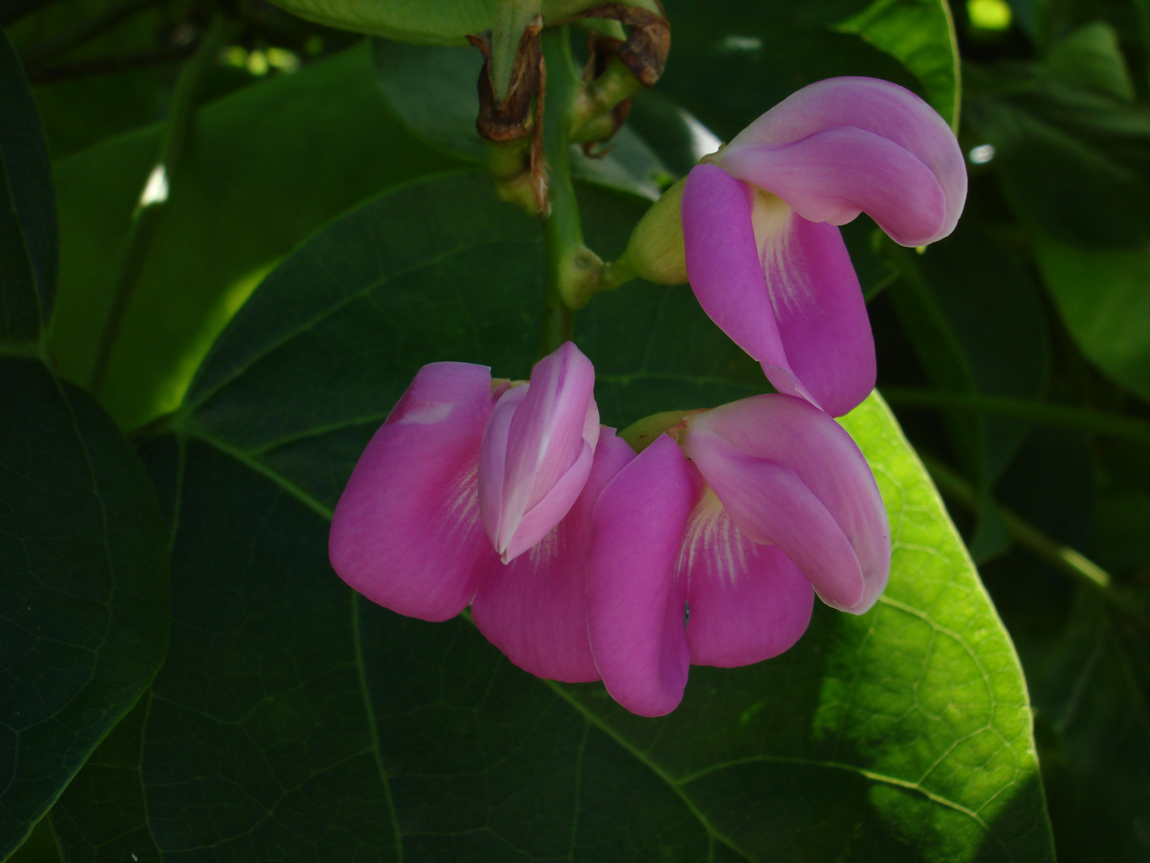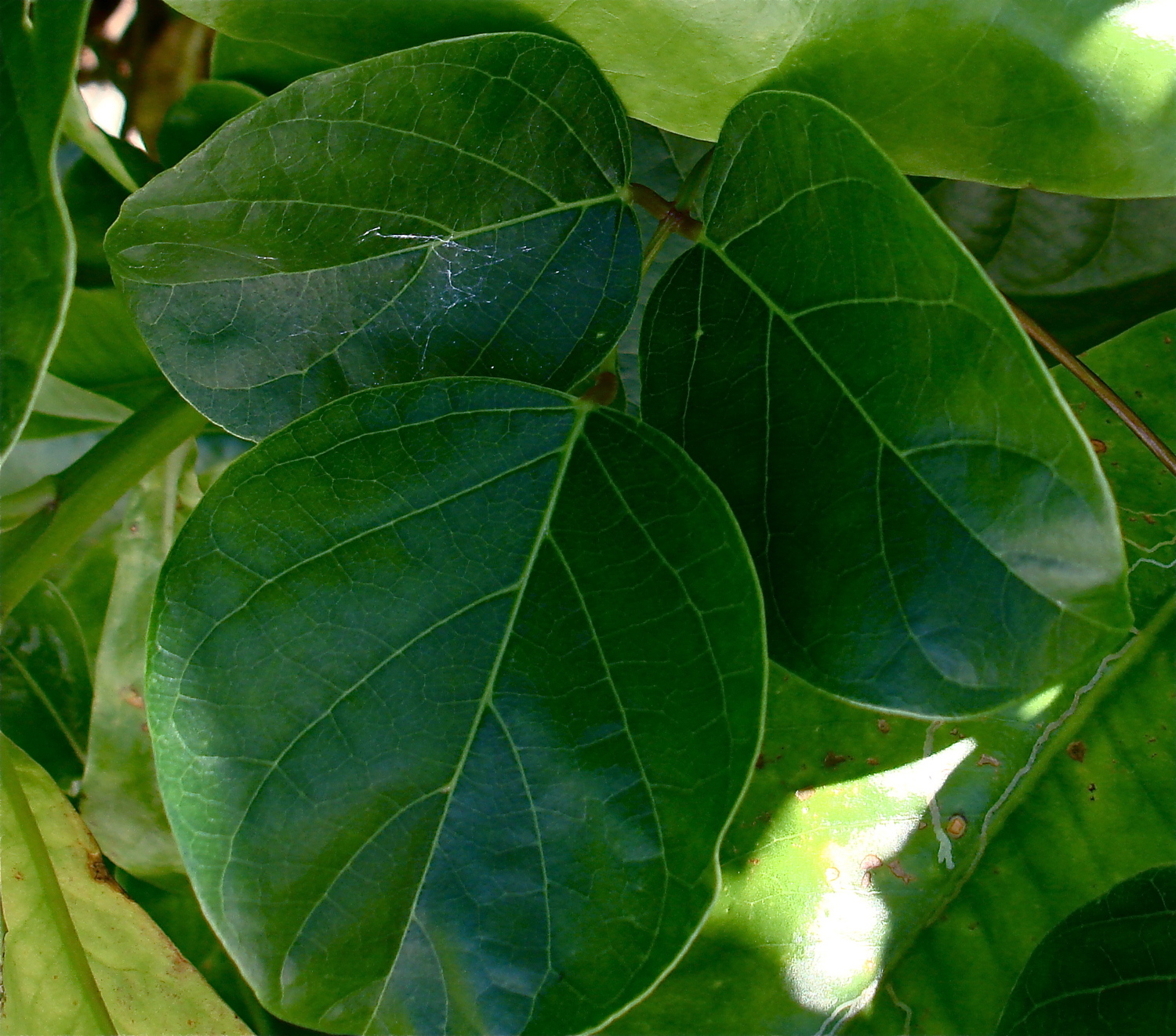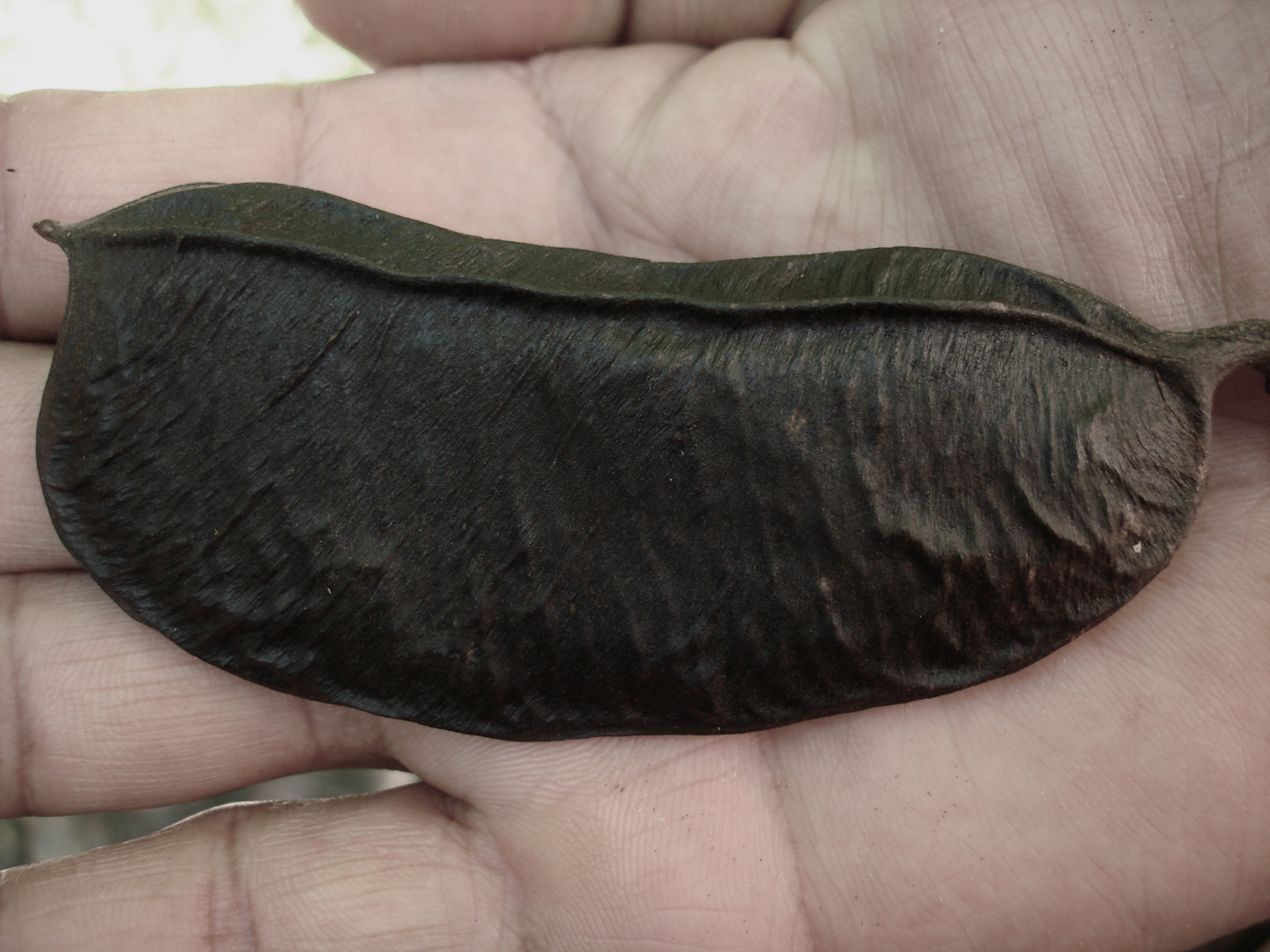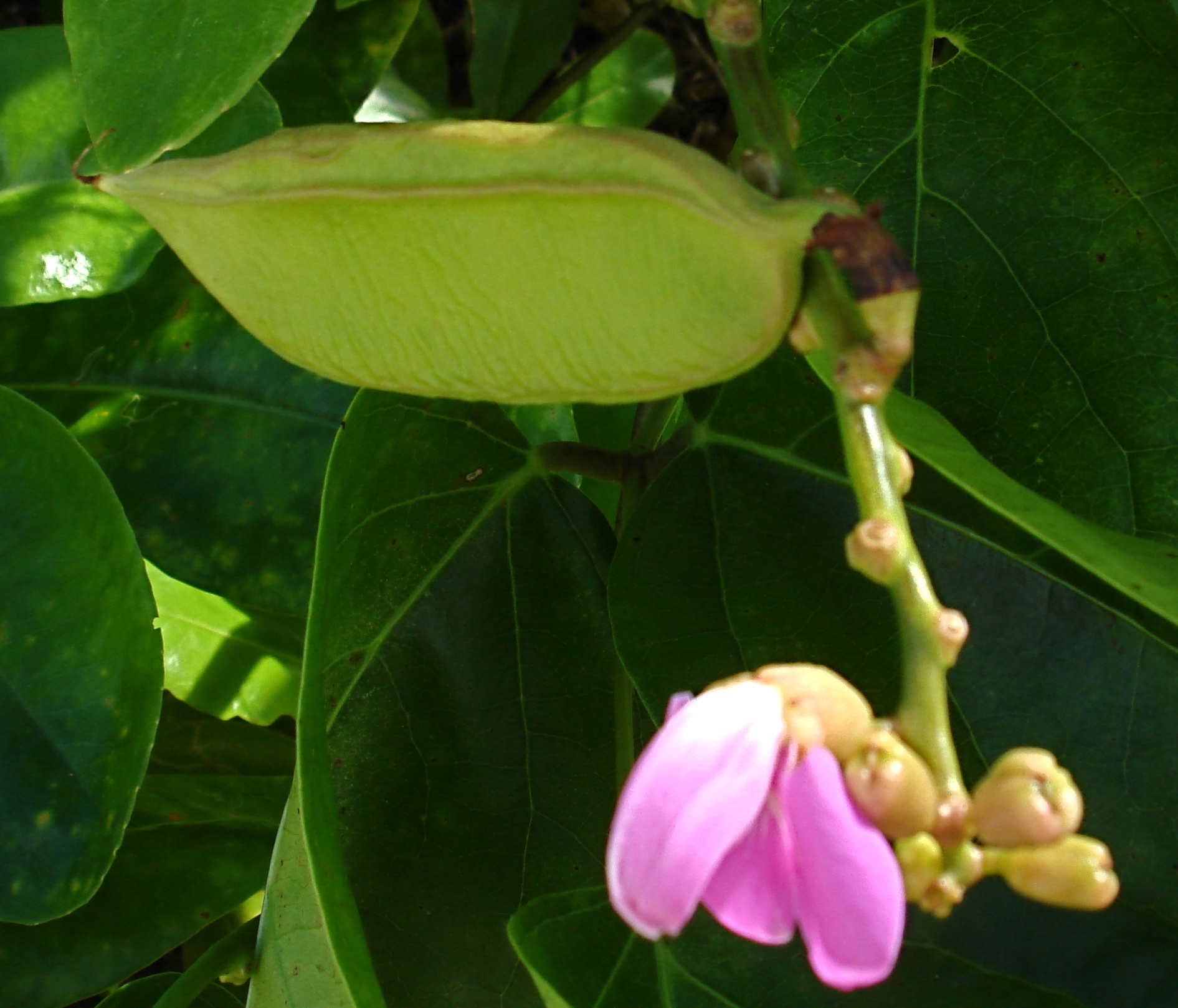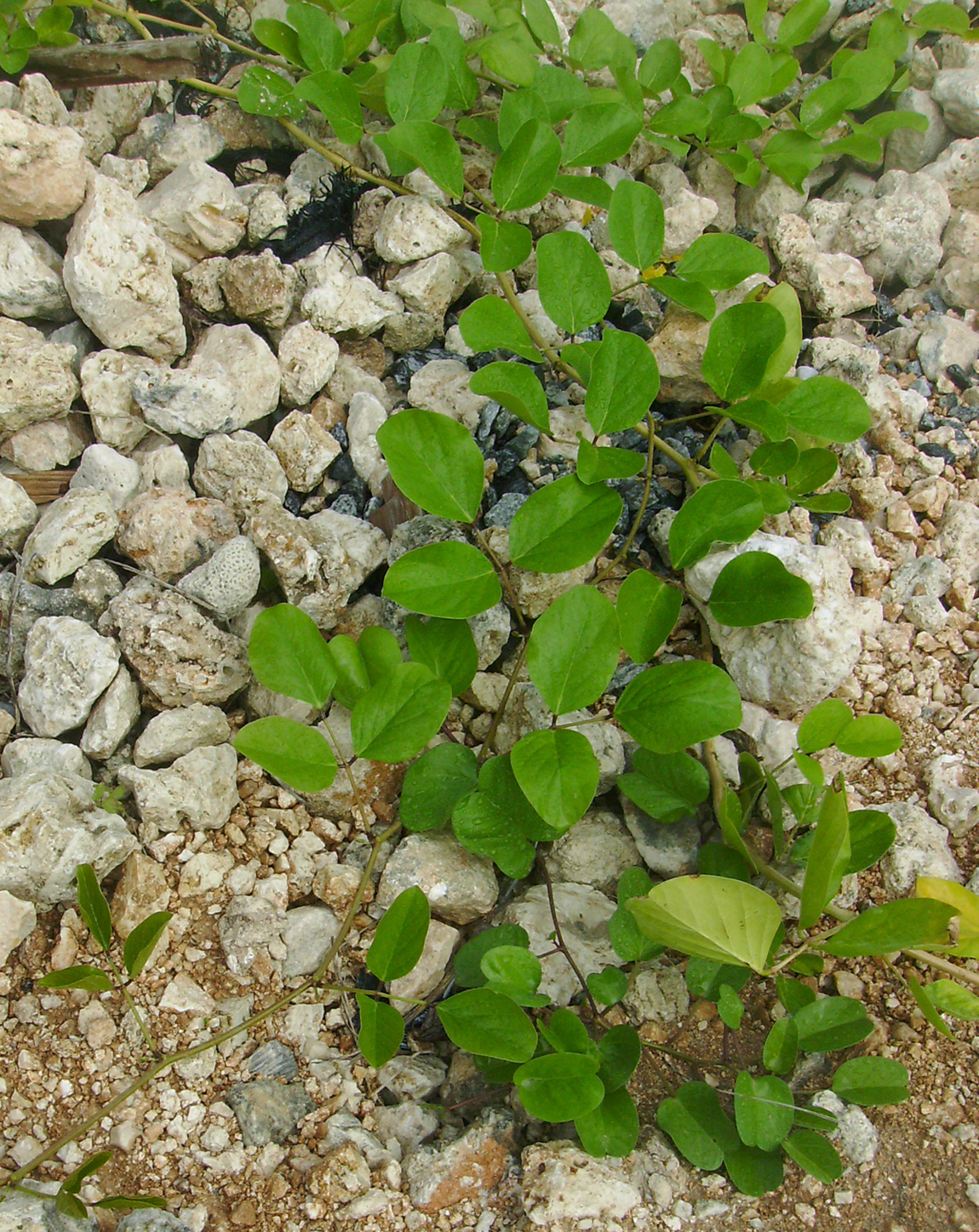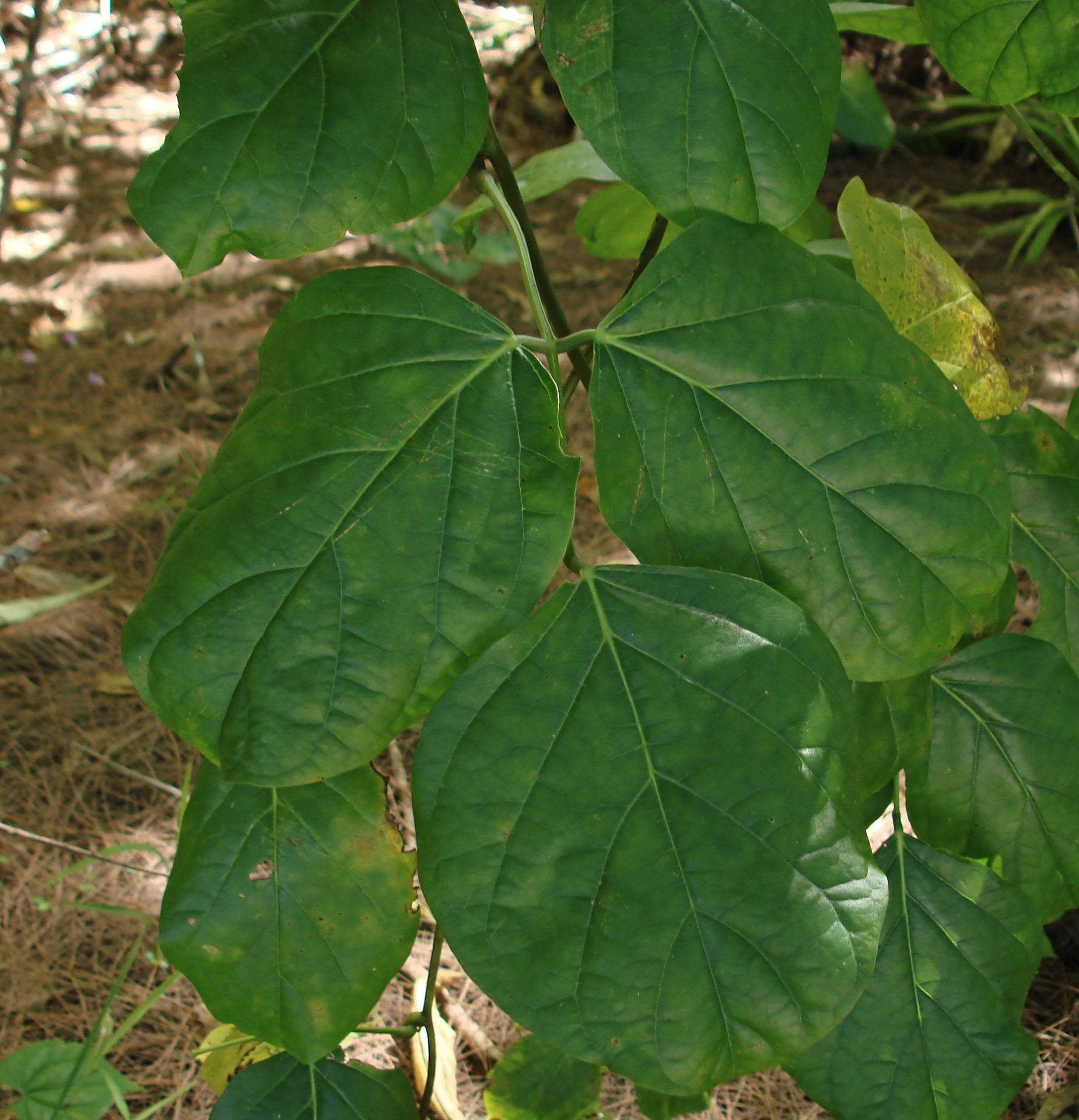
Description: Canavalia rosea is a mostly herbaceous vine that sprawls along beach dunes and coastal strand. The thick, fleshy, relatively long stems can grow to be more than 6 m (~20 ft) in length and 2.5 cm (~1 in) in thickness. The stems are rather woody near the base and several branches radiate outward, forming mats of light green semi-succulent foliage. Its leaves are compound with three thick, somewhat rounded, fleshy leaflets, each about 5-8 cm (~2-3 in) long and tend to fold up under the heat of the midday sun. Known variously in English such as the Sea Bean, Beach Bean, etc., C. rosea produces purplish pink flowers about 5 cm (2 in) long and formed as erect spikes on long stalks. The pods are flat and about 10 -15 cm (~4-6 in) long, and are prominently ridged and woody when mature. The buoyancy of the seeds the Sea Bean, C. rosea, allows them to be dispersed by ocean currents.
Distribution: The sprawling vine C. rosea is salt-tolerant and occurs naturally on seashores in the tropical Pacific and subtropics throughout much of the world growing on or near the ground in the vegetation of sandy beaches and rocky shores. It can also be found in tropical lowland forest sometimes weedy in inland in cultivated or disturbed areas.
Uses by Island or Island Group: Thaman (1992:14) referred to C. rosea as having “been planted as green manure and cover crop in Samoa.”
Uses in Palau: According to Josephs (1990:109), C. rosea and/or C. cathartica (as well as Vigna marina another coastal sprawling vine, but with yellow rather than red to pinkish flowers) are known in Palau as Keldelél (this name probably is derived from keld-él which in Palauan refers to “stem”). Kitalong et al. (2011:72-73) indicated that C. cathartica (which they referred to as Kldelleland) is used in Palau to tie light items (presumably the long stems of this sprawling vine).
Uses in Yap: The leaves and stems of a Canavalia vine (C. rosea?) are reportedly used for medicine in Yap.
Uses on Ifaluk Atoll: On Ifaluk, a coral atoll in the central Caroline Islands in the Pacific Ocean, in Yap State of the Federated States of Micronesia (FSM), the pounded leaves of Canavalia vine are reportedly mixed with coconut toddy, heated, and drunk as a cough medicine (Lessa 1977:158, who listed the species as C. cathartica).
Uses in Mariana Islands: Stone (1970:326) described C. cathartica (and/or C. rosea?) as being “Abundant in Guam, especially on the sandy beaches; absent or less common on limestone cliffs; not found inland.” McMakin (1978:43) reported tentatively that Canavalia maritima (C. rosea), reportedly known as “Akangkang-tasi” in the Chamorro language of the Mariana Islands, was one of several species from which parts were used in “Amot tabadiyo, a medicinal combination for the treatment of stroke.” McMakin indicated that the leaves of Akangkans-tasi were used in this traditional preparation. Note: Canavalia megalantha Merr., a putative endemic species in the Mariana Islands that is apparently related to C. rosea, as well as to other Cananvalia spp.; according to Stone (1970:327) “Merrill concluded that it was a close relative of C. turgida (i.e., C. cathartica).” C. megalantha is presently an unresolved species taxonomically; however, it is reportedly known to have some medicinal use in the Mariana Islands? (e.g., see Nandwani et al. 2008).
Uses on Namoluk Atoll: Namoluk is the smallest atoll in Micronesia with a total surface of only 13 km² and a land mass of less than 1 km²; it is part of the Mortlock Islands group in Chuuk State of FSM. On Namulok, the sea bean (C. rosea?) normally “grows near the beach in coconut plantations where it frequently climbs on trees and shrubs.” On this atoll, the tough seeds of this Sea Bean are reportedly “strung for leis, and the leaves serve in local medicine” (Marshall 1975:35, also see Lessa 1977:158; Marshall, who reported the local name pf this sea bean as Anikat, and Lessa both listed this species as C. cathartica).
Uses in Pohnpei: On the high volcanic island of Pohnpei, Wahntal (C. rosea) is a native vine in the strand or coastal vegetation and reportedly has medicinal uses.
Uses on Pingelap Atoll: On Pingelap, in Pohnpei State of FSM, the sea bean (C. rosea?) has been reportedly used as a medicine to aid in childbirth (Lessa 1977:158, who listed the species as C. cathartica).
Uses in the Marshall Islands: C.rosea, known as “Marļap” in the Marshall Islands, has decorative and medicinal uses in these atoll islands. For example, parts of this sprawling coastal vine are used to cleanse women after childbirth and shrink the uterus. Taafaki et al. (2006) described the biogeographical distribution of a sea bean species (C. cathartica) on Majuro and other tropical Pacific islands:
“It is rare in the more urbanized parts of Majuro, but found in inner beach forest and abandoned coconut plantations in Laura, and along and just inland from the coast on Kalalen Islet. It is rare on the main islets of Majuro. C. cathartica is native from east Africa to an including the major island groups of Micronesia and Polynesia, except the Marquesas. It has been reported present on Majuro and a number of the other outer atolls of the Marshall Islands.”
Uses in Kiribati: Thaman (1992:13) referred to the common use of the stems of C. cathartica for cordage or lashing in Kiribati.