


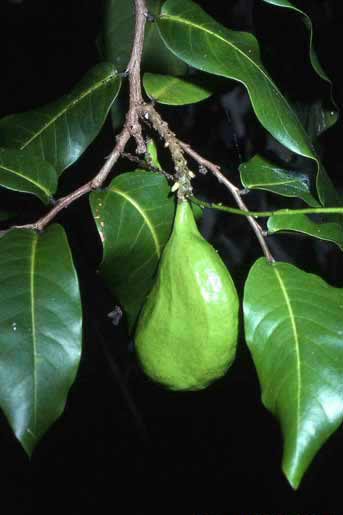
Description: Inocarpus fagifer, the so-called Tahitian chestnut, is typically found in wetland areas and is the only edible member of its genus, with a large seed that is a staple starch food. This leguminous, medium sized evergreen tree produces a gnarled, buttressed and fluted trunk with broad crown reaching heights over 20 m (65 ft). The leaves are about 15 to 30 cm (6-12 in) long and 8 to 14 cm (~3-6 in) wide, with short petioles; they are arranged alternately along the stems and have a papery or leathery texture. The clustered flowers, in axillary spikes, are small with white to cream or pale yellow petals. The large, more or less kidney-shaped, non-splitting fruits of I. fagifer vary among local varieties, but are generally about 7-8 cm (~3 in) long and 5 cm (2 in) wide. Each fruit encloses a single “nut” (seed) with a chestnut‑like flavor that is edible when cooked. Indeed, this tree is one of the most important “nut” species in the tropical Pacific.
Distribution: Adapted to tropical swampy areas, the indigenous range of Inocarpus fagifer is believed by many to stretch from parts of Indonesia in Southeast Asia through most of Micronesia to the Marquesas Islands of Polynesia, and including the Melanesian countries of the Solomon Islands, Vanuatu, Fiji, and Papua New Guinea. For example, Thaman et al. (2012:220) refer to I. fagifer as an indigenous species from “Malesia into Micronesia as far as Kosrae and the Marshall Islands, and as far east as French Polynesia.” However, in many areas of Polynesia (e.g., Samoa, Tonga, Cook Islands, and French Polynesia) and Micronesia (e.g., Pohnpei, Kosrae), the Marshall Islands and Kiribati), the species is believed to be an aboriginal or pre-European contact introduction (e.g., see Pauka 2006). I. fagifer occurs in secondary forests, as well as home gardens and coconut plantations, with its favored locations near riverbanks, swamps and marshes, as well as along coastal shorelines. It may have been cultivated more intensively on some island, and today the Tahitian Chestnut is found mostly growing spontaneously. Although I. fagifer is shade tolerant, heavy shading may lessen its yield. It has a dense canopy, which makes it unsuitable for close planting between light-demanding agricultural crops typical in the tropical Pacific such as sweet potato (Ipomoea batatas), taro (Colocasia esculenta) and sugarcane (Saccharum officinarum). On other hand, it can serve as a border tree that provides shade and shelter for more shade-tolerant crops and is apparently non-invasive. It is thus compatible with other common cultivated trees in Micronesia such as breadfruit (Artocarpus altilis),betel nut palm (Areca catechu), and coconut (Cocos nucifera).
Uses by Island or Island Group: In addition to its widespread use in parts of Micronesia, this useful tree species has been important throughout much of Polynesia and Melanesia where the “mature seeds of the Tahitian chestnut (I. fagifer) are a seasonal staple or snack food” (Thaman 1994:172; also see Whistler 2009:134-137), and the boiled or roasted “chestnut-like seeds are an important seasonal minor staple and cash crop sold at local markets and a source of plant protein, comparable in nutritional value to sweet potato” (Thaman et al. 2012:220). According to Barrau (1961:55), “In Polynesia and some Micronesian islands surplus pods [of Inocarpus] have been customarily buried in the ground for future use.” Additional uses and information for the Tahitian chestnut have been described by Pauku (2006): “Almost every part of the plant has been used traditionally. Leaves and bark are mainly used for medicinal purposes, while fallen branches are used for firewood. Even green wood is burned to dry copra. The wood is also used for crafts, tool handles, canoes, and light construction…. The kernel must be cooked to make it edible. The nutritious kernels have protein and carbohydrate contents of about 5% and 22% respectively. It is prepared in many different ways, including roasting, grilling, boiling, baking…. Fruits are harvested either directly from the tree at maturity or from the ground after ripening. The kernels have been sold mainly in domestic markets.” Pauku (2006) also provided some interesting folklore concerning the Tahitian chestnut: “A myth in Choiseul) (Varisi), Solomon Islands [Melanesia], relates a Tahitian chestnut to death of a man named Porana, who betrayed the Chief of a particular tribe. The people ate large quantities of the cooked kernels and the ensuing flatulence suffocated Porana in a packed meeting room from which he could not escape.”
Uses in Palau: In the Palauan Islands, Keám refers to both the tree, Inocarpus fagifer, and its nut. Evidence of the horticultural cultivation of this useful tree along with other major food crops on Ulong Island in Palau thousands of years ago has recently been uncovered (Farley et al. 2018: 248):
“This study represents the first starch grain analysis undertaken in Palau, performed on a sediment core extracted from a sinkhole on Ulong Island. Radiocarbon dating indicates the core spans the likely period of human occupation on Ulong (ca. 3000 years) as established by prior archaeological evidence. Samples were analysed for macrocharcoal, starch content, and geochemical composition. The results of the analyses indicate an initial period of intensive clearance and gardening from ca. 3000–2000 BP, during which bananas (Musa spp.), yams (Dioscorea spp.), Polynesian arrowroot (Tacca leontopetaloides), Tahitian chestnut (Inocarpus fagifer), and breadfruit (Artocarpus sp.) were being utilised and/or cultivated.”
This evidence documents the very early introduction of a series of food crops including I. fagifer, into the islands of Palau. It is also worth noting here that the proxy (e.g., starch grain) evidence for some of the cultigens found in the lowest/earliest archaeological levels of the sinkhole on Ulong Islands also appear “in the uppermost two samples representing the European period and these food crops [which include Musa sp. (banana), Dioscorea alata (greater yam), D. nummularia (spiny-base yam), and I. fagifer (Tahitian chestnut [see Farley et al. 2018]).” Indeed, today, the large cooked seed of I. fagifer, known as Keám in Palau, is still a starch food source in Palau; and it most likely has ancient roots in other Micronesia societies, especially those living in the higher islands of the western part of region where it also continues to be used for and other purpose. In Palau, according to Kitalong et al. (2008:93), “The entire fruit [of I. fagifer] is left to mature until it is ready to sprout and is boiled for 3 hours…. The tasty soft seed is eaten with coconut…. Young leaves and bark can be used to treat tuberculosis…, [and the] lightweight wood is used to make paddles for canoes.” The multipurpose Keám trees are reportedly often “cultivated in either peoples’ taro patches or house sites in the old villages because they were also source of food,” and although the large, cooked Keám seeds have long remained as a food source in Palau, production and use is probably not high “as before” (Cynthia Chin, Personal Communication, 2001).Today these “nuts” are harvested by the mechas (older women), cleaned, boiled, then cut open, and the inside edible nuts are extracted to be eaten. They are sometimes (seasonally) found in the local markets sold in tandem with edible pieces of older, hard coconut. It is a snack to eat the two together, taking a bite of each at the same time. Acording to Tuyama (1941), “One can eat the fruits [seed or endosperm] after boiling and [Palauans] sometimes make … dumplings by the fine powder of this fruit… [and in addition] it is eaten [following] fermentation after being buried in the earth.” There is a local legend referring to the strong powers this nut is believed to possess. Pregnant women are told not to eat Keám because their bodies cannot handle it. A popular Palauan legend tells the story of what happened to a young girl who ate the Keám against her mother’s warnings: when the mother went to the taro patch the girl ate the nut and mother came back to find her daughter eating them anyways; and then the girl ran to the ocean, jumped in and turned into a dugong, thus it is said in Palau, still today, that if you are pregnant you are not to eat the Keám nuts (Teri Brugh, personal communication, 2002; also see Palauan legend, The story of the Mesekiu, the Dugong or “Sea Mermaid”).
Uses in the Mariana Islands: Falanruw (2015:112) suggested that the Chamorro name Buoy given in Stone (1970–1971) for Inocarpus fagifer is probably derived from the Yapese name for the few trees of this species found on Guam. Stone also listed the name of this species locally as Budo, referring to this “big” tree as uncommon on Guam and that its wood is not very durable.
Uses in Yap: I. fagifer is known as Buqöy in Yap where its wood is used to make paddles and ax handles, and the husks of the seeds are utilized to fuel fires. The large seeds of Buqöy enclose a nut (kernel) with a chestnut-like flavor that is edible and delicious when cooked (boiled or roasted). It is eaten in many ways; for example, it can be grated, mixed with coconut "meat," wrapped in Ti leaves (Cordyline fruticosa known as Riich in Yap), and then steamed. The large, flavorful “nut” of Buqöy is nutritious, providing both protein and carbohydrates. I. fagifer was an important subsistence food source in the past. Pigs also eat the fallen nuts. The bark of this tree is used in traditional medicine. According to Falanruw (2015:112), Those few I. fagifer trees that only bear staminate flowers “are used for medicine.” According to Okabe, leaves of Buqöy and “gob” (which he identified as one or both of two fern species – “Angiopteris evecta and Polypodium scolopendria” [i.e., Phymotasorus grossus]) are crushed together and applied to a cut as a therapeutic treatment. A student at the College of Micronesia from Yap described some of the uses of I. fagifer in Yap:
“The seed is used for consuming. When the seeds are mature the local people take them and boil. Until it is cooked, the seeds itself tend to open. The knife is used to split the coating of the seed and take out the seed from the inside. The seed is what the local people consumed and in many different ways. It can be grinded and mixed with sugars and grinded copra, it can be grinded and mixed with grinded copra then boil it again. Or it can be consumed right after boiling and the splitting of the nut. The wood itself is used for firewood especially when the wood is dead. Some people might have some parts of it used for their family secret medicine” (see - John Gelag, Yapese contributor, 2002.) Found at COM website. Link: http://www.comfsm.fm/~dleeling/botany/2000/vhp/inocarpus_fragiler.html
Giureogiu is a word that refers to the so-called Tahitian chestnut (I. fagifer) in the Woleaian language used by many of Yap’s outer island neighbors, who can also become resource dependents in times of trouble and scarcity. For example following strong storms that can strongly damage the low lying reef islands with heavy rainfall, stong winds and high storm wave surge. Although I. fagifer is not well adapted to the low limestone habitats of the outer islands, the cooked, edible “chestnuts” of these trees are apparently offered to outer islanders who have retreated to the higher island of Yap during times of food shortages: “We ask them [the Yapese] to take care of us [outer islanders of Yap State] there; and also if there is a typhoon and we run out of food, we will sail to Yap and the Yapese people will give us free food for the Outer Islands: copra and taro and chestnuts” (e.g., see http://www.comfsm.fm/~dleeling/ethnobotany/).
Students (Kimberly Cho', Anastasia Gubung, Alonso Hulofang, Sophia Moon, Valerie Turow) in the SC/SS 115 Ethnobotany at the College of Micronesia on Pohnpei in fall 2005 presented the following information regarding food preparation involving “Bu'oy [Buqöy] ni im” on Yap in fall 2005:
“Chestnut (Inocarpus fagifer) is ground and put into a ti (Cordyline fruticosa) leaf with coconut milk. Although the modern bu'ou ni im includes sugar, today's sample has been made the traditional manner. A little water is also added. The leaf is tied with a binding cord. The whole thing is then boiled. Yellow ginger can be added to color the bu'oy ni im yellow…. Bu'oy means kidney and refers to the nut, ni im refers to wrapping food stuffs in a leaf for cooking. The bu'oy nut is a local cookie and a local medicine for the teeth” (see http://www.comfsm.fm/~dleeling/ethnobotany/53food_presentations.html).
Uses in Chuuk: Known as Kurek in Chuuk, the smoke from burning dead leaves of Inocarpus fagifer is reportedly used medicinally to strengthen babies’ legs so that they may walk as early as their seventh month after birth (e.g., see: http://www.comfsm.fm/~dleeling/botany/2000/vhp/inocarpus_fragiler.html.
Uses in Pohnpei: The Tahitian chestnut (I. fagifer), known as Mworopw [or Mwoaropw]on Pohnpei, is found growing in coastal locations and in the uplands to an elevation of 200 m (~650 ft) and is most common along riverbanks and in giant taro patches (e.g., see Pauka 2006). People eat the fruits after they have been boiled for 1-2 hours, and pigs eat the fallen nuts, In addition, the bark and leaves of Mworopw are used in various applications as traditional medicine for treating “soumwahu en naniak (mangrove sickness)” and “soumwahu en lih (characterized by stomachache and back and joint pain caused by hard work), as well as for amoebic dysentery, upset uterus, muscle pain, joint pain, headache (Balick et al. (2009:388-389).
Uses in Kosrae: I. fagifer is known as Kihrak in Kosrae. According to the German ethnologist and traveler Ernst Sarfert (1919/20), clusters of young, warmed leaves of this tree were applied to heal colds. The bark of Kihrak is also used in traditional Kosraean medicine, and pigs reportedly eat the fallen fruits or nuts. The cooked “nuts” (large kernels) of I. fagifer are also a food source among the people of Kosrae. For example, in Instructor Dana Lee Ling’s ethnobotany course held on October 7, 2010 at the College of Micronesia on Pohnpei Island, the class was sharing “traditional and neo-traditional foods of Micronesia,” and Strick Lloyd, a Kosraean student in this course, presented his Kosraean dish of cooked kernals (nuts) of Kihrak (I. fagifer):
“The nuts are placed in the uhm [earth oven] or, in this case, boiled. The nuts are filling and renowned for producing flatulence the next day. Warm, straight from an uhm is when they taste their best” (see Foods of Micronesia, http://danaleeling.blogspot.com/2010/10/foods-of-micronesia.html).
Uses in Marshall Islands: I. fagifer is known in Marshallese as Kūrak; the use of this name in the Marshall Islands suggests that it was probably brought to these islands from Kosrae, where it is a common plant known as Kihrak. In the Marshall Islands Kūrak is used for food and construction. Barrau (1961:56) reported that many “specimens of I. edule [syn. of I. fagifer], introduced by the Japanese, are flourishing on Jaluit Atoll in the Marshall Islands.” According to Vander Velde (2003:98), Kūrak is uncommon on Majuro:
“One mature tree and a number of young trees seen in household gardens in Laura. Indigenous on high islands such as Pohnpei, but current trees seem to be recent introductions due to the age of the trees in Laura. During the Majuro Biodiversity Workshop (1998), said not to be a Marshall Islands tree but still a useful species worthy of mention.”
Uses in Kiribati: I. fagifer, known in Kiribati as Te ibe, suggests linguistically that it was introduced from a Polynesian Island where the native name was Ihi. However, according to Thaman 1987:6) this tree is either has become “either extinct or only existed in legends.”